Hy-Line W-36 — a high-performing white-egg layer
Hy-Line W-36 is one of the world’s most popular white-egg laying hybrids, created by Hy-Line International. It is famous for low feed intake, a small body frame and excellent laying persistence across a long cycle. We explain what W-36 actually is, who it suits and which public norms from the Hy-Line management guide are worth knowing before placement.
verifiedFrom the team that has organised work on poultry farms for years.
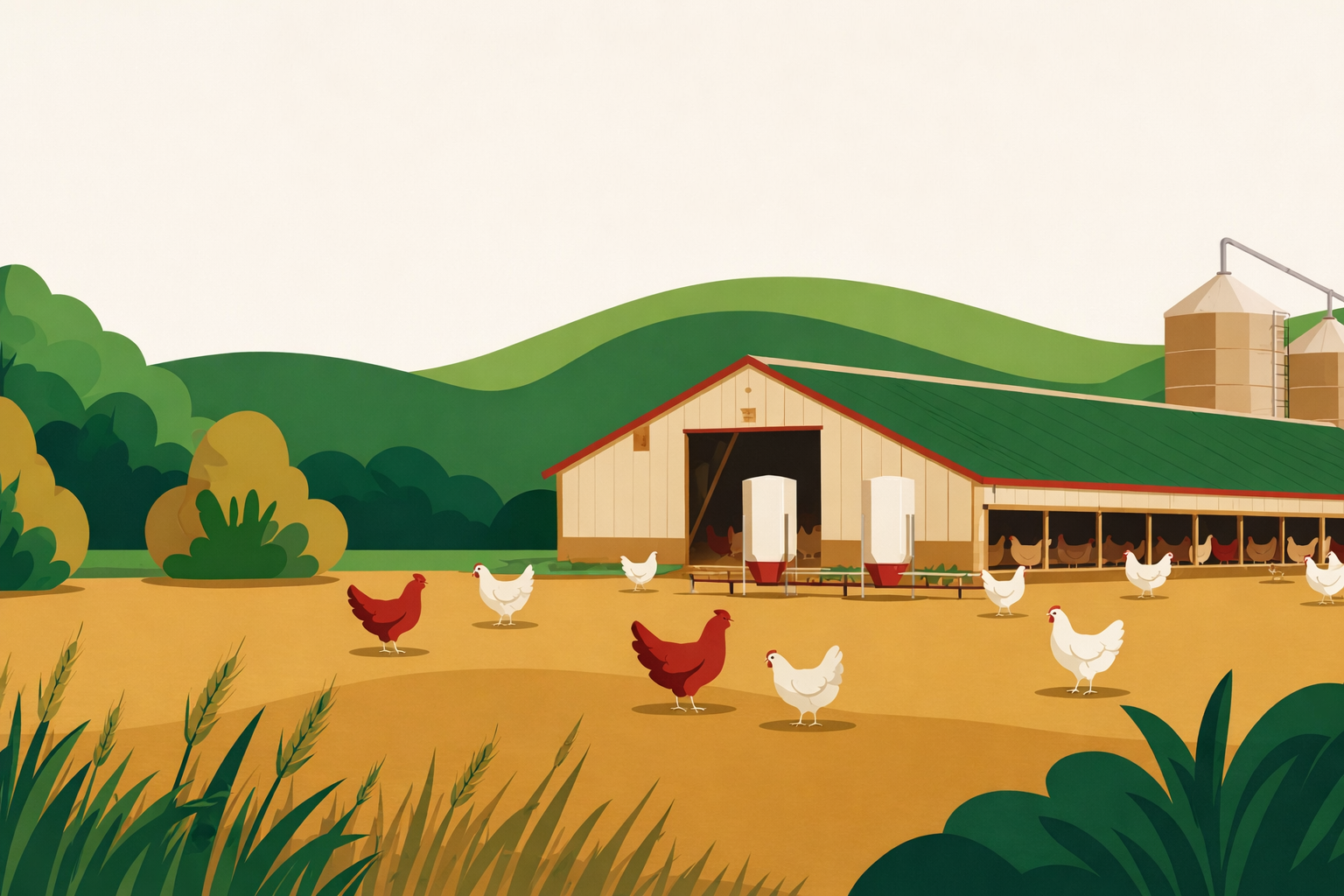
What Hy-Line W-36 is
Hy-Line W-36 is a light-type laying hybrid (a commercial cross) that produces white-shelled eggs. It is not a breed in the pedigree sense but a commercial Leghorn hybrid developed by Hy-Line International — a US genetics company and one of the world leaders in layers. The “W” stands for the white-egg line and “36” is the historic cross designation. W-36 is built for one purpose: as many eggs as possible on as little feed as possible. For a broader comparison, see the guide on layer breeds.
Where it comes from and what sets it apart
W-36 genetics are produced at Hy-Line International and reach farmers as day-old chicks or reared pullets from authorised distributors. Its strongest point is efficiency: small, low-bodyweight birds eat little yet hold a high lay rate for a long time. It is a classic hard-working white-egg layer. If brown-egg layers interest you, compare them in Lohmann vs ISA Brown and in the profiles of Shaver Brown and Novogen Brown.
White eggs — a different market from brown
W-36 lays white-shelled eggs, which is a niche in Poland — local consumers prefer brown eggs, and white ones more often go to the food industry, bakeries, confectioneries and processing. So the profitability of W-36 depends mainly on the buyer: if you have a secure outlet for white eggs, low feed intake gives a real cost advantage. If you sell directly to retail customers, brown layers usually fit better. The basics of running a laying flock are covered in layer-hen farming.
Who this layer is for
W-36 is the choice of commercial farms aiming at mass, low-cost white-egg production — mainly for processing and industry, and for export markets where the white egg is the standard. It suits small farms selling farm-gate eggs locally less well, because there shell colour and brand matter, not just feed cost. Whatever the breed, every laying flock has to be reported and recorded — see flock records in IRZplus.
Hy-Line W-36 — six defining traits
From origin and genetics company, through production type and production figures, to chick availability. All numbers are public ranges from the Hy-Line management guide.
Origin and genetics company
W-36 is a laying hybrid developed by Hy-Line International (USA) — one of the world’s leading layer-genetics companies. It is a cross of Leghorn-type parent lines, supplied as chicks or pullets by authorised distributors. The farmer buys a finished commercial hybrid, not animals for further reproduction. Other brown-egg hybrids are described in Shaver Brown and Novogen Brown.
Production type — white-egg layer
This is a light-type (Leghorn) hen aimed solely at producing table eggs with white shells. It is neither a meat nor a dual-purpose type — spent birds have little carcass value because of their small frame. All the genetics serve laying and low feed use. How W-36 sits among other layers is shown in the guide on layer breeds.
Lay rate and egg weight
According to Hy-Line’s public guide, W-36 reaches around 350–500 eggs per hen over a long cycle (up to about 90–100 weeks of age), with excellent laying persistence. Egg weight grows with flock age from about 50 g after peak to about 62–65 g near the end of the cycle (indicative ranges — exact values are in the current management guide). It is a marathon hen, not a short sprint.
Body weight and feed intake
W-36 is a small layer: an adult hen usually weighs about 1.2–1.5 kg, clearly less than brown-egg layers. Low weight means low feed intake — per Hy-Line typically about 95–105 g of feed per hen per day at peak lay. This thrift is the main economic argument for W-36 and sets it apart from heavier brown layers.
Temperament and resilience
Like most Leghorn-type hens, W-36 can be livelier and more alert than calmer brown layers, but under farm conditions it is well domesticated and predictable. Modern genetics emphasise flock liveability and persistence across a long cycle. Even so, health depends mainly on management — biosecurity, vaccination programme and a stable environment — not on the breed alone.
Chick availability
Hy-Line is among the most widely available layer genetics in the world, so W-36 chicks and reared pullets can be ordered through a network of authorised distributors, including in Europe. In practice, brown-egg layers are more common in Poland, so W-36 availability is worth confirming with the supplier before planning a placement. Every placement is reported in IRZplus flock records.
Norms, environment, feeding and risks
What W-36 really delivers and what it requires. The numbers are public ranges from the Hy-Line management guide — your results depend on feeding, environment and flock management.
Production norms (public)
Per the Hy-Line guide, W-36 starts laying at about 17–18 weeks of age and reaches peak lay (around 94–96%) at about 26–30 weeks, holding it for a long time. Feed conversion per egg (FCR) is among the best in class thanks to the low body weight. Treat these as management-guide targets, not a guarantee — compare the assumptions with other breeds in the guide on layer breeds.
Environmental requirements
A high lay rate requires stable conditions: the right stocking density (depending on the housing system and welfare rules), good ventilation and temperature, and a precise lighting programme. Light stimulation is introduced gradually only after the pullets reach the right body weight, eventually to about 14–16 hours of light. Errors in lighting and stocking hurt results the most — the basics are in layer-hen farming.
Layer feeding
W-36 needs a balanced layer feed matched to the production phase: enough energy, protein and calcium (typically about 3.8–4.5% in layer feed) for shell formation. Despite low intake, nutrient supply must be ensured — a small hen eats little, so every gram of feed must be valuable. A calcium shortage quickly spoils shell quality. Exact norms are given in the current Hy-Line management guide.
Health and risks
The biggest threats to a laying flock are infectious diseases (avian influenza first of all) and parasites, so biosecurity and a vaccination programme in line with recommendations are essential. The small frame of W-36 means the birds are sensitive to heat stress and environmental swings. A long cycle also brings the risk of shell quality declining with age — calcium and flock condition must be watched to the end of production.
Welfare and management
The longer the cycle, the more important good management is: regular pullet body-weight checks during rearing, flock uniformity, clean water and feed, and calm handling. All of it is worth documenting to see trends and react early. In DlaFerm.pl you keep a digital Flock Card and the whole flock history in one place, ready for inspection.
Who for — summary
W-36 is the choice for commercial farms with a secure outlet for white eggs (processing, industry, export) that want to cut feed cost per egg as much as possible. For small farms selling brown eggs locally, brown layers fit better — compare them in Lohmann vs ISA Brown. The decision depends on the market you produce for, not just on the hen’s figures.
Frequently asked questions about Hy-Line W-36
What eggs does Hy-Line W-36 lay?add
W-36 is a white-shelled-egg layer — a Leghorn-type hybrid developed by Hy-Line International. White eggs are a niche in Poland and go mainly to industry, bakeries, confectioneries and processing, while retail consumers prefer brown eggs. So whether W-36 makes sense depends above all on having a secure buyer for white eggs.
How many eggs does W-36 lay per cycle?add
According to Hy-Line’s public management guide, W-36 reaches around 350–500 eggs per hen over a long cycle of up to about 90–100 weeks of age, with peak lay around 94–96% at about 26–30 weeks. These are management-guide targets — the real result depends on feeding, the lighting programme, health and flock management. Exact curves are in the current Hy-Line guide.
Why does W-36 use little feed?add
W-36 is a small light-type hen usually weighing about 1.2–1.5 kg, clearly lighter than brown-egg layers. A smaller bird has lower maintenance needs, so it eats less feed — per Hy-Line typically about 95–105 g per hen per day at peak. With a high lay rate this gives a very good feed conversion per egg (FCR), which is the main economic argument for this hybrid.
How does W-36 differ from brown-egg layers?add
The main differences are shell colour (white versus brown), body weight (W-36 is clearly smaller) and feed intake (W-36 eats less). Brown layers like Lohmann Brown or ISA Brown are heavier and lay the brown eggs preferred by Polish retail consumers. You will find comparisons of brown breeds in Lohmann vs ISA Brown and in the profiles of Shaver Brown and Novogen Brown.
Is W-36 suitable for a small farm?add
Usually not as a first choice. W-36 shines on commercial farms with a secure, mass outlet for white eggs — mainly processing, industry and export. On a small farm selling eggs locally, shell colour and brand matter, and brown eggs sell more easily there. Low feed intake only gives an edge at large scale with a secure white-egg buyer.
How do I keep records for a W-36 laying flock?add
Every laying flock has to be reported to ARiMR and recorded in the IRZplus system, plus you keep records of treatment and drug withdrawal. It is most convenient to do this digitally, in one place, rather than on paper. DlaFerm.pl lets you keep a digital Flock Card and treatment records, and the flock-status reports it can — if you want — send to IRZplus for you automatically, so you stay ready for an inspection throughout the long production cycle.
Run your laying flock smartly with DlaFerm.pl
Whatever the breed — W-36 or a brown layer — good records and result tracking across the whole cycle are what count. We will show you how DlaFerm.pl runs a laying flock through the digital Flock Card and records in IRZplus. Create a free farm account.
Phone
+48 796 258 151