Ross 308 vs Cobb 500 — which broiler for your farm
Ross 308 and Cobb 500 are the world’s two most popular meat-chicken crosses — Ross from Aviagen, Cobb from Cobb-Vantress. Both reach very similar results and both are widely available in Polish hatcheries. We show how they really differ: growth rate, feed conversion, breast yield, flock uniformity and leg health. At the end we suggest what to choose and when.
verifiedFrom the team that has organised work on poultry farms for years.
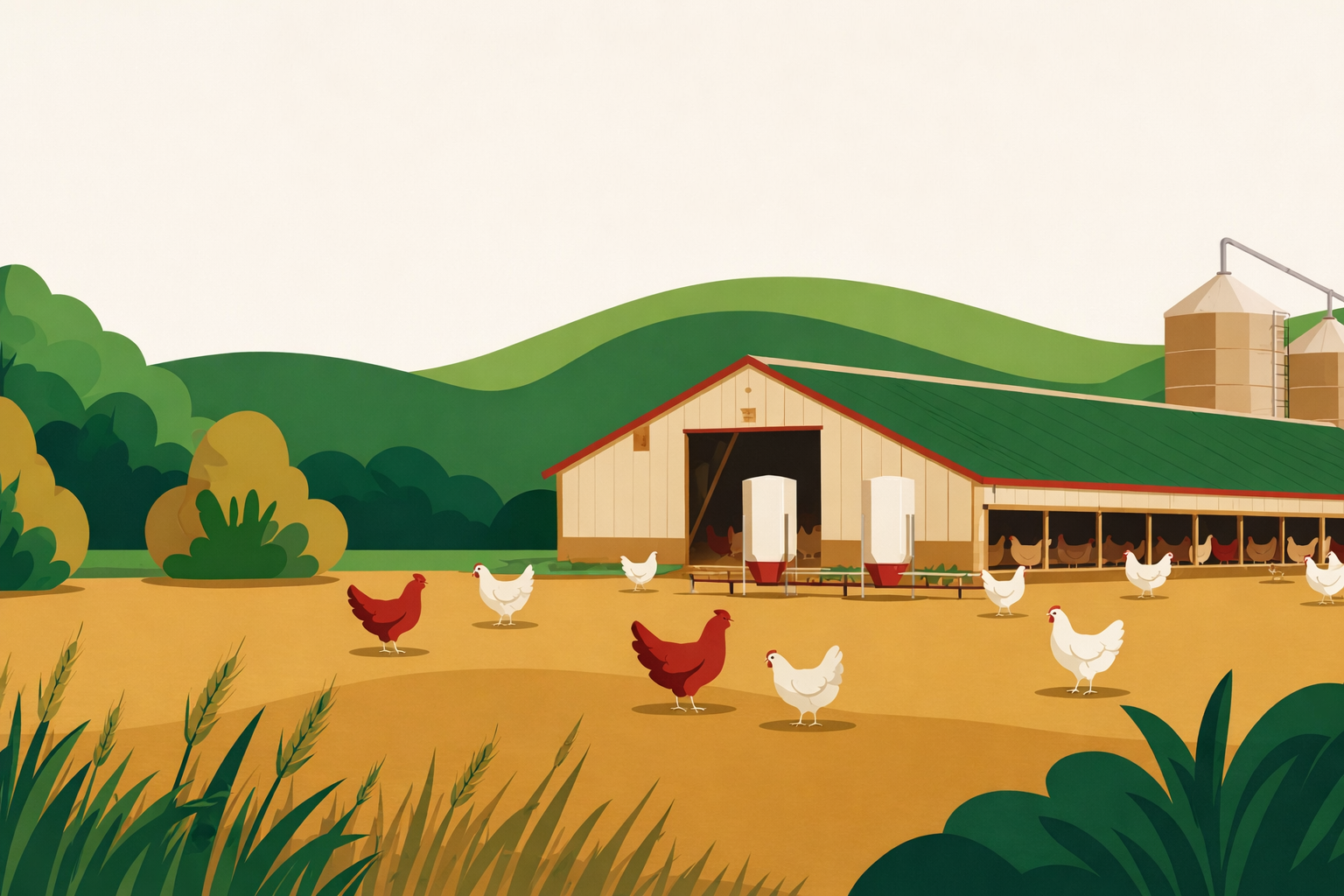
Two crosses, one goal — fast, profitable fattening
Ross 308 and Cobb 500 are commercial broiler crosses — the result of years of breeding work by two global leaders: Aviagen (the Ross line) and Cobb-Vantress (the Cobb line). Both chicks aim at the same thing: maximum weight gain with the lowest possible feed use. For the farmer this means the choice between them is rarely a choice between “good" and “bad" — it is more about fitting your market, your house and your habits. You will find the background of both breeds in the guide on Ross and Cobb broiler breeds.
Why this choice matters at all
Although the differences between Ross 308 and Cobb 500 are small, across a whole farm even a few FCR points or a few percent of dressing yield turn into real money. It also matters which buyer you sell to: the light-bird market (1.8–2.2 kg chicken) has different requirements from the heavy market (above 2.5 kg, often for cutting). The fattening rules are shared by both — we describe them in the guide on broiler farming.
Chick availability usually decides
In practice the first constraint is not the results table but chick availability. Many farms run the cross their hatchery delivers reliably — because continuity of placements matters more than a small genetic edge. It is also worth knowing the slower-growing lines if you aim at welfare programmes: compare them in the article on the Ross Ranger cross and in the guide on Arbor Acres.
Use the producer’s norms, not rumours
Both companies publish free management guides and performance-objective tables for their crosses. This is the only reliable source of weight, FCR or temperature norms — figures from a forum or “from a neighbour" can be misleading. It is best to keep the producer’s norms at hand and compare your own results with them as you go, by keeping a digital broiler Flock Card.
Everything under control with DlaFerm.pl
Whether you place Ross 308 or Cobb 500, every batch is worth measuring: weight over the days, FCR, mortality and feed use. DlaFerm.pl lets you keep a digital Flock Card in one place, and the tedious flock records in IRZplus you can leave to us — we’ll file the flock-change reports to IRZplus for you automatically, if you want, or report them yourself, whichever you prefer. So after a few batches you will see for yourself which cross works better in your house. You can create a farm account for free.
Comparison — criterion by criterion
Six criteria that most often decide between Ross 308 and Cobb 500. We give ranges from both producers’ public management guides — remember that your results also depend on feed, the house and management.
Growth rate and slaughter weight
Both broilers grow very fast and reach similar weights. Per the producers’ tables, body weight around day 35 usually sits near 2.2–2.5 kg, and by day 42 often exceeds 2.8–3.0 kg (depending on sex and conditions). Ross 308 can be marginally faster in the first days, Cobb 500 catches up in the second half of the cycle. The differences are small enough that in practice they take a back seat to feeding and climate — details in the broiler farming guide.
FCR and feed conversion
FCR (feed conversion ratio — kg of feed per 1 kg of gain) is the key economic figure. Per both companies’ guides, FCR at around 2.5 kg usually falls in the range of about 1.55–1.70. Cobb 500 has historically been marketed as the low-feed leader, with Ross 308 matching it almost point for point. The real difference between batches is often bigger than between crosses — so it is worth measuring each batch’s FCR in the digital Flock Card.
Dressing yield and breast muscle
Here is the classic reputational difference: Cobb 500 is seen as the champion of dressing yield and high breast-muscle share, valued by the cutting and fillet market. Ross 308 gives a very good carcass with balanced proportions and often works better for whole-carcass sales. Per the producers’ tables, the breast share is on the order of about 22–25% of live weight — the differences are small, but at large scale and fillet sales they matter.
Flock uniformity
Uniformity is the percentage of birds close to the average weight — the higher it is, the easier the pick-up and the fewer losses on sorting. Both crosses are well uniform, but many farms note that Ross 308 tends to be a touch more uniform, while Cobb 500 can spread more under poorer management. Uniformity, though, depends mainly on chick quality, access to feed and water and the climate — you, not the genetics, have the biggest influence on it.
Robustness and leg health
With very fast growth the legs and heart are under heavy load. Both crosses need attention here: a lighting programme that curbs too fast a start, good litter and weight control. In practice the differences in leg health between Ross 308 and Cobb 500 are secondary to management — stocking density, litter quality and fattening pace decide lameness and pododermatitis. If you want slower, calmer growth, consider lines such as Ross Ranger.
Chick availability and price
For many farms this is the deciding criterion. Both crosses are widely available in Polish hatcheries, and chick prices are similar and shift seasonally. More often it comes down to which line your supplier delivers steadily and whether it ensures continuity of placements. A third option is the related Arbor Acres line (also Aviagen) — easier to get in some regions. Match the cross to real availability, not just to the results table.
Decision: Ross 308 or Cobb 500
Six situations that really tip the scale. In practice a good farmer will get excellent results on both crosses — the key is fitting your market, your house and your own experience.
Light-bird vs heavy-bird market
If you sell light chicken (about 1.8–2.2 kg) as a whole carcass, both crosses do great and the choice matters little. For heavy birds (above 2.5 kg, often for cutting and fillet), Cobb 500 has a slight edge thanks to breast muscling. Always confirm requirements with your buyer — it is the buyer, not the genetics, who sets the expected weight and carcass quality.
House conditions and climate
In a hotter, harder-to-ventilate house, calmer, more “forgiving" growth can be safer. Both crosses are sensitive to overheating and poor litter, but with a weaker climate leg problems come more easily at the fastest pace. First improve ventilation and litter — only then pick genetics. You will find the basics in the guide on broiler farming.
Farmer’s experience
A beginner will succeed with either cross if they stick to the producer’s norms. An experienced farmer who finely controls feed and light will squeeze a slightly better FCR and dressing yield out of Cobb 500. If you are just starting, do not chase the “best" cross — focus on mastering brooding and measurement, because those make the biggest difference.
Availability at your supplier
The best cross is the one your hatchery delivers on time and at steady quality. A break in placement continuity costs more than a small genetic edge. Ask your supplier which line (Ross 308, Cobb 500, or Arbor Acres) they have steadily and whether they guarantee healthy, uniform chicks. Only then optimise the genetics choice.
Common mistakes when comparing
The most common mistake is comparing crosses on one batch or on rumours rather than producer norms and your own measurements. The second is blaming genetics for results actually spoiled by feed, water or climate. The third is switching lines often “chasing a better one", which makes learning harder. A fair comparison needs several batches measured the same way, ideally in the digital Flock Card.
Final recommendation
There is no single right answer: Cobb 500 is worth considering for heavy birds and fillet sales, where dressing yield counts; Ross 308 is a safe, versatile choice with great uniformity, good for whole-carcass sales and for beginners. The wisest move is to pick the line steadily available from your supplier, master management and measure results in flock records in IRZplus and the Flock Card — after a few batches the data will point to the winner for your farm.
Frequently asked questions about Ross 308 and Cobb 500
Which broiler is better — Ross 308 or Cobb 500?add
There is no clear answer — both are top crosses with very similar results. Cobb 500 is more often valued for dressing yield and breast muscling, Ross 308 for versatility and good flock uniformity. The differences in growth rate and FCR are small and often smaller than the differences between batches or farms. In practice management, not the genetics alone, decides success.
How does Ross 308 differ from Cobb 500?add
Ross 308 comes from Aviagen genetics, Cobb 500 from Cobb-Vantress. The most often cited differences are: Cobb 500 — slightly better breast muscling and dressing yield; Ross 308 — a touch better flock uniformity and versatility. Growth rate and feed conversion are very similar. The most reliable data is in both producers’ free management guides, not in forum opinions.
What FCR do Ross 308 and Cobb 500 reach?add
Per both companies’ performance tables, FCR (kg of feed per 1 kg of gain) at around 2.5 kg usually sits near 1.55–1.70 — with very good management it can go lower. Cobb 500 is sometimes marketed as the low-feed leader, but Ross 308 reaches almost identical figures. Real FCR depends on feed, climate and slaughter weight, so it is worth measuring it in every batch.
Which cross has the better dressing yield?add
Cobb 500 is traditionally seen as the leader in dressing yield and high breast-muscle share, valued by the cutting and fillet market. Ross 308 gives a very good, balanced carcass and often works better for whole-carcass sales. The differences in breast share are small, but at large scale and fillet sales they can matter economically.
Do Ross 308 and Cobb 500 have similar leg-health issues?add
Yes — both grow very fast, so the legs and heart are under heavy load. The risk of lameness or pododermatitis (footpad dermatitis) depends mainly on stocking density, litter quality, the lighting programme and fattening pace, not on the cross itself. If you want slower, calmer growth, consider slow-growing lines such as Ross Ranger or welfare varieties.
Ross 308 or Cobb 500 — what to choose at the start?add
For a beginner both are a good choice, as they are widely available and have free management guides. The most important thing is which line your hatchery delivers steadily and whether it ensures continuity of placements. Instead of chasing the “best" cross, focus on mastering brooding and measurement. After a few batches measured in the digital Flock Card you will see for yourself which works better in your house.
Compare Ross 308 and Cobb 500 on your own data
Want to finally know which cross works best in your house? Measure weight, FCR and mortality of every batch in one place. We will show you how DlaFerm.pl keeps a digital Flock Card and records in IRZplus. Create a free farm account.
Phone
+48 796 258 151