Egg conveyors and belts — from nest to packing
An egg conveyor is a system of belts and elevators that gently moves eggs from nests or cages to a collection table and on to grading. It replaces hand collection, cuts cracks and labour, and the eggs arrive cleaner and faster. We explain how it works, the types, how to size it to your flock and how to run it so it lasts for years.
verifiedFrom the team that has organised work on poultry farms for years.
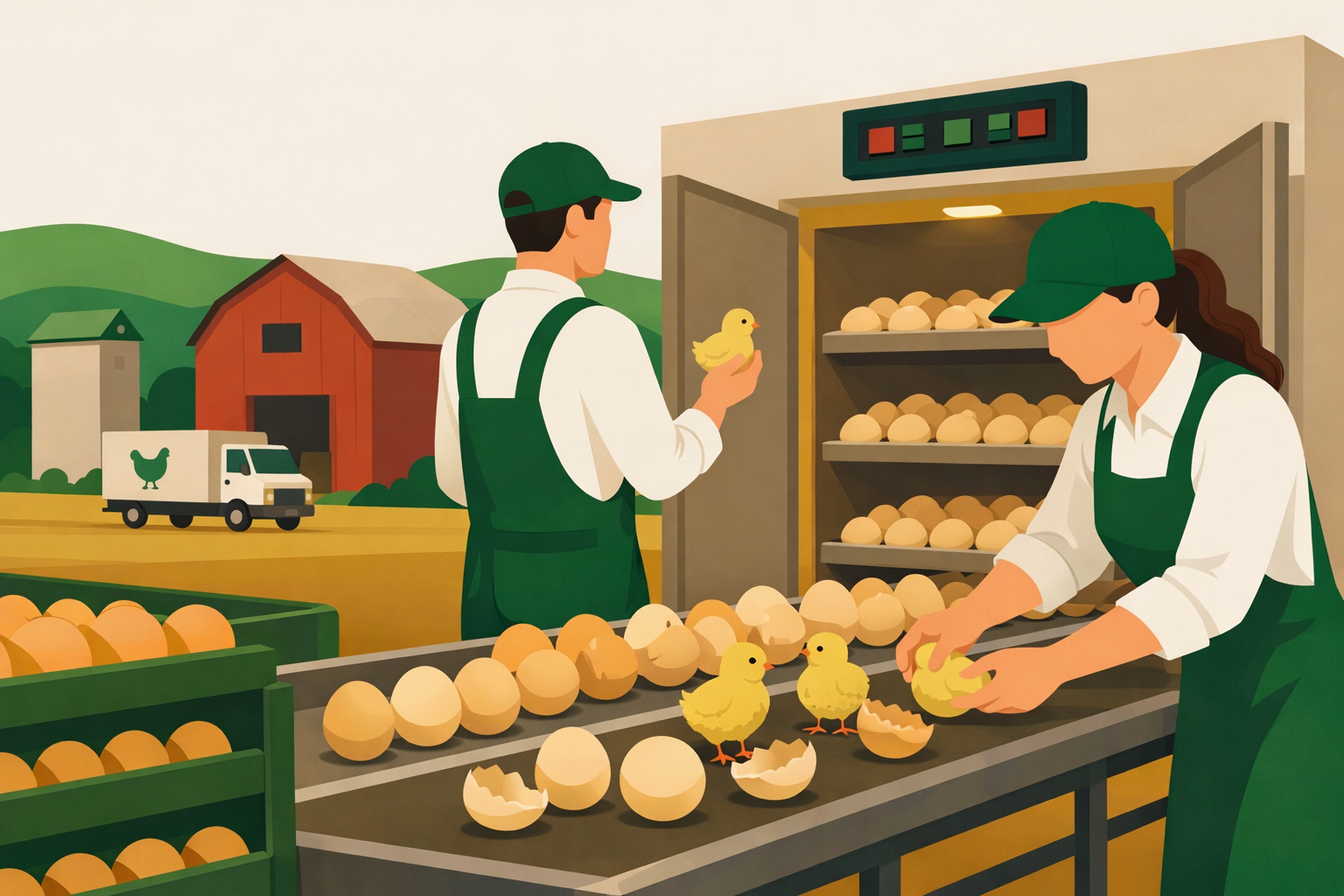
What an egg conveyor is and what it is for
An egg conveyor is a mechanical system that moves eggs from where they are laid — nests in a litter system or cages — to a collection table and from there to packing or grading. It usually consists of belts under the nests, elevators (vertical lifts) and a central conveyor that gathers eggs from many rows into one stream. It is basic equipment on any layer-hen farm focused on egg production. Thanks to it the eggs “come to” the operator instead of being collected by hand across the whole house.
Where it is used
Egg conveyors are fitted in commercial and breeder layer houses — wherever the daily number of eggs is large enough that hand collection would be too labour-intensive. In a litter system with automated nests eggs roll from the nest onto the belt; in cage or aviary systems they come down onto belts under the tiers. In a small backyard flock hand collection is usually enough, but from a few thousand birds a conveyor becomes the standard.
Why it matters — fewer cracks, less labour, hygiene
A well-chosen conveyor really affects the farm result for three reasons. First, it cuts cracks: eggs roll and are carried gently rather than lugged in buckets. Second, it saves labour — one person handles a flock that by hand would need several collectors. Third, it improves hygiene: less contact with hands and faster cooling means less dirt and lower infection risk. Clean, whole eggs mean a better grade and a higher price.
Part of a larger egg-handling line
The conveyor is the middle of the egg’s journey: from the nest, through belt and elevator, to the collection table and beyond. At the end of this line usually stand egg graders, which weigh, candle and pack eggs by class. The conveyor and grader must match in throughput and pace, otherwise a bottleneck forms in one place. It pays to see the whole line as one system rather than buying parts separately without checking they fit together.
Equipment is half the job — the rest is records
Moving eggs is one thing, but a well-run layer farm also means numbers: how many eggs a day, how many birds lost, what treatment and withdrawal. DlaFerm.pl brings this into one place — you keep a digital Flock Card and treatment and drug withdrawal records, and DlaFerm.pl can file your flock records in IRZplus for you — automatically, if you want. So your investment in equipment goes hand in hand with solid production records. You can create a farm account for free.
Egg conveyors — six things you need to know
From belt types to integration with nests and the grader. Here are six steps that explain how egg transport on a farm works and what it is made of.
Learn the types: belts, elevators, central conveyor
The three basic parts are nest belts (collect eggs from under nests or from cages), elevators (vertical lifts that move eggs between levels) and a central conveyor (horizontal, joins streams from many rows into one route to the table). In multi-tier houses there are also tier lifts. The choice and layout depend on the housing system — different in a litter system with nests, different in cages.
Understand how it works
After laying, eggs roll out of the nest onto the belt thanks to a slight slope of the floor. The belt moves slowly and feeds eggs to the elevator, which lifts them with gentle “fingers” or pockets to a higher level. From there the central conveyor leads them to the collection table. The key is smoothness and low speeds — the fewer jolts and drops, the fewer cracks.
Check the key parameters: throughput and gentleness
Two parameters decide the choice. Throughput (eggs per hour) must cover the collection peak — hens lay mostly in the morning, so the system is sized for that peak, not the daily average. Transport gentleness is the number and height of transfers, belt speed and cushioning of drops — that is what translates into the crack rate. Good kit combines high throughput with the fewest egg-on-egg “knocks”.
Know where and when to use it
A conveyor pays off where hand collection would be too labour-intensive or too risky for quality — that is, from a few thousand layers up. In a backyard flock or keeping for your own needs it usually makes no sense. The larger the flock and the higher the required egg grade, the more transport automation pays. The decision depends on scale, labour availability and the price you get for eggs.
Plan installation and integration with nests
The belt must fit the nests: the nest floor has the right slope and the outlet leads the egg straight onto the belt with no step and no drop. It is best to choose nests and belts from one system or make sure they are compatible. A badly matched nest-to-belt transition is the most common source of cracks and dirt. Installation also covers drives, limit sensors and levelling — a crooked belt slides eggs to the side.
Connect transport with the grader
The collection table is where the conveyor meets further processing. From here eggs go to egg graders, which weigh, candle and pack by weight class. Conveyor and grader throughput must be matched — if the grader is slower, eggs wait on the table and a jam forms; if faster, it stands idle. The whole line is designed so the pace is even from nest to pack.
Sizing, costs and upkeep of a conveyor
You buy this kit once for years, so size it to your scale and service it sensibly. Here are six areas that decide whether a conveyor pays off.
Sizing to flock scale
A conveyor is sized to the number of layers and the collection pace at peak, not the average. Too little throughput means jams in the morning; too much means overpaying for idle kit. Work out how many eggs a day your flock gives and when it lays most, then choose a system with headroom for those hours. When planning scale it helps to look at the whole production you run in layer-hen farming.
Costs: purchase, installation, energy
The cost is the kit itself (belts, elevators, drives), installation and levelling, plus running energy and parts. Cheaper systems tempt on price, but if they generate more cracks the “saving” disappears in egg-quality losses. Look at total cost over the life cycle, not just the purchase price. A realistic budget also means a reserve for servicing and belt replacement after years of work.
Servicing and cleaning
Egg belts get dirty with droppings, feathers and shell debris — without regular cleaning the risk of dirty eggs and infection grows. After each cycle, during the technological break, belts are washed and disinfected together with the whole house; this is the same regime as for manure belts. Daily checks cover drives, tension and sensors. A neglected conveyor means not only breakdowns but also a worse egg grade.
Effect on egg quality — cracks and dirt
Transport is one of the main places where cracks and dirt arise. Every extra transfer, step or too-fast belt is a risk of cracking the shell. Dirty belts pass contamination onto clean eggs. A well-chosen and maintained system lowers the rate of cracked and dirty eggs, and that translates directly into a higher grade and better price — because a cracked or dirty egg drops out of the table-egg class.
Common mistakes
The most common slips are: belt speed too high “for output”, a badly matched nest-to-belt transition with a step, crooked installation, neglected cleaning and under-sizing throughput for the morning peak. A second frequent mistake is buying a conveyor without checking it pairs with the grader — then a bottleneck forms in one place. Each of these mistakes costs either in cracks or in handling time.
When it pays off
Egg-transport automation pays back where hand collection would soak up a lot of labour or spoil quality — that is, with larger layer flocks aimed at sale. The dearer a high-grade egg is and the harder labour is to find, the faster the kit pays. With keeping for your own needs the investment usually does not pay back. Make the decision soberly, counting labour savings and lower crack losses.
Frequently asked questions about egg conveyors and belts
What is an egg conveyor?add
It is a mechanical system that moves eggs from nests or cages to a collection table and on to packing. It usually consists of nest belts, elevators (vertical lifts) and a central conveyor joining streams from many rows. It replaces hand collection, cuts cracks and labour, and improves hygiene because eggs spend less time in contact with hands.
From what flock scale is a conveyor worth fitting?add
Usually from a few thousand layers up, because then hand collection becomes too labour-intensive and risky for quality. In a backyard flock or keeping for your own needs hand collection is usually enough and cheaper. The larger the flock and the higher the egg grade you want, the more transport automation pays. The decision depends on scale, labour availability and the egg price.
How does a conveyor affect cracks?add
Transport is one of the main places cracks arise, so a well-chosen system really lowers them. The keys are low belt speed, few transfers and gentle drops with no steps. A badly set or too-fast conveyor raises the rate of cracked shells. Fewer cracks mean a higher commercial grade and a better price, because a cracked egg drops out of the table-egg class.
How do you clean egg belts?add
Belts are washed and disinfected at the technological break, together with the whole house, and their cleanliness, tension and drives are checked routinely. Dirty belts pass droppings and debris onto clean eggs, so the hygiene regime is similar to that for manure belts. Neglected cleaning means a worse egg grade, higher infection risk and more frequent breakdowns.
How does an egg conveyor differ from a manure belt?add
An egg conveyor moves eggs from nests to packing, while a manure belt collects droppings from under the birds and carries them out of the house. They are two different systems with different goals, though both need regular cleaning and servicing. In a layer house they often run side by side — one cares for the product, the other for hygiene and manure removal.
Does the conveyor have to match the grader?add
Yes. The conveyor and grader form one line, so their throughput and pace must be matched. If the grader is slower, eggs wait on the table and a jam forms; if faster, it stands idle. The whole line from nest to pack is designed so the pace is even. That is why the parts are chosen as a system, not bought separately without checking compatibility.
Run your layer farm sensibly with DlaFerm.pl
You have the kit to collect eggs — now take care of the numbers too. We will show you how DlaFerm.pl helps you keep a digital Flock Card, treatment and withdrawal records and records in IRZplus. Create a free farm account.
Phone
+48 796 258 151