Egg graders — weight classes, candling and code marking
An egg grader is a machine that sorts eggs into weight classes (S, M, L, XL), candles them to find defects and prints a producer code. Without it, selling eggs on the market in line with trade standards is hard. We explain how graders work, how a small tabletop unit differs from a large in-line machine and how to match the equipment to your farm scale.
verifiedFrom the team that has organised work on poultry farms for years.
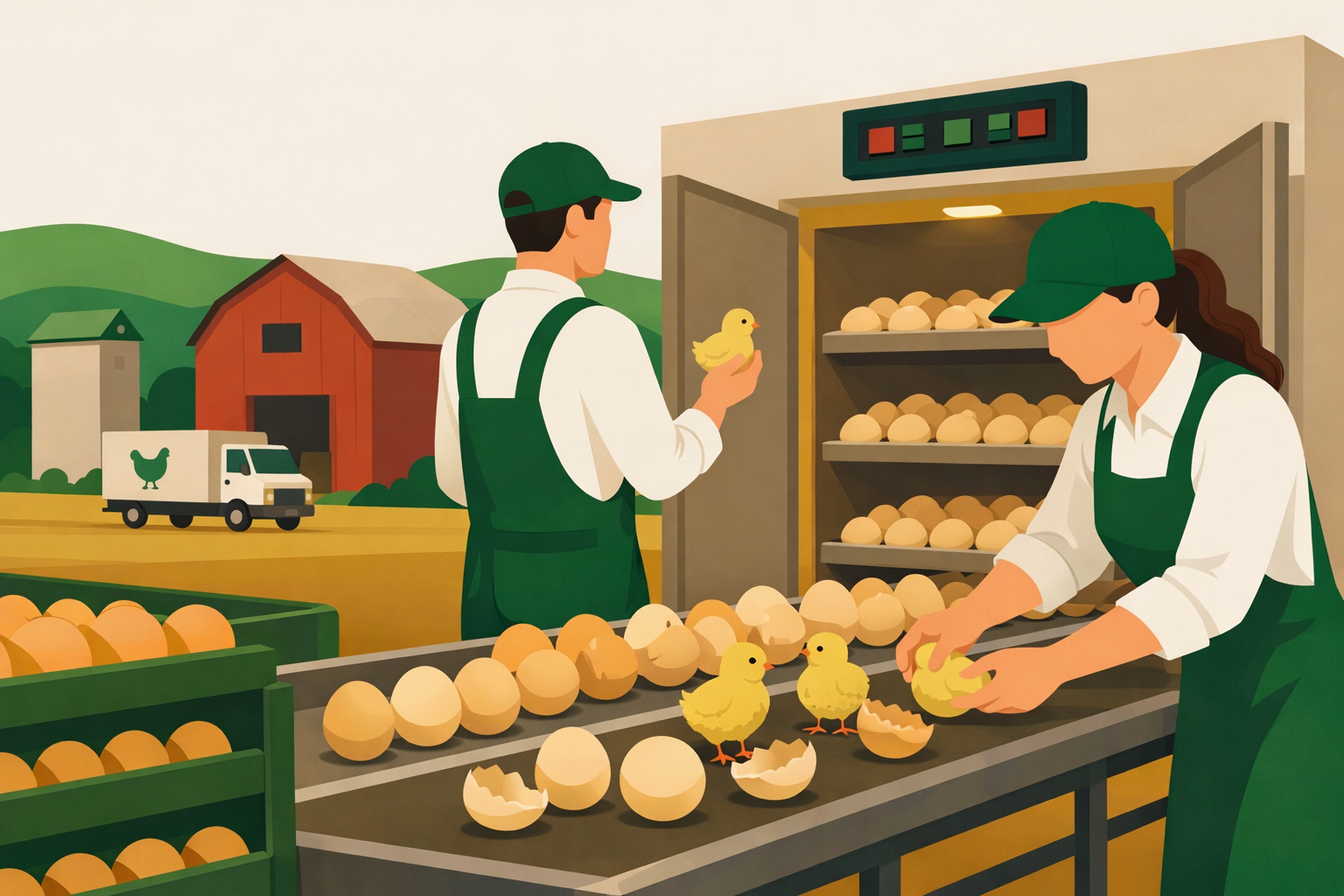
What an egg grader is and why to use one
An egg grader is a machine that takes eggs straight from the hens and prepares them for sale: it weighs each egg and assigns it to a weight class (S, M, L or XL), candles it for defects and prints a marking code. As a result, uniform eggs labelled in line with the rules reach the market. It is basic equipment for any layer-hen farm that sells eggs on the market rather than only for its own needs.
Weight classes and quality — why they matter
In trade, hen eggs are split into four weight classes: S (under 53 g), M (53–63 g), L (63–73 g) and XL (73 g and above). The buyer pays for a specific class, so mixed eggs are hard to price and sell well. A grader does this split quickly and repeatably — by hand it would be slow and inaccurate. The more even the flock and the better-chosen the layer breed, the cleaner the class distribution leaving the machine.
Candling — catching defects
The grader’s second job is candling eggs with light, that is shining light through the shell. The operator or a camera then sees shell cracks, blood spots, foreign bodies or an abnormal air cell. Defective eggs are rejected so they do not reach consumer sale. This is a step of quality and food-safety control — an egg with a cracked shell spoils faster and can be a source of infection.
Code marking — a legal requirement
Every egg on the market must carry a producer code. The first digit of the code describes the farming method: 0 — organic, 1 — free-range, 2 — barn, 3 — cage. Then comes the country code (PL) and the farm veterinary number. In-line graders print this code automatically as the eggs move along. You can conveniently link flock and production data to the digital Flock Card and flock records in IRZplus.
The grader in the farm production line
On larger farms the grader does not work alone — it connects to a line that brings eggs from the hens. Eggs travel on egg conveyors from the house to the packing room, fall into the grader and, after grading, go onto trays and pallets. The better the whole line is matched, the fewer breakages and the faster eggs are ready for dispatch. Choosing a grader therefore starts with how many eggs a day you collect and how you transport them.
What an egg grader is and how it works — six things to understand
From machine types to code marking — here are six elements that explain how a grader splits, checks and labels eggs before they go to sale.
Types: tabletop and in-line
Small tabletop graders are simple units handling a few hundred to a few thousand eggs per hour, good for small and medium layer farms. Large in-line machines are automated lines for tens of thousands of eggs per hour, usually coupled with a packing room. The choice depends on scale — a larger farm cannot keep up with its flock on tabletop equipment.
Weighing and splitting into classes
The heart of a grader is the scale, which measures each egg and directs it to the right lane: S, M, L or XL. The thresholds are fixed (S under 53 g, M 53–63 g, L 63–73 g, XL from 73 g), so the split is repeatable. An even flock gives a cleaner class distribution — a good layer breed and stable feeding help here.
Candling
Eggs pass over a light source that shines through the shell — this is candling. It reveals cracks, blood spots, foreign bodies and the state of the air cell. Defective eggs are rejected by the operator or automation so they do not reach consumer sale. It is a quality-control step you cannot skip when selling on the market.
Egg code marking (0–3)
As eggs move along, the grader prints the producer code on the shell. The first digit is the farming method: 0 organic, 1 free-range, 2 barn, 3 cage — then the country code and the farm veterinary number. It is a legal requirement: an egg without a code cannot go to market. Linking the code to the farm is easier with flock records in IRZplus.
Key parameter: eggs per hour
A grader’s capacity is given in eggs per hour. Tabletop units handle a few hundred to a few thousand; in-line machines from tens of thousands up. Match the capacity to your daily collection: the machine should comfortably process several hours of eggs. You can estimate the egg count from stocking and laying rate — the laying calculator helps.
Integration with conveyors
On a larger farm the grader connects to a line that delivers eggs: they travel on egg conveyors from the house straight to the machine and, after grading, to packing. A well-matched line limits breakages and manual handling. The gentler the transport and the smaller the rises, the fewer damaged shells along the way.
Choosing, costs and operating a grader
Most mistakes are a badly matched scale and skipped hygiene. Here are six things to think through before you buy and run an egg grader.
Matching to farm scale
First count how many eggs you collect daily, then choose the machine. A small farm needs a tabletop grader; a large one needs an in-line. Oversizing is a wasted cost, undersizing is a bottleneck that blocks packing. You can estimate the egg count from stocking and laying rate — the laying calculator and a productive layer breed help.
Costs — purchase, energy, space
The cost is not just the machine price but also power, room in the packing area and integration with the line. Tabletop units are cheap and mobile; in-line ones are a bigger investment and a fixed station. Calculate it soberly together with the rest of the equipment, including egg conveyors. A realistic budget protects you from buying gear that will not add up.
Service, cleaning and hygiene
A grader contacts food, so it must be cleaned and disinfected regularly — residue on rollers and belts risks contaminating eggs. Moving parts (the scale, lanes, print head) need inspections and calibration. Plan access to service and spare parts before you buy — line downtime in season is a real loss.
Compliance with class and marking rules
Weight classes (S/M/L/XL) and the egg marking code are set by regulations — the machine must work in line with them and the scale must be calibrated. Wrong classes or a missing code risk complaints and inspections. Link production to flock documentation: the digital Flock Card and flock records in IRZplus make egg origin easier to prove.
Common mistakes
The most common slips are too little capacity (the machine cannot keep up with the collection), rough transport of eggs to the grader (breakages) and neglected hygiene. Sometimes a farm buys an expensive in-line line although the flock is small. Start by counting eggs and thinking through the whole egg path — from the house, through conveyors, to packing.
When it pays off
A grader pays off when you sell eggs on the market and must classify and mark them in line with the law — manual work is then too slow and inaccurate. For keeping eggs for your own needs it is usually not needed. The break-even rises with the egg count: the larger and more even the flock, the faster the machine pays back. A well-run layer-hen farm is the starting point.
Frequently asked questions about egg graders
What does an egg grader do?add
An egg grader weighs each egg and splits it into weight classes (S, M, L, XL), candles the shell to find defects and prints the producer code on the egg. As a result, uniform, checked and properly marked eggs reach the market. It is basic equipment for a layer farm that sells eggs on the market.
What is the difference between a tabletop and an in-line grader?add
A tabletop grader is a simple unit handling a few hundred to a few thousand eggs per hour, good for small and medium farms. An in-line machine is an automated line for tens of thousands of eggs per hour, usually coupled with conveyors and a packing room. The choice depends on scale — a large farm cannot keep up with its flock on tabletop equipment.
What are the weight classes for hen eggs?add
In trade, hen eggs are split into four weight classes: S (under 53 g), M (from 53 to under 63 g), L (from 63 to under 73 g) and XL (73 g and above). The grader assigns each egg to the right class based on a weight measurement. The buyer pays for a specific class, so the split must be accurate and repeatable.
What does the first digit of the egg code (0–3) mean?add
The first digit of the code on an egg describes the hen-keeping method: 0 is organic, 1 is free-range, 2 is barn and 3 is cage. After the digit comes the country code (e.g. PL) and the farm veterinary number. Every egg on the market must carry such a code — in-line graders print it automatically.
Does a small farm need an egg grader?add
It depends on how you sell eggs. For keeping eggs for your own needs a grader is usually not needed. If you sell eggs on the market, you must classify and mark them in line with the law, so even a small tabletop grader makes the work much easier. The break-even point rises with the number of eggs collected daily.
How do I choose a grader’s capacity?add
Capacity is given in eggs per hour. Match it to your daily collection so the machine comfortably processes several hours of eggs without creating a bottleneck in packing. You can estimate the egg count from stocking and laying rate — the laying calculator helps. It is better to have a small capacity buffer than a machine that cannot keep up.
Grade and document egg production with DlaFerm.pl
Want your egg production, weight classes and marking linked to flock documentation? We will show you how DlaFerm.pl keeps a digital Flock Card and records in IRZplus, and — if you want — files your IRZplus reports for you automatically, so you can easily prove egg origin. Create a free farm account.
Phone
+48 796 258 151