Ozone generators — chemical-free disinfection of an empty house
An ozone generator produces ozone (O3), a strong oxidiser that sanitises air and surfaces and removes odours without any chemicals. It is used in an empty house, during the downtime, as a complement to washing and biosecurity. We explain how ozonation works, how to size capacity to the volume and how to do it safely. Important: ozone is toxic — it works only in an empty house, with no people and no birds.
verifiedFrom the team that has organised work on poultry farms for years.
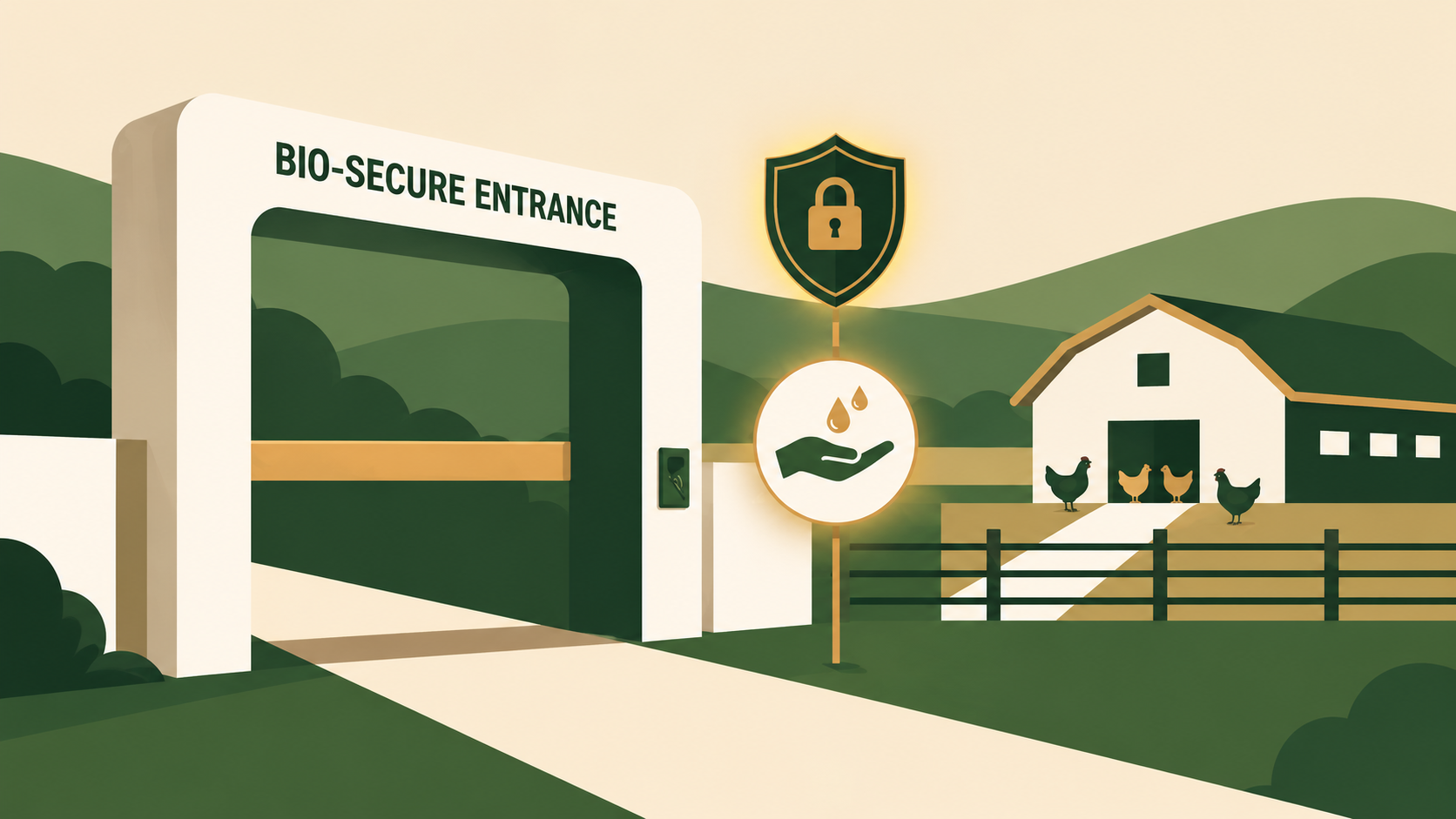
What an ozone generator is and why to use it
An ozone generator is a device that turns oxygen from the air into ozone (O3) — a gas that is a very strong oxidiser. Ozone destroys bacteria, viruses, moulds and their spores, and at the same time breaks down the molecules responsible for unpleasant smells. This lets you sanitise the air and surfaces of the house and remove odours without spraying chemicals. Ozonation does not replace washing — it complements it, finishing off the cleaning of the house between flocks.
Where and when ozone makes sense
Ozonation is done only in an empty house, during the downtime — once the previous flock has left and the new one has not yet arrived. This is the moment when the house is washed and dried, so ozone can reach every surface. The generator is placed in a closed, as airtight as possible room, run for a set time, and then the house is thoroughly ventilated. The house has to be washed beforehand anyway — pressure washers for the poultry house help with that.
Why it matters — a biosecurity complement
A clean, sanitised house is one of the pillars of protecting a flock from disease. Ozonation reinforces poultry farm biosecurity: it reaches where liquid is harder to apply and lowers the number of microbes in the air and on surfaces before a new placement. Together with thorough washing, mat disinfection and spray sanitation it gives a more complete effect than any of these methods alone. It is an investment in a calm start to the next cycle.
Ozone vs wet methods — what when
Ozone works “dry”, as a gas, so it reaches nooks, cracks and fittings that liquid will not wash. Where you need to spread a disinfectant as a mist across a large volume, disinfection foggers work better. The two methods complement each other: washing removes organic dirt, fogging and ozonation finish off the disinfection. It is best to treat them as parts of one plan, not as competitors.
Safety note — ozone is toxic
At working concentrations ozone is toxic to people and birds — it irritates the airways and eyes, and at higher doses it is dangerous. That is why the generator runs only in an empty house, with no people and no animals inside, and afterwards the house must be thoroughly ventilated before anyone enters. This is not a device for working “next to the flock”. The ozonation cycle, cleaning and ventilation are most conveniently planned and logged in the digital Flock Card.
The ozone generator from scratch — six things to know
Before you buy and switch on a generator, it is worth understanding where ozone comes from, how it sanitises and what its effectiveness depends on. Here are six key topics of poultry-house ozonation.
Types: corona discharge and UV
The most common are corona-discharge generators (a quiet spark splits oxygen into ozone) — efficient and popular on farms. The second type is UV lamps, which produce less ozone and suit smaller rooms. For a house of substantial volume a corona model of adequate capacity is usually chosen.
Principle: producing O3 and oxidising pathogens
The generator takes oxygen (O2) from the air and splits it to form ozone (O3). Ozone is an unstable, highly reactive molecule: it gives up one oxygen atom and oxidises whatever it meets — bacterial membranes, viruses, moulds and odour compounds. After acting, ozone decays back into ordinary oxygen, leaving no chemical residue.
Key parameters: capacity, concentration, exposure time
Effectiveness depends on three quantities: the generator’s capacity (how many grams of ozone per hour, g/h), the concentration reached in the air and the exposure time. The larger the volume, the higher the capacity needed. Dose and time are set so that ozone reaches everywhere — always per the device manual and the maker’s guidance for the given type of house.
Where and when: an empty, airtight house
Ozonation makes sense only in an empty house during the downtime, ideally already washed and dried. The room should be as airtight as possible — closed windows, inlet and outlet — so ozone does not escape and reaches a working concentration. Wet, dirty surfaces lower effectiveness, because organic dirt “consumes” ozone, which is why washing always comes before ozonation.
Technique: closing, exposure, ventilation
The procedure is simple: wash and dry the house, close it, set up the generator, run it for the planned time, and afterwards leave it closed for a while so ozone finishes acting. Then ventilate — best with the fans — until the concentration drops to a safe level. Only then may you enter. Fresh, clean air is also helped by cooling pads (cooling pad panels), which look after the microclimate once birds are in.
Integration with the biosecurity plan
Ozonation should be a fixed point of the between-flock procedure, not an ad-hoc action. Build it into the plan: washing → surface disinfection → ozonation → ventilation → cleanliness check. Dates and results are easy to keep in the digital Flock Card and tie in with the rest of your duties, e.g. with flock records in IRZplus. This keeps you orderly and ready for inspection.
Sizing, costs and safety of an ozone generator
Most mistakes come from the wrong capacity and from underrating ozone’s toxicity. Here are six areas to think through before buying and before every run.
Sizing capacity to the volume
A generator is matched to the house volume in cubic metres, not by guesswork. A model that is too weak will not reach a working concentration in a large house and the ozonation will be merely nominal. Check the recommended volume in the device data and count with a margin, because leaks and temperature affect effectiveness. Too little capacity is wasted time; too much is needless cost.
Costs: purchase, power, lifespan
The cost consists of the device price, power use during operation and the lifespan of the ozone-producing parts (e.g. ceramic plates or lamps). Generators differ in durability and capacity, so the cheapest is not always cheaper per cycle. Calculate the cost per ozonation and per year, taking into account the number of batches — that is a real basis for the decision.
Service and maintenance
A generator needs periodic care: cleaning, replacing consumable parts and checking capacity. A neglected one loses strength and produces less ozone than the label shows. Stick to the service schedule in the manual and log inspections. A sound device means a repeatable disinfection effect, not a lottery between batches.
Safety: ozone toxicity comes first
At working concentrations ozone is toxic — absolutely no one may stay in an ozonated room, neither people nor birds. Start the generator remotely or from outside, mark the door that ozonation is in progress, and let no one inside. Afterwards ventilate until the air is safe; an ozone concentration sensor helps. Entering without ventilation is a real health hazard.
Common mistakes
The most common errors are: ozonating a dirty or wet house (dirt “eats” the ozone), too short an exposure time, too weak a generator for the volume, a leaky room (ozone escapes) and — most dangerous — no ventilation before entering. Another mistake is treating ozone as a substitute for washing. Without a washed, dried house, ozonation only creates an illusion of cleanliness.
When it pays off — a complement, not a substitute
Ozonation pays off as part of a plan that finishes off disinfection and removes odours where wet methods do not reach. It will not replace mechanical washing with a pressure washer or disinfection with a fogger — it works after them. It is most valuable on farms with disease pressure or an odour problem, as a fixed point of biosecurity.
Frequently asked questions about ozone generators in the poultry house
Can you disinfect a house with ozone while birds are inside?add
No. At working concentrations ozone is toxic to birds and people, so you ozonate only an empty house during the downtime, with no live animals and no staff inside. Afterwards the house must be thoroughly ventilated until the concentration drops to a safe level, and only then may you enter. This is a key safety rule with no exceptions.
Does ozonation replace washing and liquid disinfection?add
It does not replace them, it complements them. Ozone will not remove a layer of organic dirt — on the contrary, dirt “consumes” ozone and lowers effectiveness. So the order is fixed: first wash and dry the house, then disinfect surfaces, and finally ozonate as a finishing step and air refresh. Ozone reaches where liquid does not, but it works only on a clean, dry house.
How do I size an ozone generator to the house?add
Capacity (given in grams of ozone per hour) is matched to the house volume in cubic metres. The larger the house, the stronger the generator. The maker usually states the recommended volume for a model — it is worth counting with a margin, because leaks and low temperature lower the effective concentration. A generator that is too weak in a large house will not reach the working dose and the ozonation will be merely nominal.
How long should I ventilate the house after ozonation?add
You must ventilate until the ozone concentration drops to a level safe for people and birds — the time depends on the volume, dose and ventilation efficiency. The surest guide is an ozone concentration sensor, not the clock or smell alone. Never enter a freshly ozonated room without ventilation. It is best to set the procedure and time per the device manual and record them in the documentation.
Does an ozone generator remove odours in the house?add
Yes, that is one of its strengths. Ozone oxidises the molecules responsible for unpleasant smells — e.g. ammonia and sulphur compounds — instead of masking them, as fresheners do. So it works well for removing odours in an empty house between batches. You must, however, remember the same safety rules: ozonate only an empty house and then ventilate it thoroughly.
Is ozonation safe for the house equipment?add
Ozone is a strong oxidiser, so with long, intense exposure it can speed up the wear of some materials, e.g. rubber or plastics. In practice, at the doses and times recommended by the maker, ozonation is used on farms without major problems. It is worth sticking to the device manual and not exceeding the recommended parameters, to protect both effectiveness and the equipment.
Sources & resources
- linkGeneral Veterinary Inspectorate — biosecurity (wetgiw.gov.pl)
- linkEFSA — poultry health and welfare (efsa.europa.eu)
- linkNational Research Institute of Animal Production (izoo.krakow.pl)
- linkAviagen / Ross — Biosecurity Guidelines (aviagen.com)
- linkCobb-Vantress — Biosecurity & Cleaning (cobb-vantress.com)
Plan disinfection and downtime with DlaFerm.pl
Want washing, ozonation, ventilation and your whole biosecurity logged in one place, ready for inspection? We will show you how DlaFerm.pl runs between-flock procedures through the digital Flock Card and IRZplus records. Create a free farm account.
Phone
+48 796 258 151