A day in the life of a broiler farmer — hour by hour
A broiler farmer’s work is not one big effort but a steady rhythm of small tasks from dawn to night. We show a typical day based on real tasks: the morning round, water and feed checks, collecting mortality, setting the climate, weighing a sample, paperwork and night monitoring. This is a picture of an average day, not a specific farm — it is meant to show what this job really involves.
verifiedFrom the team that has organised work on poultry farms for years.
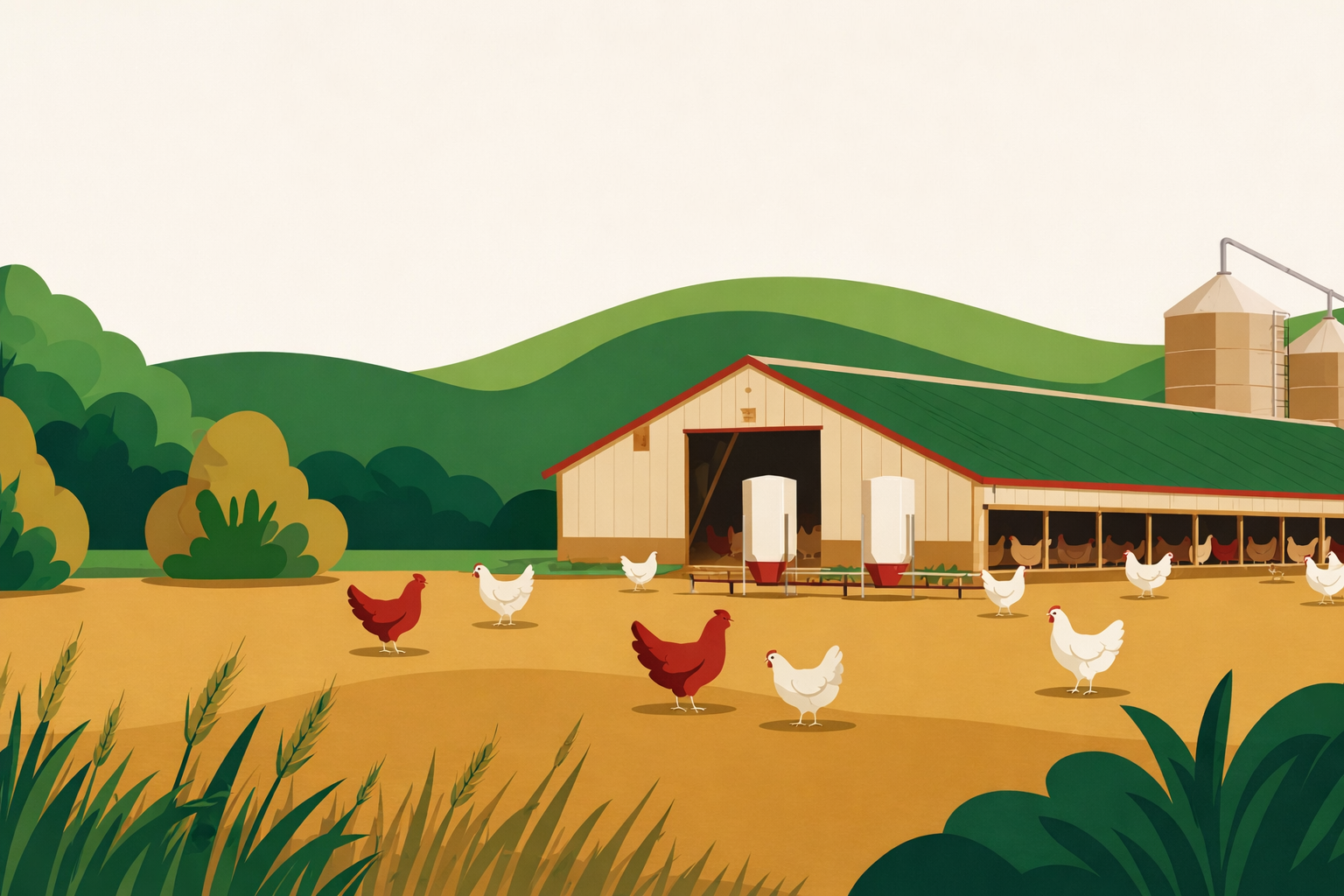
What a broiler farmer’s day really looks like
A broiler farmer’s day rarely looks the way an outsider imagines it. It is not a few hours with the birds now and then, but a steady rhythm of rounds, checks and records that repeats throughout the whole fattening cycle. We show a typical run of the day based on real farm tasks — not on a specific person or holding. If you are only getting to know this work, a good background is the guide on broiler farming and the poultry farmer’s handbook.
The rhythm of the day depends on the flock’s age
A day with day-old chicks looks different from a day with birds in the second half of the cycle. In the first days the farmer revolves mainly around temperature, water access and getting the birds onto feed; later come growth checks, stocking density and preparing for collection. Even so, the skeleton of the day is similar: round, checking conditions, collecting mortality and records. We describe how this rhythm changes with the flock’s age in more detail in the guide on broiler farming.
Observation matters more than the clock
Although the day has its schedule, the farmer’s most important tool is observation. How the birds are spread on the litter, the level of sound, appetite at the feeders and movement at the drinkers tell you more about the flock than the hour itself. An experienced farmer “reads” the house with eyes, ears and nose before reaching for instruments. This skill is worth practising from the first flock — the organised knowledge in the poultry farmer’s handbook helps.
Every round is also data
A well-run day does not end with watching the birds — it ends with a record. Mortality, water and feed use, temperature, sample weight and any treatment are data that only together show which way the flock is heading. It is most convenient to note them right away, at the birds, rather than from memory in the evening. That is what the digital broiler Flock Card is for, gathering daily entries in one place.
Why we describe a typical day
This picture of the day has two roles: to show people considering this profession what the work really looks like, and to remind beginners of the order of tasks. If you are thinking about starting, see the articles how to become a poultry farmer and the poultry farmer’s profession and how to start. A printable poultry calendar also helps, tying together the recurring tasks of the whole cycle.
A typical broiler farmer’s day — from morning to night
Six parts of the day, six sets of tasks. This is a simplified, typical run — on a real farm the hours shift, and the flock’s age changes the emphasis. We show the skeleton that repeats through the whole cycle.
Morning — round, water, feed, mortality
The day starts with a round of the whole house: the farmer looks at how the birds are spread on the litter, checks the drinker and feeder lines, cleans and tops up feed and collects the night’s mortality. Every dead bird is counted and recorded — the first important indicator of the day. Everything goes straight into the digital Flock Card so the numbers are not lost. The basics of these tasks are described in the guide on broiler farming.
Late morning — climate and sample weighing
After the round the farmer deals with conditions in the house: temperature, humidity and ventilation must match the flock’s age. They adjust heating and air exchange and check there are no draughts or stale air. This is also a good time to weigh a sample of birds — a control measurement of weight that shows whether growth is on plan. How to read these results is explained in the poultry farmer’s handbook.
Midday — paperwork and feed orders
In the middle of the day the farmer sits down to the records: filling in water and feed use, noting sample weight and any treatment, planning deliveries. They check the level in the silos and, if needed, order the next batch of feed so it does not run out at a key moment of the cycle. Recurring deadlines are easier to handle with a printable poultry calendar, and the records themselves are tied together by the digital Flock Card.
Afternoon — equipment checks and minor repairs
In the afternoon comes the technical side: checking drinkers and feeders, fans, heating and sensors, small repairs before they grow into big breakdowns. Working equipment means less stress for the birds and a lower risk of losses. It is also a moment to check supplies and keep order in the clean and dirty zones. Why these checks are daily, not “once in a while”, is explained in the poultry farmer’s handbook.
Evening — another round and responding to alarms
Towards evening the farmer does a second full round: again counting mortality, checking water, feed and the flock’s behaviour after the whole day. They respond to signals that appeared since morning — a shortage of water in a line, birds bunched in one place, a change in sound. The evening entry closes the day’s data in the digital Flock Card. It is also the time to make sure the night climate settings are right.
Night — monitoring, sensors, readiness
Night does not mean the farm sleeps peacefully. The climate keeps working, and the farmer relies on sensors and alarms: temperature, ventilation and sometimes backup power. A ventilation failure on a hot night can threaten the whole flock, so readiness to react quickly matters even after hours. This is one of the things worth knowing before entering this profession — we also describe it in the guide on how to become a poultry farmer.
How a good farmer differs from an average one
The same tasks can be done by ticking off a list or with your head. Here are six traits that, in a typical day, separate the farmer whose flocks “run smoothly” from one constantly caught out by problems.
Routine and a repeatable round
A good farmer does the round at fixed times and always in the same order, because that way they immediately notice what has changed. Routine is not boredom — it is a way to make sure nothing slips through. A steady rhythm of the day, like the one described above, is their greatest ally. How to build such a rhythm from the first flock is suggested in the guide on broiler farming.
Quick response to the flock’s signals
Reaction time makes the difference. Birds bunched against the wall, a quiet — or the opposite, too loud — house, a drop in water intake are signals a good farmer responds to at once, not “at the next round”. The earlier, the smaller the losses. This skill of reading the flock is honed over years — it is supported by the knowledge in the poultry farmer’s handbook.
Reliable records every day
A good farmer records mortality, water, feed and sample weight daily, not from memory at the end of the cycle. Only a run of data shows the trend and lets you compare the flock with the previous one. It is also the basis of inspection readiness. The easiest way is digitally — in the digital broiler Flock Card, which calculates the indicators for the farmer.
Biosecurity discipline
The best treat biosecurity as a daily habit, not a procedure “for show”. Changing footwear, disinfection mats, separating the clean and dirty zones, controlling entries — these small things repeated without exception protect the flock from avian influenza and other diseases. One neglected day can cost a whole batch. Why it pays off is explained in the poultry farmer’s handbook.
Planning ahead
A good farmer does not wait until the feed runs out or collection draws near — they plan deliveries, weighings and deadlines ahead. As a result the key moments of the cycle do not catch them out, and the day does not turn into firefighting. The recurring tasks of the whole cycle are easier to arrange with a printable poultry calendar, which reminds you what to do and when.
Constant learning and drawing conclusions
After each flock a good farmer analyses what went well and what can be improved: growth, mortality, feed use. They treat every cycle as a lesson for the next. This attitude cannot be bought with equipment — it is built with experience and knowledge. The starting points for those entering the profession are the articles how to become a poultry farmer and the poultry farmer’s profession and how to start.
Frequently asked questions about a day in the life of a broiler farmer
How many hours a day does a broiler farmer work?add
There is no single figure, because it depends on the size of the farm, the degree of automation and the flock’s age. The active time with the birds alone is usually several rounds and checks spread across the whole day, plus readiness to react in the evening and at night should an alarm go off. In practice the work spreads across the day in several “blocks” rather than one continuous shift. The better the organisation and equipment, the fewer unplanned bursts.
What exactly does a farmer do during the morning round?add
The morning round is a review of the whole house: assessing how the birds are spread on the litter, checking the drinker and feeder lines, topping up feed and collecting and counting the night’s mortality. The farmer also checks temperature, ventilation and the flock’s general behaviour. All the numbers — mortality, water, feed — are best recorded right away rather than reconstructed from memory later. It is the first and one of the most important rounds of the day.
Why is a sample of birds weighed and how often?add
Sample weighing is a control measurement of the weight of a randomly chosen group of birds, showing whether growth is in line with the targets for the flock’s age. It is done regularly during the cycle, most often every few days or once a week, depending on the practice adopted. The result is compared with a reference curve so you can react in time to too slow or uneven growth. It is one of the basic indicators of how well the flock is being run.
Does a farmer have to watch the farm at night too?add
At night the farm does not require constant presence, but it does require readiness. The climate keeps working, and the farmer relies on temperature and ventilation sensors and alarms. In case of a failure — for example ventilation on a hot night — a quick response matters, because the whole flock can be at risk. That is why in a typical farmer’s day “night” means monitoring and being on call, not peaceful sleep without safeguards.
What do the records kept during the day look like?add
During the day the farmer notes mortality, water and feed use, temperature, sample weight and any treatment and drug withdrawal. Together these data show which way the flock is heading and are the basis for settlements and inspection readiness. The most convenient way is digitally, entering records right at the birds. DlaFerm.pl lets you do this in the digital Flock Card, which calculates the indicators and keeps everything in one place.
How does a day with chicks differ from a day with birds before collection?add
At the start of the cycle the day revolves around temperature, water access and getting day-old chicks onto feed — the most sensitive period. In the second half of the cycle growth checks, stocking density, litter quality and preparing for collection come to the fore. The skeleton of the day — round, checking conditions, collecting mortality and records — stays the same, but the emphasis changes and so does what the farmer watches most closely.
Run your day on the farm calmly with DlaFerm.pl
Want your rounds, weighings and records to fall into one rhythm rather than a mess at the end of the cycle? We will show you how DlaFerm.pl keeps a daily broiler Flock Card and calculates the indicators for you. Create a free farm account.
Phone
+48 796 258 151