Cages, barn or aviary — which laying-hen housing system to choose
The choice of a laying-hen housing system is one of the most important on an egg farm — it affects bird welfare, investment and labour costs, disease risk, and even the code you stamp on the eggs. We compare three systems: enriched cages, barn housing and the aviary (with free-range in the background), criterion by criterion. We show where each works and how EU rules are changing the game.
verifiedFrom the team that has organised work on poultry farms for years.
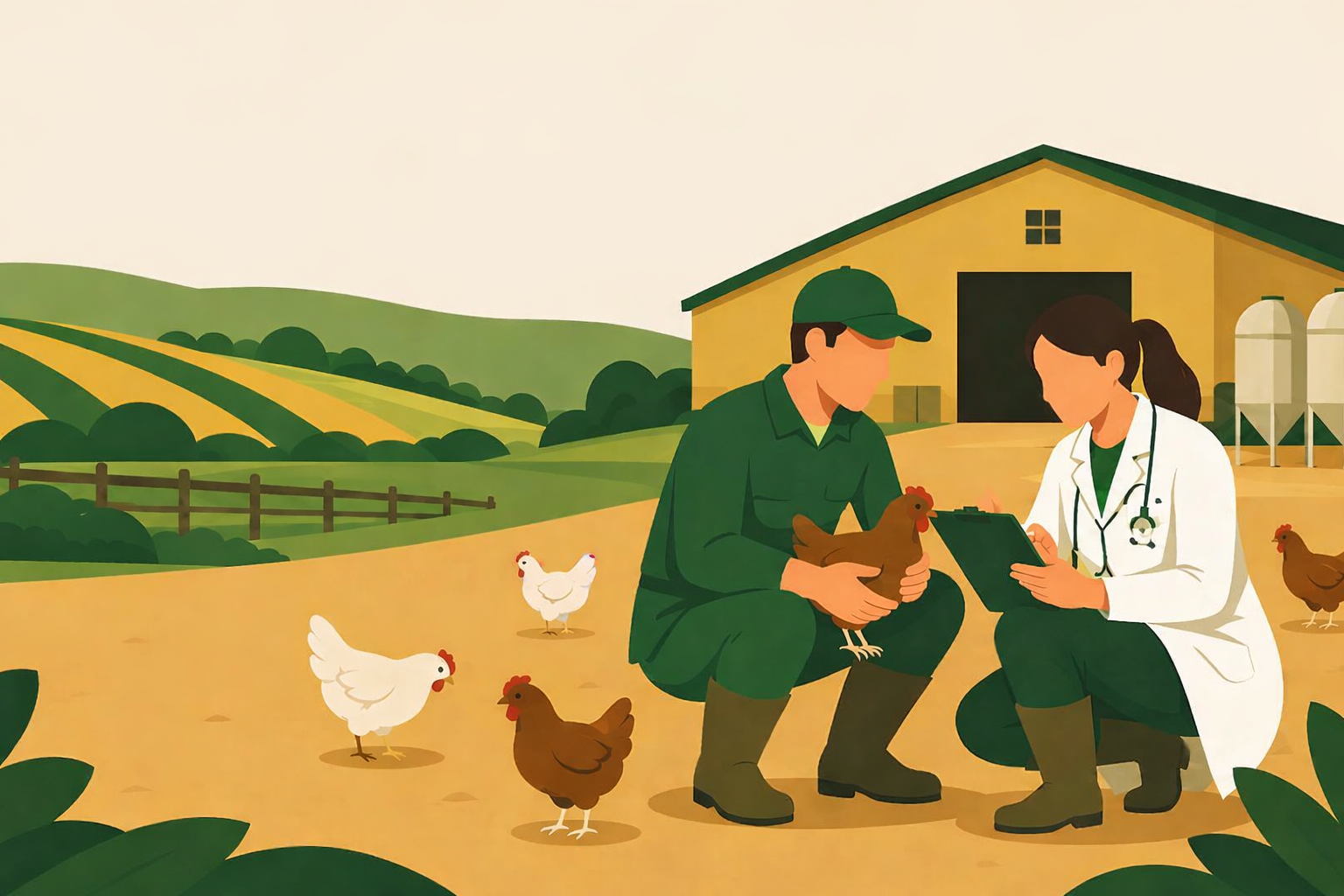
Three housing systems — and why the choice matters
A laying hen can be kept in several ways, and almost everything depends on the system: how many birds fit per square metre, how much you spend on the building, how easily you keep things hygienic and what kind of egg reaches the shelf. In practice three main systems are compared — enriched cages, barn housing and the aviary (a multi-tier cage-free system) — plus free-range, where hens have outdoor access. Before you decide, it is worth getting to know the laying-hen breeds and the whole topic in the guide on layer-hen farming.
Welfare — the hen’s natural behaviour
A hen has strong needs: scratching, dust bathing, laying eggs in a nest and perching. An enriched cage offers a nest, a perch and scratching material, but movement is heavily limited. Barn housing and the aviary allow free movement and the full range of behaviours, and the aviary also uses vertical space. Free-range goes furthest — hens have access to grass and daylight. The higher the welfare, the higher the costs and the greater the management demands, as a rule.
Cost, hygiene and performance are connected vessels
There is no perfect system — only one matched to the scale, market and rules. Enriched cages are hygienically easy and cheap to run, but produce eggs with the lowest market status (code 3). Barn and aviary give a more valued egg (code 2, and code 1 with free-range), but labour and the risk of diseases spread by birds contacting droppings both grow. Good farm management — whatever the system — rests on records and ongoing control, which is what a digital Flock Card serves.
Egg marking and EU law — what you must not skip
Every table egg in the EU gets a housing-system code: 0 — organic, 1 — free-range, 2 — barn, 3 — caged (enriched cages). This is not a marketing detail — it is a legal duty and the first thing the consumer sees. Conventional battery cages have been banned in the EU since 2012; today “cages” mean enriched cages only. What is more, the direction of the rules and market pressure are moving away from cages, which must be taken into account in every investment.
Run any system calmly with DlaFerm.pl
Whether you go for cages, barn or aviary, a layer farm means documentation, deadlines and flock health to watch. DlaFerm.pl brings it together in one place: you keep a digital Flock Card, stay on top of data on lay rate, mortality and treatment, and the tedious flock records in IRZplus you can leave to us — we’ll file the flock-change reports to IRZplus for you automatically, if you want, or report them yourself, whichever you prefer. So you see faster whether the chosen system really pays off. You can create a farm account for free.
Cages vs barn vs aviary — six criteria
Each system has strengths and weaknesses. We compare them one by one: welfare, stocking, costs, hygiene, production results and legal compliance with egg marking. We name the systems directly under each criterion.
Welfare and natural behaviour
An enriched cage offers a nest, a perch and a scratching mat, but limits movement and dust bathing. Barn housing allows free movement and scratching, and the aviary adds use of tiers and perches at different levels. Free-range goes furthest — hens go outside. On welfare the order is clear: free-range > aviary ≈ barn > enriched cage. Higher welfare also means more work and flock knowledge — compare laying-hen breeds by temperament.
Stocking and use of floor space
Enriched cages pack the most birds per square metre of building, because they use racks. Barn housing has the lowest density on a flat floor, so it needs a bigger building for the same flock. The aviary is the middle ground — it is cage-free, but thanks to its multi-tier design (hens use the tiers) it holds more hens than a flat barn. Free-range additionally needs land outside, which most strongly limits scale on a given plot.
Investment and labour costs
Enriched cages are cheapest to run: eggs and droppings move on belts, less manual work, fewer dirty eggs. Barn housing has lower equipment cost but higher labour cost — more collecting of floor-laid eggs, more litter handling. The aviary means higher investment (multi-tier structure, automation) but lower labour cost than a plain barn. Free-range adds the cost of maintaining land and fencing. Each system spreads the spend over time differently.
Hygiene, health and disease risk
Here the enriched cage wins: the bird does not contact droppings on the floor, so the risk of intestinal parasites and coccidiosis falls. Barn and aviary mean hens contact litter and droppings, so disease risk rises, and the aviary adds injury risk during flights between tiers. Free-range additionally means contact with wild birds and a higher risk of bringing in avian influenza. Biosecurity and health control matter more in cage-free systems — an ongoing digital Flock Card helps with this.
Production results and egg quality
In enriched cages lay rate and shell cleanliness are usually very stable, and there are few dirty and cracked eggs. In barn and aviary, floor-laid eggs appear — dirtier, which raises the sorting effort. Free-range and aviary give an egg valued higher on the shelf, which offsets part of the cost. The hen’s own performance largely depends on genetics — compare it in Lohmann vs ISA Brown.
Legal compliance and egg marking (code 0-3)
The system translates directly into the code printed on the egg: 3 — caged (enriched cages), 2 — barn, 1 — free-range, 0 — organic. Conventional battery cages have been banned in the EU since 2012, so today a “cage” always means an enriched cage. Each system has its own space, nest and perch requirements that must be met to sell eggs legally. This criterion often decides, because the market and the rules choose for us.
Which system fits your farm
The choice of system is not only about welfare, but also the market, scale and the direction of the rules. Here are six situations and pitfalls worth thinking through before investing in cages, barn or aviary.
Small farm — often barn or free-range
On a small farm, close to a local buyer, barn or free-range usually pays off better. An egg with code 2 or 1 sells higher and more easily to a retail customer, and the smaller scale absorbs the higher labour cost. Building a multi-tier aviary hall rarely makes sense with a small flock. Before you choose a breed for such housing, check the laying-hen breeds and the whole topic in the guide on layer-hen farming.
Large farm — aviary or enriched cages
At large scale, stocking per metre and labour cost per egg matter. Enriched cages give the lowest unit cost and the most stable hygiene, but a code-3 egg has the weakest market status. The aviary combines cage-free status (code 2) with good use of the hall thanks to its tiers. Choosing between them is often choosing between the lowest cost and a higher egg price with a better market image.
The market decides: where you sell the egg
First check who will buy your eggs. Retail chains and some buyers increasingly drop caged eggs (code 3), preferring barn and free-range. If your buyer no longer accepts caged eggs, the decision is made for you. For organic eggs (code 0) there are separate, stricter feed and range requirements. Match the system to a real sales channel, not to theory.
EU rules direction — look ahead
EU policy and consumer pressure are moving away from cages — a scenario of phasing out enriched cages too in the longer term is being discussed. A farm investment lasts a dozen or more years, so it is worth reckoning with this direction. Building a new hall today purely for cages carries the risk that in a few years it will need rebuilding. The aviary and barn are safer “for the future”.
Cost of switching from cages — not just the hall
Switching from cages to a cage-free system is not changing the furniture — it is a different building, different ventilation, different work organisation and often lower stocking in the same hall. You must add the rebuild, a temporary production break and learning to manage a flock on litter. A common mistake is counting only the structure cost without lost production and the higher labour effort in the new system.
Recommendation — and common mistakes
The recommendation depends on scale and market, but the direction is clear: new investments are worth planning as cage-free — an aviary for large scale, barn or free-range for smaller, local sales. Common mistakes are: choosing a system for the lowest cost without looking at the market, underestimating the labour on litter, and neglecting biosecurity in free-range systems. Whatever you choose, keep flock records in IRZplus and control your results to fix what limps quickly. The choice of drinkers also matters — compare nipple vs bell drinking.
Frequently asked questions about laying-hen housing systems
How do cage, barn and aviary housing differ?add
In cage housing (enriched cages) hens live in cages with a nest, perch and scratching mat, but with limited movement. In barn housing hens walk freely on litter across the floor of the hall. The aviary is a cage-free, multi-tier system — hens use tiers, perches and nests at different levels. The cage gives the best hygiene and the highest stocking, while barn and aviary give higher welfare and an egg valued better on the market.
What do the egg codes 0, 1, 2, 3 mean?add
The first digit on an egg is the housing system: 0 — organic, 1 — free-range, 2 — barn, 3 — caged (enriched cages). It is a mandatory marking across the EU, so the consumer sees at once where the egg comes from. The lower the digit, the higher the welfare and usually the higher the price.
Are cages for hens banned in Poland?add
Conventional battery cages have been banned across the EU, including Poland, since 2012. Enriched cages remain allowed and must provide a nest, perch, scratching mat and more space per bird. However, there is a discussion about gradually moving away from enriched cages too, and the market is already increasingly dropping caged eggs. When planning an investment, it is worth taking this direction into account.
Which system is cheapest to run?add
The lowest unit cost usually comes from enriched cages: high stocking, automatic egg and droppings collection, few dirty eggs and good hygiene. Barn housing has lower equipment cost but higher labour cost. The aviary is a higher investment, but at large scale a reasonable cost per egg thanks to using the tiers. The cheapest to run is not always the most profitable — the price you get for the egg matters too.
Which system gives the best hen welfare?add
The highest welfare comes from free-range and organic, because hens have outdoor access, grass and daylight. Just behind them are the aviary and barn housing, which allow free movement, scratching and dust bathing. The enriched cage covers basic needs (nest, perch, scratching), but movement is limited. Higher welfare, however, comes with greater labour and a higher disease risk that has to be controlled.
Is it worth switching from cages to a cage-free system?add
It depends on the market and scale. If your buyers are moving away from caged eggs, switching to barn or aviary may be a necessity rather than a choice. The switch is, however, a real cost: a different building, lower stocking in the same hall, a temporary production break and learning a new work organisation. It is worth calculating this as a whole — with lost production and higher labour — before deciding, rather than looking only at the structure cost.
Choose a system and run your layer farm calmly with DlaFerm.pl
Wondering about cages, barn or aviary? Whatever you choose, we will help you stay on top of lay rate, health and flock documentation. We will show you how DlaFerm.pl keeps the Flock Card and IRZplus records. Create a free farm account.
Phone
+48 796 258 151