Biosecurity quiz — find out how much you really know about farm protection
This is a short biosecurity knowledge test in a question-and-answer format. Each question has a correct answer with a brief explanation, so even if you get it wrong you immediately learn how it really is. We cover six areas: zones and the hygiene lock, washing and disinfection, entry and vehicle control, water and feed, notifiable diseases and documentation. Read the question, think for a moment, then look at the answer.
verifiedFrom the team that has organised work on poultry farms for years.
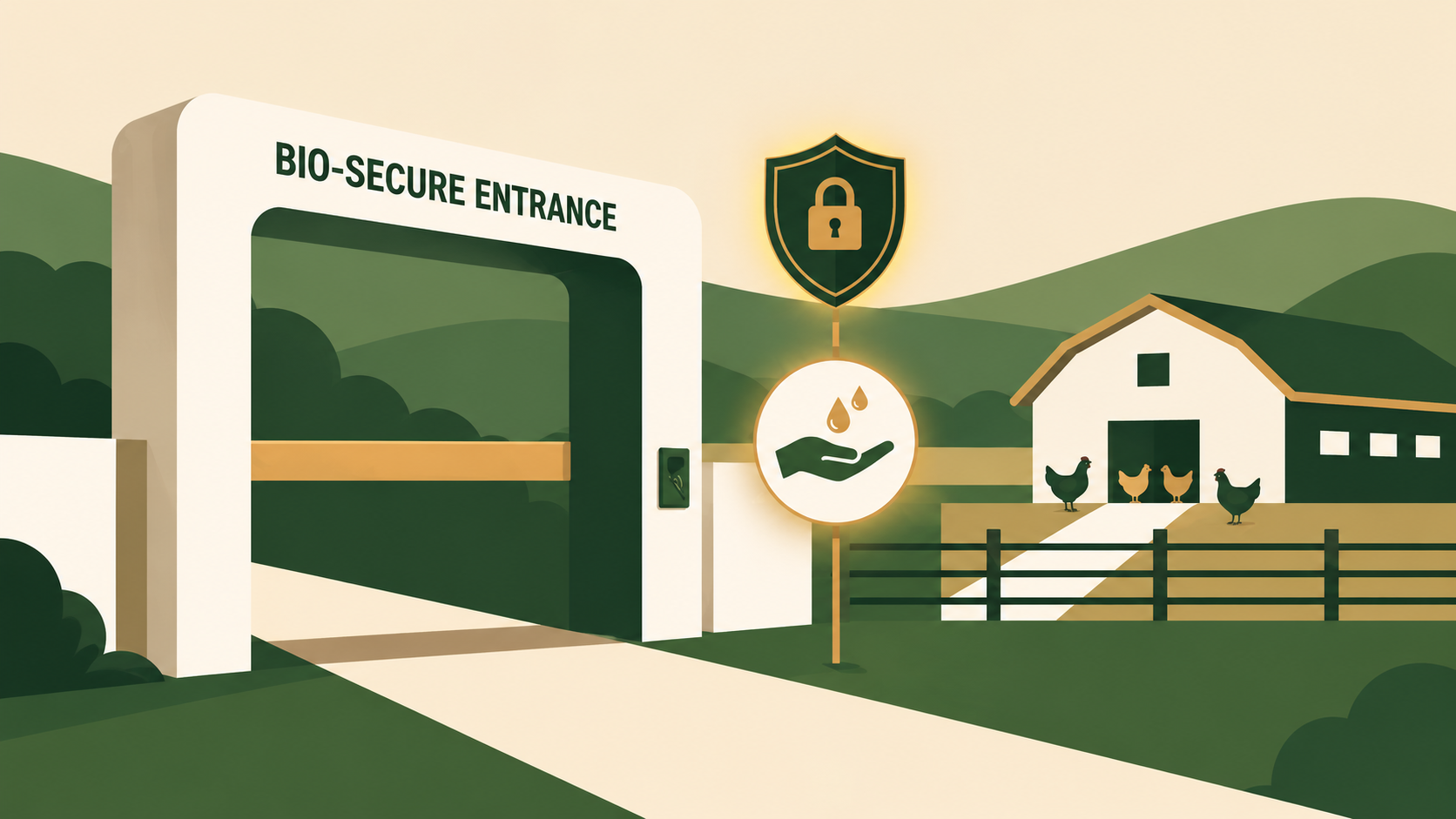
Why test your biosecurity knowledge
Biosecurity is a set of simple rules that keep disease away from the flock — and avian influenza (highly pathogenic avian influenza, HPAI) means culling the whole farm. The trouble is that many people are sure of their habits while in practice repeating mistakes that open a door for the virus. This quiz helps catch gaps in your knowledge before an inspection does, or worse, an outbreak. If you want to refresh the basics first, start with the guide on poultry farm biosecurity.
How to use the quiz
The rule is simple: read a question from the questions section, pause for a moment and answer in your head, and only then check the correct answer with its explanation. This is not an interactive scored test — it is study material where the correct answer is always at hand. What matters is not the score but whether, after reading the explanation, you change something on your farm.
What you will learn along the way
The questions are not detached from real life — each one is about decisions you make on the farm every day: who enters the house and how, what you wash with, when you report deaths, where your water and feed come from. Along the way we debunk a few myths that many farmers get wrong. You will find the wider disease context in the articles on avian influenza (HPAI) and the avian influenza season summary.
From knowledge to action
Knowledge alone does not protect the flock — an implemented routine and written documentation do. After the quiz it is worth writing your own biosecurity plan and keeping it up to date. The biosecurity plan generator will help, and you can keep daily entries and events in the digital Flock Card in DlaFerm.pl. You can create a farm account for free.
The areas this quiz tests
The questions spread across six areas of biosecurity. Each is a different way disease can enter the farm — and a different set of habits that stop it.
Zones and the hygiene lock
Splitting the farm into a clean and a dirty zone and passing through a lock with a change of clothing and footwear is the foundation. The quiz checks whether you know where the zone boundary runs and how to pass through the lock without carrying germs into the house. For the basics, see the guide on poultry farm biosecurity.
Washing and disinfection
The most common mistake is disinfecting without washing first. The questions check the order: first remove dirt and wash, and only then apply a disinfectant at the right concentration and contact time. Without a clean surface, disinfection is only apparent.
Entry and vehicle control
A farm is no place for random visitors. The quiz checks the rules for people entering (register, clothing, quarantine after contact with other poultry) and for vehicles (mats and wheel spraying, limited access). This is the most common route the virus takes for the last few metres to the flock.
Water and feed
Feed and water are daily contact with the flock, so also a potential route of infection. The questions cover protecting the feed store from wild birds and rodents and the quality and source of water. Open intakes and feeding outdoors are a straight path to trouble.
Notifiable diseases
Some poultry diseases must be reported to the district veterinary officer — it is a legal duty, not goodwill. The quiz checks whether you recognise the warning signs and know when to pick up the phone. You will find the background in the article on avian influenza (HPAI).
Biosecurity documentation
A biosecurity plan, an entry register, records of washing and disinfection and of deaths are proof that the farm runs by the rules. The questions check what and for how long you must document. It is most convenient to keep it digitally in the digital Flock Card.
Myths that many people get wrong
These beliefs sound reasonable, which is what makes them dangerous — they lull your guard. Here are six myths the quiz helps debunk before they cost you the whole flock.
Myth: “disinfection without washing is enough”
The most dangerous misconception. A disinfectant works only on a clean surface — a layer of droppings, dust and feed residue shields the germs from it. Always wash and remove dirt first, and only then disinfect at the right concentration and with the right contact time. Skipping washing makes disinfection a show. More in the guide on poultry farm biosecurity.
Myth: “family and guests are no risk”
The virus does not ask for names. A household member, neighbour or fellow farmer can bring germs on their boots, clothes or hands — especially if they have contact with other poultry. Every person entering the flock zone passes through the lock and goes into the entry register. No exceptions “for our own” is not an overreaction but a basic rule.
Myth: “wild birds are not a problem in winter”
The opposite — the cold months and wild-bird migrations are the peak of avian influenza risk. The virus survives longer at low temperatures, and wild birds migrate and gather near water. Protecting runs, the feed store and water intakes from wild birds matters most precisely in winter. The scale of the problem is shown by the avian influenza season summary.
Myth: “a disinfection mat settles it”
A mat alone is not enough. If it is dry, dirty or the agent has long lost strength, it gives only the illusion of protection. The mat must be soaked in an active solution, refreshed regularly and backed by a change of footwear. It is one element of the lock, not the whole of biosecurity.
Myth: “it does not apply to a small farm”
Biosecurity applies regardless of scale, and a backyard flock can be even more exposed — it often has a run, contact with wild birds and looser entry rules. The virus does not tell a commercial farm from a dozen hens in a yard. The rules are the same, only their scale differs.
Myth: “I will report dead birds when there are more”
Waiting costs you. A sudden rise in deaths, a drop in laying or nervous symptoms are signals that, when a notifiable disease is suspected, must be reported at once to the district veterinary officer — it is a legal duty. The sooner you do, the lower the risk of an outbreak spreading. What raises the alarm is described in the article on avian influenza (HPAI).
Ten quiz questions on biosecurity — with the correct answers
Question 1. What do you do first: wash or disinfect the house?add
Correct answer: wash first, then disinfect. A disinfectant works only on a clean surface. First you remove the litter and dirt, wash the surfaces, let them dry, and only then apply the agent at the right concentration and contact time. Disinfecting over dirt wastes the agent and gives a false sense of safety.
Question 2. Why is the farm split into a clean and a dirty zone?add
Correct answer: so that germs from outside do not reach the flock. The dirty zone is the area of contact with the outside world (e.g. the yard, deliveries), and the clean zone is the inside of the house. You cross the boundary only through the lock, changing footwear and clothing. This split is a physical barrier that stops the virus at the zone boundary.
Question 3. Does a household member entering the house have to pass through the lock?add
Correct answer: yes, with no exceptions. Biosecurity has no category of “our own people”. Every person — household member, technician, neighbour — passes through the lock, changes footwear and clothing and goes into the entry register. Be especially careful with people who have had contact with other poultry.
Question 4. Is a disinfection mat at the entrance enough on its own?add
Correct answer: no. The mat is just one element of the lock. It must be soaked in an active agent, refreshed regularly and clean, plus a change of footwear, clothing and hand washing. A dry or dirty mat gives the illusion of protection, not protection.
Question 5. How do you protect the feed store from infection?add
Correct answer: a closed store inaccessible to wild birds and rodents. Feed must be kept in sealed, covered conditions, with no access for wild birds, mice and rats that carry disease. You never spread feed in the open where wild birds gather.
Question 6. Where should the flock’s water come from?add
Correct answer: from a safe, controlled source, not an open reservoir. Water from open intakes (ponds, puddles) can be contaminated with wild-bird droppings and carry the avian influenza virus. The flock is watered with water of verified quality, and the watering system is cleaned and disinfected between batches.
Question 7. When does avian influenza risk rise in winter?add
Correct answer: precisely in the cold months, during wild-bird migrations. Low temperatures extend the virus’s survival, and migrating wild birds carry it over long distances. That is why in winter you especially watch runs, the feed store and water intakes. The scale of the phenomenon is shown by the avian influenza season summary.
Question 8. What do you do when deaths in the flock suddenly rise?add
Correct answer: report the suspicion to the district veterinary officer without delay. A sudden rise in deaths, a sharp drop in laying or nervous symptoms are warning signals. When a notifiable disease (e.g. avian influenza) is suspected, reporting is a legal duty, and a fast response limits the risk of an outbreak spreading. More in avian influenza (HPAI).
Question 9. Does biosecurity apply to a small backyard flock too?add
Correct answer: yes, it applies at every scale. The virus does not tell a commercial farm from a few hens in a yard, and small flocks with a run can be even more exposed to contact with wild birds. The rules are the same — only the scale of applying them differs. The basics are gathered in the guide on poultry farm biosecurity.
Question 10. What must you document as part of biosecurity?add
Correct answer: the biosecurity plan, the register of people and vehicles entering, records of washing and disinfection and of deaths. Documentation is proof that the farm runs by the rules and the basis of inspection readiness. It is most convenient to keep it digitally, in one place — in the digital Flock Card, rather than on loose sheets. Want more questions like these about farming? See 50 questions about broiler farming.
From knowledge to implemented biosecurity with DlaFerm.pl
Did the quiz reveal gaps? The best next step is to write your own plan and keep it up to date. We will show you how, in DlaFerm.pl, to build a biosecurity plan and track washing, disinfection and events in the digital Flock Card. Create a free farm account.
Phone
+48 796 258 151