Poultry welfare assessment — the Welfare Quality protocol and self-assessment
Welfare shows most clearly on the birds themselves, not just in the conditions of the house. The Welfare Quality protocol organises this into four principles and a set of animal-based measures. We explain what exactly is assessed and how to run a regular flock self-assessment, so you catch problems early and stay ready for an audit.
verifiedFrom the team that has organised work on poultry farms for years.
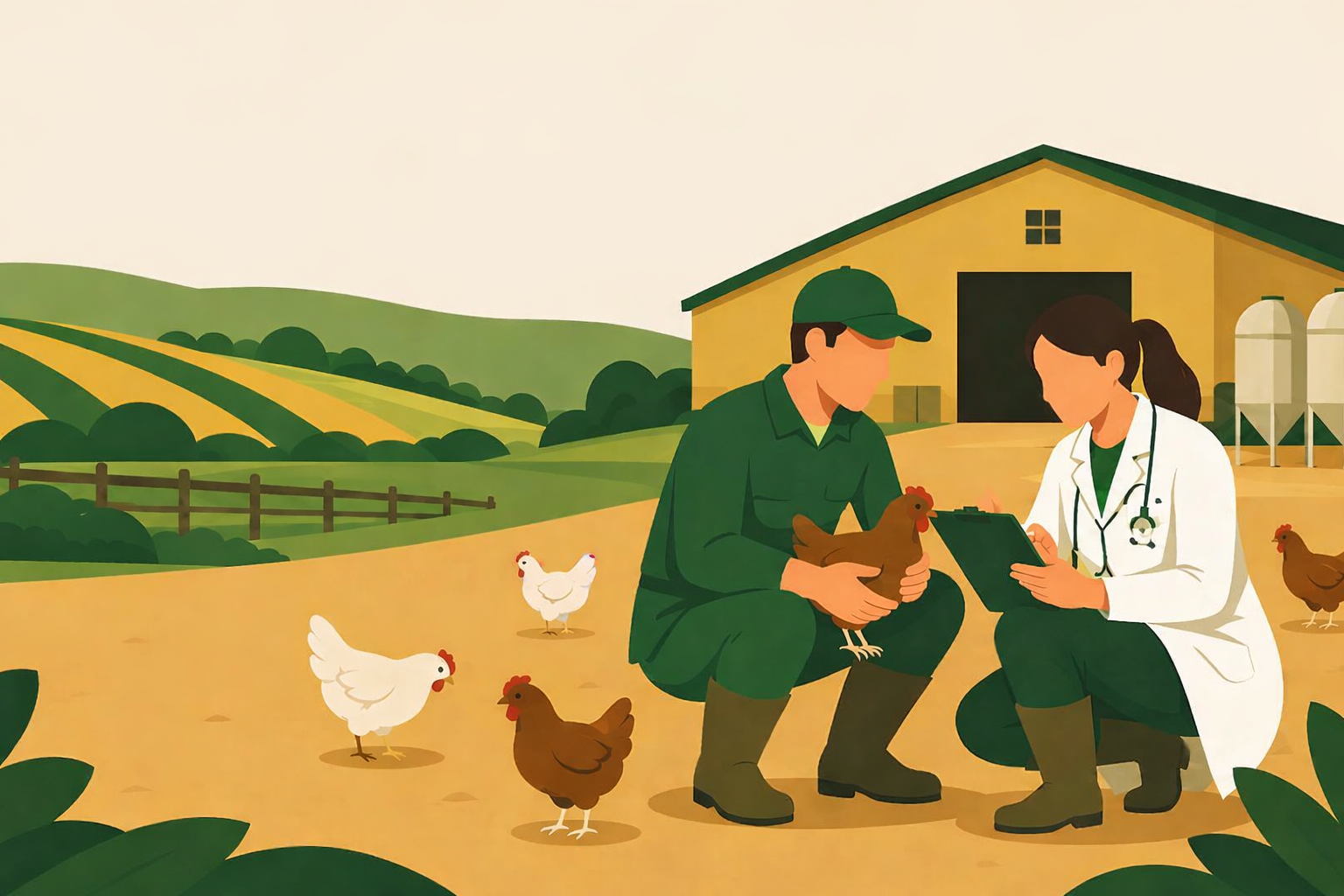
For years welfare was judged mostly by conditions: space per bird, ventilation, access to feed and water. That matters, but it tells you what a bird has available, not how it actually feels. Two flocks in an identical house can look completely different. That is why modern assessment looks first at the animals themselves — these are the so-called animal-based measures (ABM). You check how the birds walk, how their feet and feathering look, how they react to a person. The Welfare Quality protocol ties these observations into one structured system.
Why put welfare into a protocol?
Without a shared method everyone judges “by eye”, and the results are hard to compare between days, houses or farms. A protocol gives the same indicators, the same scoring scales and the same way of sampling birds, so the assessment becomes repeatable and objective. A regular self-assessment run to such a protocol does three jobs at once: it shows compliance with standards and buyer requirements, it prepares you for external audits, and — most important day to day — it catches deteriorating measures early, before they show up in the flock’s results.
What a welfare assessment is made of
Welfare Quality describes welfare in four principles. Each covers specific indicators — below are examples of what is actually checked in a poultry flock.
Good feeding
Whether the birds have constant access to feed and clean water and use them without obstruction. You check body condition and flock uniformity, the absence of emaciated and dehydrated birds, and clear drinking and feeding lines. Uneven growth or visible emaciation is a signal of a problem with access to, or quality of, feed and water.
Good housing
Whether the environment lets the birds rest and stay clean. This covers litter quality, plumage cleanliness, and thermal comfort — whether the birds are panting from heat or huddling from cold. Wet, capped litter drags further problems behind it, which is why it is assessed together with the state of feet and feathers.
Good health
Whether the birds are free from injury, disease and pain caused by conditions. This is where measures such as footpad dermatitis (FPD), hock burn, lameness scored on a gait scale, plus mortality and culling, belong. It is the principle where the most figures can be counted objectively.
Appropriate behaviour
Whether the birds can express natural behaviour and whether their relationship with people is calm. You assess activity and the spread of birds in the house, use of perches or enrichment, and the reaction to an approaching person — whether the flock is flighty or calm. Strong fear of handling is a warning sign.
Example ABM measures
The most commonly used animal-based measures are: gait score, footpad dermatitis (FPD), hock burn, plumage cleanliness and quality, mortality, and reaction to a person. Each has its own scale and its own interpretation — we cover the definitions in separate guides, and this page ties them together into one assessment method.
Animal-based versus resource-based measures
Resource-based measures describe what a bird has (space, drinkers, ventilation), while animal-based ones describe how the bird comes out of it (gait, feet, feathers, behaviour). A good assessment combines both: resources tell you where to look for the cause, while animal-based measures tell you whether the conditions actually work. Welfare Quality puts the latter first.
Flock self-assessment step by step
- 1
Choose the measures and scales
Set a short list of animal-based measures you will assess — most often gait, feet, hock, feather cleanliness, reaction to a person and mortality. For each, adopt a ready scoring scale (for example 0–2 or 0–4) in line with the protocol. It is important to keep the same definitions every time, because they are what makes results comparable.
- 2
Plan the bird sampling
You don’t assess the whole flock, only a representative sample. Pick birds at random in several points of the house — including near the walls and under the ventilation, not just in the centre. Set a fixed number of birds to examine, so results from different days can be compared. A consistent procedure matters more than a large but haphazard sample.
- 3
Set the frequency and timing
Observe some measures (bird spread, panting, reaction to a person) every day on the walk-through. Do the full scored self-assessment cyclically — for example on fixed days of the cycle and before its end, when feet and hock are under the most load. Keeping the same moments across cycles makes the data form a clear trend.
- 4
Assess calmly and consistently
Enter the flock calmly, give the birds a moment, and always assess the same way — ideally the same person, or criteria agreed in advance. Score gait when the birds move freely, and feet and feathers when a bird is lifted calmly. The consistency of the assessor is half the value of the whole self-assessment.
- 5
Record the results in one place
Note the score of each measure together with the date, the house and the flock age — ideally digitally, so it doesn’t get lost on loose sheets. In DlaFerm.pl you can keep a digital flock card and record welfare observations against a given cycle, so the history is at hand when an audit or a buyer’s question comes.
- 6
Compare over time and react
A single result says little; the value comes from comparing successive assessments and cycles. A rising share of birds with a worse gait or feet lesions is a signal to check litter, drinking and stocking, before the problem grows. React to the trend, and confirm improved conditions with the next self-assessment.
Frequently asked questions about poultry welfare assessment
What are animal-based measures (ABM)?add
They are measures you assess by looking at the birds themselves, not at the equipment of the house. Instead of measuring space or the number of drinkers, you check how the birds walk, how their feet and feathering look, and how they react to a person. ABM show the real effect of the conditions — two flocks in the same building can have different results, and it is these measures that tell you how the birds truly are.
What is the Welfare Quality protocol?add
It is a recognised method of assessing the welfare of farm animals, poultry included, built on four principles: good feeding, good housing, good health and appropriate behaviour. Each principle has specific indicators and scoring scales assigned to it. This makes the assessment repeatable and comparable, instead of resting on a general impression.
How often should you run a flock self-assessment?add
Some observations are worth doing every day on the walk-through — bird spread, panting, reaction to a person. The full scored self-assessment of measures such as gait or foot condition is done cyclically during the cycle, especially before its end, when the load on the feet is greatest. Regularity and the same moments matter most, because only then does a trend become visible.
Does self-assessment replace an external audit?add
It doesn’t replace it, but it prepares you for it. A self-assessment run to the same measures as the audit means you know the flock’s weak points in advance and have a documented history of observations. An external audit confirms compliance independently, and a regular self-assessment means the audit result is rarely a surprise.
Record welfare observations in DlaFerm.pl
In DlaFerm.pl you keep a digital flock card and record welfare observations against it — measure scores, dates and bird age — so the history is ready for an audit and buyers’ questions. Create a free account or write to us.
Phone
+48 796 258 151