Coccidiostats or vaccination against coccidiosis
Coccidiosis is one of the costliest threats in broiler rearing, and it is controlled in two ways: by adding coccidiostats to the feed or by vaccinating with a live vaccine. Each approach has its strengths and weaknesses. We explain how they work, what the resistance risk and the withdrawal period mean, and when it makes more sense to choose one over the other.
verifiedFrom the team that has organised work on poultry farms for years.
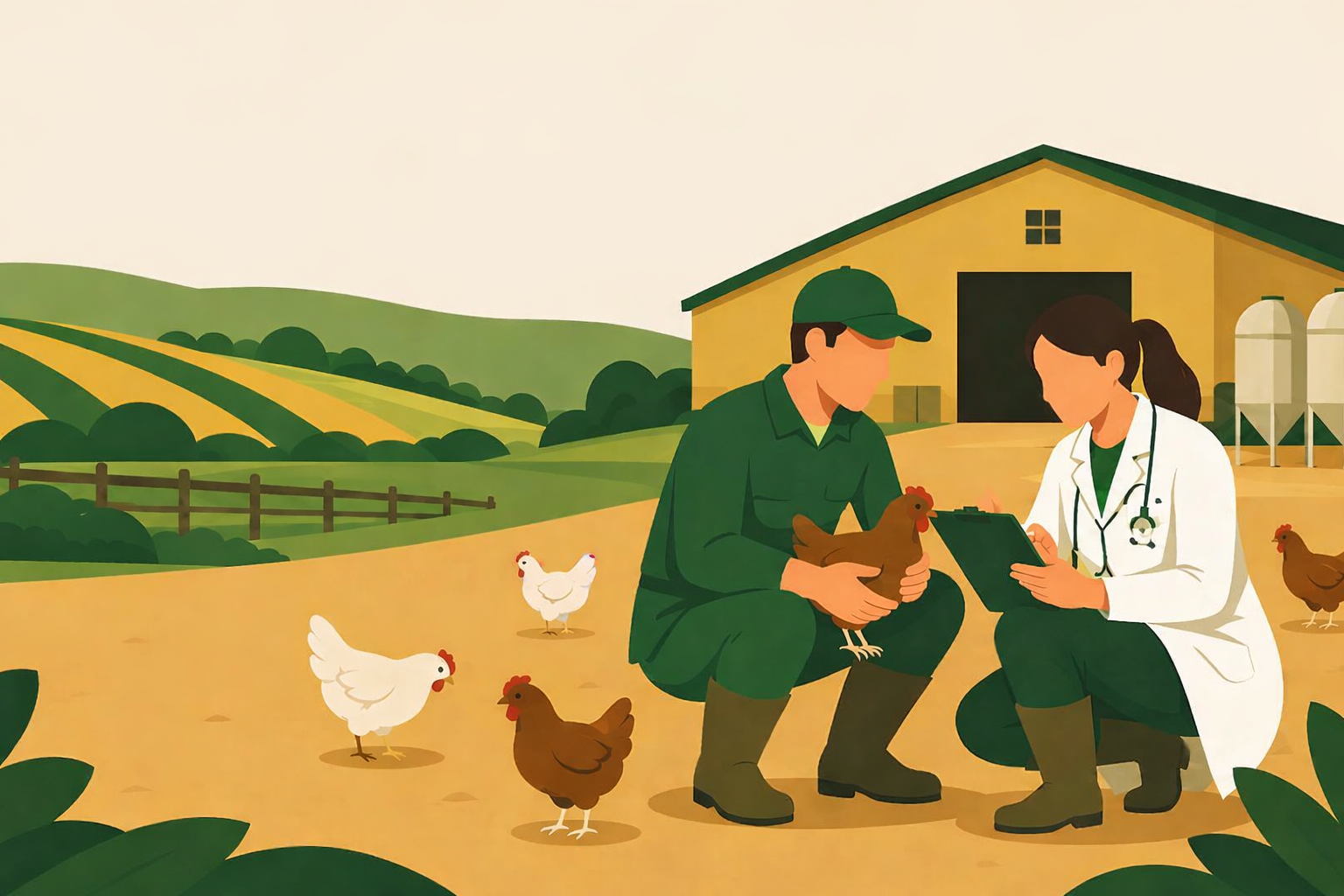
Coccidiosis, caused by Eimeria protozoa, damages the gut, worsens feed conversion and opens the door to secondary infections such as necrotic enteritis. The disease itself is a separate topic — here we deal with the decision that comes before the birds ever fall ill: which prevention strategy to control Eimeria with in a flock. In practice it comes down to a choice between coccidiostats in the feed and vaccination with a live vaccine, sometimes combined into a single programme.
Two roads to the same goal
Coccidiostats hold back the protozoan’s development in the gut, so they limit its multiplication and the symptoms. A vaccine works the other way round: it gives the birds a small, controlled dose of live oocysts that trigger a mild, natural infection and prime immunity. The first road is constant pressure on the parasite, the second is teaching the flock to cope with it on its own. The choice depends on whether you rear with coccidiostats or without them (ABF), how strong the resistance pressure on the farm is and how you manage the litter.
Coccidiostats and vaccination in brief
Two approaches to controlling coccidiosis, their variants and limits — from ionophores to bioshuttle programmes.
Ionophore coccidiostats
Derived from fermentation (for example monensin, salinomycin, narasin). They act on the protozoan but let a small amount through, so the birds build partial immunity. They are gentler on resistance than chemical products and form the backbone of most feed programmes. They are classed as feed additives, not therapeutic antibiotics.
Chemical (synthetic) coccidiostats
Synthetic compounds (for example diclazuril, nicarbazin, robenidine) with a stronger, more direct action on the protozoan. Effective, but they exert greater selection pressure — Eimeria develops resistance to them faster. That is why they are used in rotation and in shuttle programmes, not the same product over and over.
Shuttle and rotation programmes
To slow resistance, you don’t feed one coccidiostat endlessly. A shuttle programme changes the product within a single flock (one in the starter feed, another in the grower), while rotation changes products between successive flocks. The aim is not to let the Eimeria population get used to a single substance.
Live-vaccine vaccination
The birds get a precise dose of live, attenuated or field oocysts — at the hatchery or in the first days of life. These cause a mild infection that passes through a few cycles in the litter and builds lasting immunity for the rest of rearing. There is no withdrawal period here and no selection pressure for drug resistance.
Refreshing the Eimeria population’s sensitivity
A vaccine introduces drug-sensitive strains into the house. They mix with the resistant field strains and dilute them, restoring sensitivity to part of the Eimeria population. As a result, after a vaccination season the coccidiostats work better again — hence the common practice of alternating the two methods on a farm.
Bioshuttle programmes (combining methods)
A bioshuttle combines both roads in one flock: the birds are first vaccinated with a live vaccine, and later in rearing a coccidiostat is introduced that damps down any stronger reaction. This gives the benefits of vaccine-induced immunity plus a safety net in case the gut is colonised by oocysts unevenly.
Choosing a strategy step by step
- 1
Check which programme you rear under
First set the frame: is the rearing meant to be with coccidiostats or without them (ABF, “raised without antibiotics”). In coccidiostat-free programmes vaccination is often the only real way to control coccidiosis. In classic feed programmes you have the full range of products, but you have to keep an eye on rotation.
- 2
Assess the resistance pressure on the farm
If the coccidiostats work less and less well — worse results, traces of coccidiosis despite the drugs — that is a sign of growing Eimeria resistance. A season of live-vaccine vaccination lets you refresh the population’s sensitivity, after which the feed products start working again. This is a typical reason for a temporary switch to vaccination.
- 3
Count the withdrawal and market requirements
Coccidiostats have a set withdrawal period — the time after which the birds may be slaughtered. A vaccine needs no withdrawal. If you sell into markets with stricter requirements or in drug-free programmes, this argument often tips the balance towards vaccination. Use every product per the leaflet and the vet’s advice.
- 4
Plan litter management
Vaccination only works if the oocysts can pass through a few cycles in the litter — you need moderate, even moisture and a substrate that is not dried out. Litter that is too dry stalls immunity build-up, litter that is too wet risks an infection overgrowth. With coccidiostats, wet litter also raises the pressure, so either way it is the key to success.
- 5
Set the programme with your vet
Settle the specific products, the shuttle or rotation scheme, and the decision on vaccination or a bioshuttle with the vet who looks after the farm. They know the local disease situation and the resistance history in your region. A coccidiosis strategy is not set once and for all — it is reviewed between flocks.
- 6
Record what you gave and when
Whatever you choose, keep records: which coccidiostat or vaccine, on which days, with what withdrawal. This is the basis for working out the withdrawal period before slaughter and for judging whether the programme works. In DlaFerm.pl you record this in the treatment and withdrawal log and in the digital flock card — in one place, without paper notes.
Frequently asked questions about controlling coccidiosis
Coccidiostats or vaccination — which is better?add
There is no single right answer, because these are two strategies for different situations. Coccidiostats are cheaper and simpler in a typical rearing with medicated feed, but they risk growing resistance and require a withdrawal period. Vaccination builds lasting immunity, needs no withdrawal and refreshes Eimeria sensitivity, but it demands careful litter management and can be more expensive. Many farmers combine both approaches, alternating them or in a bioshuttle programme.
How do ionophore and chemical coccidiostats differ?add
Ionophores (for example monensin, salinomycin) come from fermentation, act more gently and let a little of the protozoan through, so the birds build partial immunity and resistance grows more slowly. Chemical ones (for example diclazuril, nicarbazin) are synthetic and stronger, but exert greater selection pressure, so Eimeria becomes resistant to them faster. That is why chemical products are usually used for shorter periods and in shuttle programmes.
What is a shuttle programme and rotation?add
Both are meant to slow resistance by changing the product. In a shuttle programme the coccidiostat is changed within a single flock — one in the starter feed, another in the grower. Rotation changes products between successive flocks so the Eimeria population does not get used to a single substance. This is the standard way to keep feed drugs effective for as long as possible.
Why does vaccination refresh Eimeria sensitivity?add
A vaccine introduces drug-sensitive protozoan strains into the house. They mix with the resistant strains present on the farm and dilute them, so after a vaccination season a growing part of the Eimeria population responds to coccidiostats again. That is why periodic vaccination can be a way to “reset” resistance, after which feed products work better again.
Keep a treatment and withdrawal log in DlaFerm.pl
In DlaFerm.pl you record which coccidiostat or vaccine you gave, on which days and with what withdrawal — in the treatment and withdrawal log and in the digital flock card. Create a free account or write to us.
Phone
+48 796 258 151