Wired or LoRaWAN — which sensors to choose for a poultry farm
On a poultry farm you can connect sensors to the system in two ways: by cable (wired sensors) or by radio, through a LoRaWAN network (a long-range, low-power radio network). Each has its strengths — wired ones are reliable and battery-free, but you have to run cabling to them; LoRaWAN reaches between buildings and installs fast, but runs on batteries. We compare both approaches criterion by criterion so you can choose deliberately.
verifiedFrom the team that has organised work on poultry farms for years.
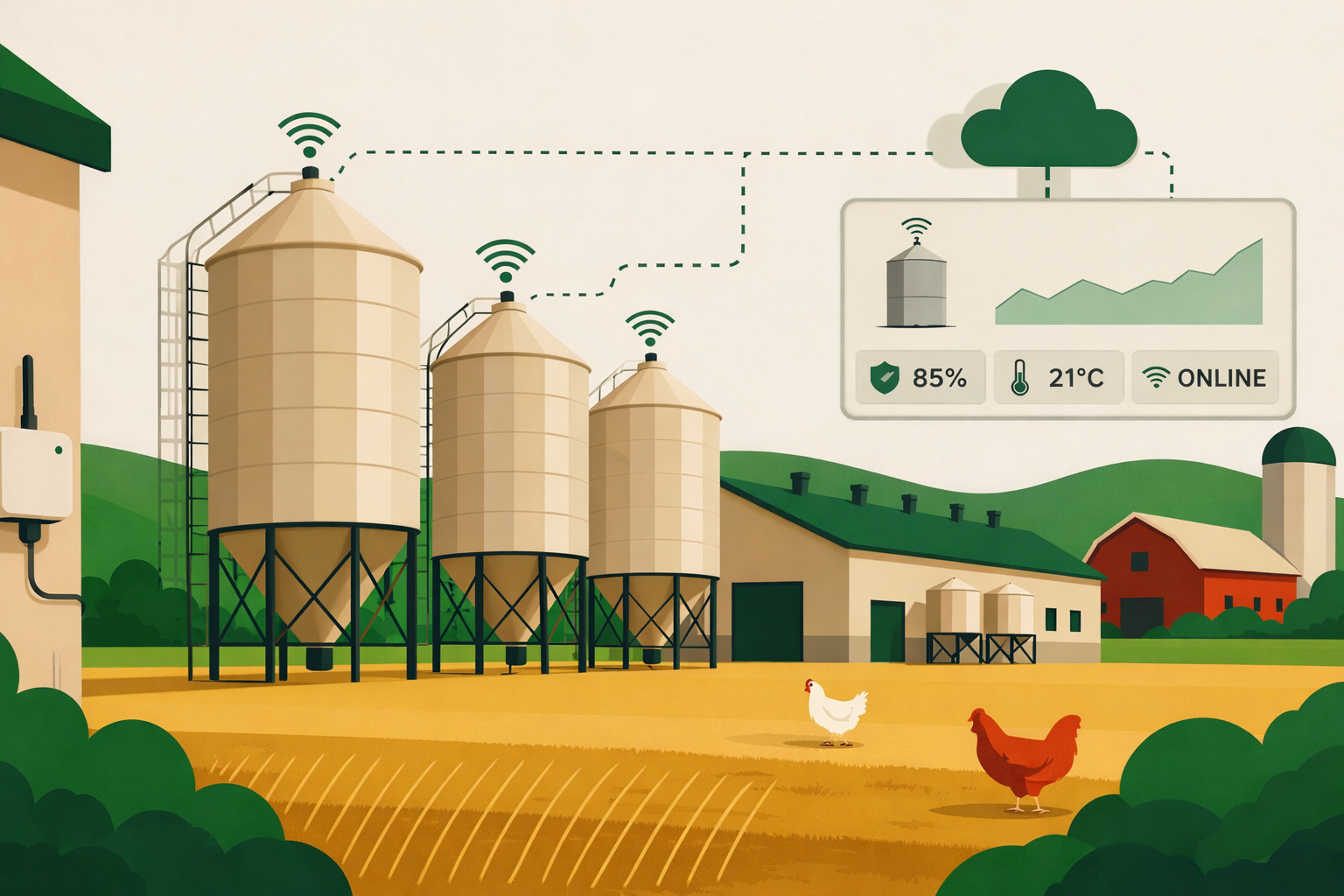
Two ways to connect sensors to the system
The measurement itself — temperature, humidity, feed or water level — is taken by the same sensor regardless of technology. The difference is in how the data reaches the system. Wired sensors connect by cable: constant power and transmission over one wire, no batteries. LoRaWAN sensors send readings by radio to a gateway (the receiving device), and from there the data goes to the cloud. This is not so much a choice of “better or worse” as “what fits your facility”. We gather the basics of what these devices even are in the article on sensors and flock monitoring.
Why this choice matters
The wired vs LoRaWAN decision translates into real money and hassle: how many metres of cable you have to run, whether the sensor reaches the next house, how often you replace batteries and what happens during a power failure. The wrong technology means either overpriced cabling where radio would do, or dead batteries and gaps in readings where a cable would be more reliable. So it is worth going through the criteria one by one before you buy the first devices.
Wired sensors — certainty on a cable
Wired is the classic: the sensor hangs on a cable with constant power and constant transmission. No batteries to replace, no risk the radio signal disappears. They work great where the sensor is close to a controller or a climate computer and where running a cable is not a problem — most often in one, well-cabled building. The drawback is the cable itself: every new measurement point is installation work, and long distances and many buildings quickly push the cost up.
LoRaWAN — long range and low power
LoRaWAN is a long-range (large reach) radio network with very low power consumption. A sensor runs on a battery for several years, because it sends short data packets now and then, and a single gateway serves many sensors scattered across the whole farm — including separate buildings. Installation is fast, because there is no cable to run. It is especially handy where feed silo monitoring matters for silos standing away from the building, or when you want to cover several houses at once.
A sensor is only half — the system matters
Regardless of technology, a sensor alone is just a source of a number. The value appears when the data reaches a system that stores it, draws charts and sends alerts. So before you compare wired with LoRaWAN, it is worth understanding the difference between a system and the sensors alone. In DlaFerm.pl the readings tie into the digital Flock Card, so temperature or feed level sit in the same place as the rest of the facility documentation.
Wired vs LoRaWAN sensors — criterion by criterion
Six criteria that really decide the choice. For each we show both sides — wired and LoRaWAN — so you can see where each technology wins on your farm.
Installation and cabling
Wired: every sensor must be connected by cable to a controller or power — that means installation work, trays, lead-throughs, time. The more points, the more cable. LoRaWAN: installation is screwing on the sensor and pairing it with the gateway (the receiving device) — no cable runs, done in minutes. When modernising an old facility where cables are hard to route, radio wins clearly.
Range and multi-building coverage
Wired: range is limited by cable length — it works sensibly within one building; beyond that cost and trouble grow. LoRaWAN: long-range radio reaches hundreds of metres, and one gateway covers several houses and silos spread across the farm. If you want to cover the whole facility, including distant silos, LoRaWAN does it from a single receiving point — see feed silo monitoring.
Power and battery life
Wired: constant power from the cable, zero batteries to replace — their biggest advantage. The sensor works as long as the controller does. LoRaWAN: a battery sensor, but thanks to low power consumption it runs for several years on one. You have to remember replacement and that frost shortens battery life. It is the convenience of no cables at the cost of periodic servicing.
Reliability and interference resistance
Wired: very reliable, because the signal goes over cable — no wall or other device disturbs it. The weak point is cable damage and dependence on power (an outage stops the measurement). LoRaWAN: resistant to single cabling failures, but a thick wall or steel structure can weaken the radio signal, and the gateway needs power and connectivity. For critical readings it is worth having backup power regardless of technology.
Cost of installation and expansion
Wired: a single sensor is cheap, but installation is expensive — cable, labour, trays — and every next point is installation cost again. LoRaWAN: the gateway and the sensor may cost more, but adding another measurement point is practically just buying a sensor and pairing it. For a farm that is meant to grow and add sensors in stages, LoRaWAN gets cheaper to expand. Calculate it soberly for your scale.
Integration with the system and monitoring
Wired: they usually plug into a given maker’s controller or climate computer — integration can be closed within one ecosystem. LoRaWAN: data goes through the gateway to the cloud and easily reaches an independent system, with phone access and alerts. Whatever the route, what matters is that the readings land in one system, not in separate apps — then you have the full picture of the farm in one place.
Wired or LoRaWAN — the decision for your farm
There is no single right answer — there is a right answer for your facility. Here are six situations that most often settle the choice, plus a recommendation at the end.
One house vs many buildings
For a single, well-cabled house, wired sensors are often enough and tend to be the most reliable — the cable is short and constant power is a plus. When you have several buildings or silos scattered across the farm, LoRaWAN covers them from one gateway without running cables between facilities. The more dispersed the farm, the more the balance tips toward radio.
Modernising an existing facility
In an old house with no ready cable routes, where every new wire means chiselling and trays, LoRaWAN is often the only sensible choice — installation without touching the structure. For a build from scratch or a major rebuild, consider wired where you are laying the installation anyway, and radio where a cable would be costly.
Distances and obstacles
Wired sensors work sensibly over short distances in one building. LoRaWAN is long-range radio, but remember: thick walls, concrete and steel structures weaken the signal. Over large distances check that the gateway “sees” all sensors — sometimes it must sit centrally or you add a second one. Distance favours radio; strong obstacles are an argument for a cable or good gateway placement.
Budget — installation vs expansion
If you set up a few sensors once and do not plan to expand, wired may come out cheaper despite the installation cost. If the farm is to grow and add measurement points in stages, LoRaWAN gets cheaper with every next sensor, because the gateway is already there. Count not only device price but also labour and the cost of future expansion.
Common mistakes when choosing
The most common mistake is to look only at a single sensor’s price and ignore the cost of installation or batteries over the years. The second is to pick LoRaWAN without checking range in a real building with thick walls. The third is to buy sensors without a system to handle them — then you have numbers but no alerts or history. A sensor without a system is only half a solution.
A recommendation at the end
For one easy-to-cable house with the sensor near the controller — wired is reliable and battery-free. For a dispersed farm, modernising an old facility, distant silos and expansion plans — LoRaWAN wins on convenience and range. Above all: match the technology to the facility, and tie the readings into one system. The manual workaround, namely checking feed level with a phone, is a fallback, not a target.
Frequently asked questions about wired and LoRaWAN sensors
How do wired sensors differ from LoRaWAN?add
Wired ones connect to the system by cable — they have constant power and transmission, no batteries. LoRaWAN are wireless sensors that send readings by radio to a gateway (the receiving device) and run on batteries thanks to low power consumption. The measurement itself is the same; the difference is in how they connect, in range, power and installation cost.
Which is better for a poultry farm — wired or LoRaWAN?add
It depends on the facility. For a single, well-cabled house, wired tends to be the most reliable and needs no batteries. For a farm with many buildings, distant silos, or when modernising an old facility, LoRaWAN wins on range and fast cable-free installation. It is best to go criterion by criterion: installation, range, batteries, reliability, cost and integration.
How long do batteries last in LoRaWAN sensors?add
Thanks to low power consumption, a LoRaWAN sensor can run for several years on one battery, because it only sends short data packets now and then. The exact time depends on measurement frequency and conditions — low temperatures shorten battery life. Wired sensors need no batteries, because they have constant power from the cable.
Will LoRaWAN reach several buildings on a farm?add
Yes, this is one of LoRaWAN’s main advantages — long-range radio covers several houses and silos from one gateway, over hundreds of metres. Keep in mind, though, that thick walls, concrete and steel structures weaken the signal, so the gateway should sit centrally, and on a large farm you sometimes add a second one so it “sees” all sensors.
Are wired sensors more reliable?add
In terms of transmission, yes — the signal goes over cable, so no wall or other device disturbs it. Their weak point is cable damage and dependence on power: an outage stops the measurement. LoRaWAN is resistant to single cabling failures, but the gateway also needs power and connectivity. For critical readings it is worth having backup power regardless of technology.
Will a sensor replace checking feed level by hand?add
Yes — that is the very point of monitoring. Instead of walking over to peek into the silo or typing data from your phone, the sensor reports the level automatically and sends an alert when feed runs low. We describe the difference in the article on whether a phone or a feed-level sensor is better. What matters, though, is not the sensor alone but that its data reaches a system with history and alerts.
Tie sensors into monitoring with DlaFerm.pl
Got wired, LoRaWAN or a mix of both? What matters most is that the readings land in one place — with history, charts and alerts. We will show you how DlaFerm.pl links sensors with the digital Flock Card. Create a free farm account.
Phone
+48 796 258 151