Holiday poultry — demand and farm preparation
Demand for holiday poultry — mainly duck and goose — is not spread evenly across the year but spikes on a few fixed dates: St Martin’s Day, Christmas and Easter. Anyone who wants to earn from it plans placements backwards from the sale date, matches species and breed to the date, and lines up slaughter, cooling and sales. We show the demand calendar and how to prepare the farm for the season.
verifiedFrom the team that has organised work on poultry farms for years.
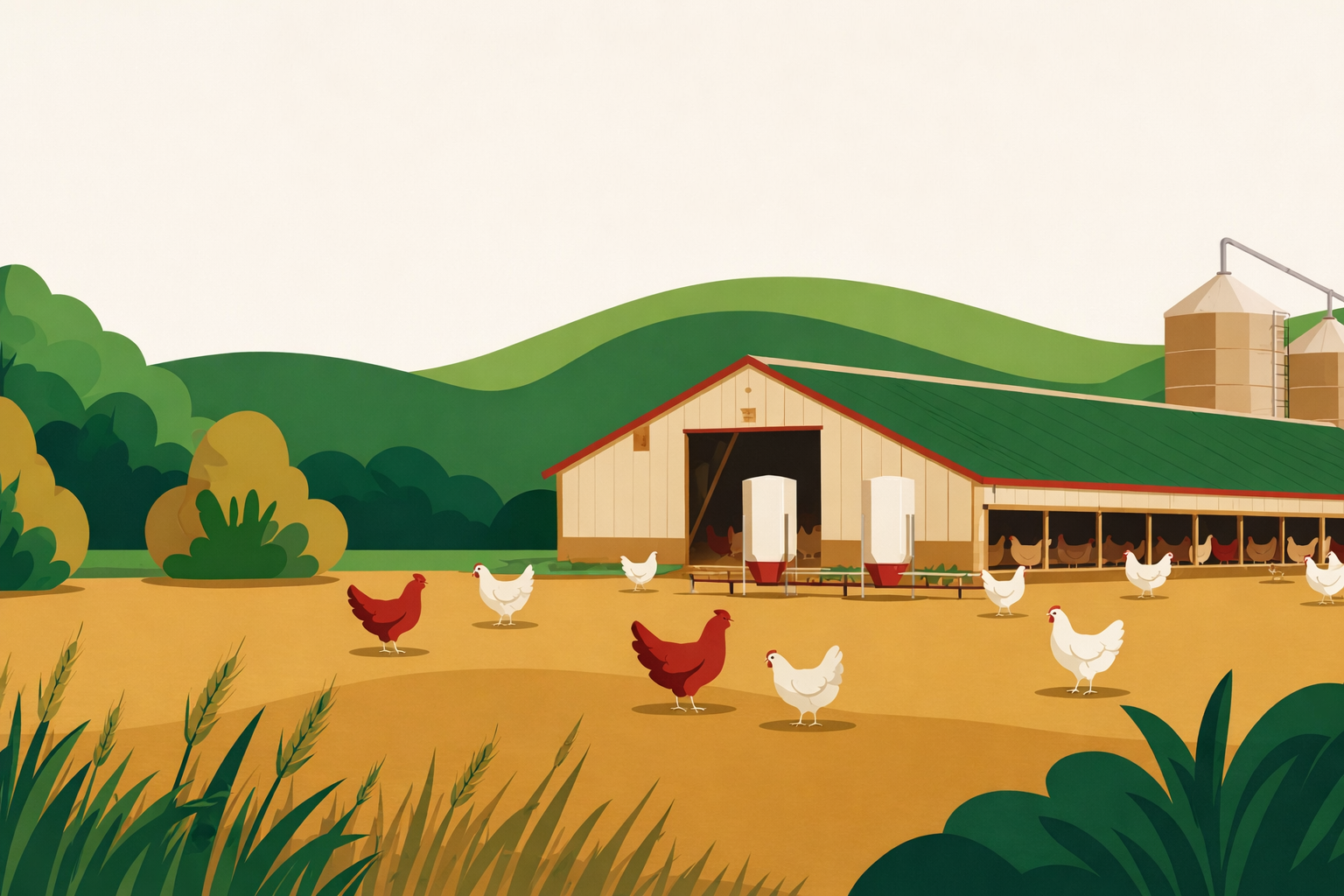
Festive poultry follows the season
Holiday poultry is mainly duck and goose — birds people buy for specific occasions rather than every day. So demand is not even: it is quiet for most of the year, then peaks within a few weeks. Anyone farming for these dates has to think in a calendar — when the sale will be, not when it happens to be convenient to place the birds. This is a completely different approach from a broiler sold all year in a steady cycle.
Three fixed demand peaks a year
The festive poultry season rests on three pillars: goose for St Martin’s Day (11 November), poultry for Christmas and poultry for Easter. Each date has its own species, its own bird size and its own buyer. Goose is most strongly tied to November; duck comes in both for the winter holidays and family occasions. If you are considering this direction, start with the basics — goose farming and duck farming — because the requirements of the two species differ greatly.
The sale date sets the placement date
In festive production the order of thinking is reversed: first you choose when you want the birds ready, and only then count back to when to place them. Goose grows slowly — many weeks pass from chick to a market bird — so geese for St Martin’s are placed back in spring or early summer. Duck grows faster, so it has a shorter run. That is why, before choosing a species, it is worth comparing duck and goose on profitability — they differ in cycle length, feed cost and sale price.
Goose meat also means export
Poland is a large goose producer, and a sizeable part of the goose meat is taken by the German market, where roast goose is a strong holiday tradition. This means demand for goose does not end with local sales — large farmers work under an export contract with a set date and bird weight. Export gives a stable offtake but imposes discipline: the slaughter date, weight and quality must be delivered to the week. Whether that direction adds up is covered in the article on the profitability of goose farming.
The season must be planned, not guessed
Production for the holidays forgives less than continuous farming, because the whole profit depends on hitting a single date. A late or too-light bird is a missed sale, and overproduction after the peak sells at a lower price. So it pays to map the season like a project: placement dates, slaughter dates, a sales plan. DlaFerm.pl helps keep it in one place — you keep a digital Flock Card for each batch, and a printable poultry calendar with the key dates also helps. You can create a farm account for free.
When demand for poultry rises — six occasions
Festive poultry sells on a few fixed dates, and each has its own species and buyer. Here are the six occasions around which the whole season is built — from November goose to local fairs.
St Martin’s Day — goose (11 November)
The most important date for goose. “The best goose is on St Martin’s Day” is a tradition that drives demand every year in the first half of November. This is the moment most goose producers work towards — both locally and for sales of larger batches. Birds for this date must be placed early enough, because goose grows slowly.
Christmas — poultry alongside carp
For the winter holidays poultry reaches the table alongside carp — roast duck, goose and, increasingly, turkey. Demand rises in December, and sales go both locally and through shops. This is the second peak after St Martin’s for duck from duck farming and for goose, if not all of it went to November.
Easter — spring demand
In spring demand returns at Easter — a time for poultry on the festive table and an opening for duck and younger birds. The date is movable (it depends on when Easter falls), so placement planning has to be recalculated each year. For some farms this is the second selling season of the year, closing the calendar after winter.
Goose meat export — the German market
A large share of Polish goose meat goes to export, mainly to Germany, where roast goose is a holiday classic. Export works to contract: a set slaughter date, weight and bird quality. It is a stable offtake for larger flocks, but with a hard discipline of dates — whether the model pays off is covered in the article on the profitability of goose farming.
Turkey and autumn–winter demand
Turkey adds to the autumn–winter season — it is bought for larger family gatherings and holidays. It is a heavier bird with a longer cycle, so here too planning backwards from the date matters. Together with duck and goose it makes a fuller festive offer, which is easier to sell to a single buyer.
Local traditions and fairs
Beyond the big dates, local occasions count: markets, fairs and regional culinary traditions. This is a channel for smaller farms that sell directly — duck and goose from their own rearing. Local sales give a better price per bird but require presence and contact with the customer. It is worth weaving these dates into a yearly poultry calendar.
Preparing the farm for the holidays — six areas
The festive season is won by preparation, not improvisation. Here are six areas to sort out before you place birds for a specific sale date.
Plan placements backwards from the date
The key rule of festive production: start from the sale date and count back to when to place the birds. Goose grows slowly, so for St Martin’s it is placed in spring or early summer; duck has a shorter cycle. A mistake in the date means a bird that is too light or too late. Map the placement and slaughter dates in the digital Flock Card so nothing slips.
Match species and breed to the date
St Martin’s is mainly goose, winter and Easter bring in duck, and turkey is added for heavier occasions. Each species has a different cycle, sale weight and buyer. Before deciding, compare duck and goose on profitability and review the requirements of goose farming and duck farming — they determine the costs and the date.
Slaughter and cooling logistics
In seasonal production all sales pile up in a short window, so slaughter and cooling have to be booked in advance. A slot at the abattoir, transport, the cold chain and storing the carcasses — all of it must be lined up before the peak, not during it. A bottleneck at slaughter can ruin the whole season, even when the birds are ready on time.
Quality and marketing
Festive poultry is bought with the eyes and by brand: a well-finished bird, clear origin and a story about the rearing sell better and for more. It is worth caring about the carcass’s look, the description and customer contact in advance, and arranging regular buyers before the season. A local “our goose” brand can fetch a clearly higher price than anonymous wholesale.
Risk: avian influenza season
The peak in demand for festive poultry falls in autumn and winter — exactly when the risk of highly pathogenic avian influenza (HPAI) rises. An outbreak or a movement-restriction zone just before the sale date is a real threat to the whole season. That is why biosecurity and flock health are especially important here, and it pays to have a plan for a restricted scenario too.
Sales channels: local and RHD/MLO
Decide in advance where you will sell the birds: locally to customers, at a market, to shops or under contract (including export). Small quantities from the farm can go under agricultural retail trade (RHD) or marginal, local and restricted activity (MLO) — the rules differ in scale and duties. The earlier you set the channel, the more certain the price per bird after the season.
Frequently asked questions about holiday poultry
Which poultry is bought most often for the holidays?add
Festive poultry is mainly duck and goose, and increasingly turkey too. Goose is most strongly tied to St Martin’s Day (11 November), duck comes in both for Christmas and Easter, and turkey is added for heavier autumn–winter occasions. Each of these species has a different cycle and buyer, so farms often combine them into one seasonal offer.
When should I place geese to be ready for St Martin’s Day?add
Goose grows slowly, so for a date in the first half of November it is usually placed back in spring or early summer — the exact moment depends on the breed, the feeding method and the target bird weight. It is best to count back from the slaughter date: set when the market bird should be ready and subtract the rearing length. Worth mapping the placement dates in a flock card so the date is not missed.
Why is goose meat so strongly tied to St Martin’s Day?add
It is an established culinary tradition — the saying that the best goose is on St Martin’s Day drives demand every year in the first half of November. For goose farmers it is the most important sale date of the year, around which placements and slaughter are planned. Part of the production goes locally and part to larger, including export, contracts with a set weight and date.
Is there export demand for goose meat?add
Yes. Poland is a large goose producer, and a significant part of the goose meat is taken by the German market, where roast goose is a holiday classic. Export works to contract: a set slaughter date, weight and bird quality. It is a stable offtake for larger flocks, but with a hard discipline of dates — whether the model pays off depends on feed cost, sale price and scale.
How do I prepare the farm for the festive season?add
Start from the sale date and count back to when to place the birds. Match species and breed to the date, book slaughter and cooling in advance, care about quality and marketing, and set the sales channel (local, shops, contract). Remember the avian influenza risk that rises in autumn and winter. The whole season is best mapped like a project — with placement, slaughter and sale dates in one place.
Where can I legally sell festive poultry from the farm?add
Small quantities from the farm can be sold under agricultural retail trade (RHD) or marginal, local and restricted activity (MLO) — two paths that differ in scale and duties. Larger sales or export require registered slaughter and the right permissions. It is worth setting the channel before the season, because the price per bird and the requirements you must meet depend on it; confirm the details with the district veterinary inspectorate.
Sources & resources
Plan the festive season calmly with DlaFerm.pl
Want to hit the demand dates for duck and goose rather than guess? Map the placements, slaughter and sales in the digital Flock Card and run each batch towards a specific date. Create a free farm account and prepare for the season in advance.
Phone
+48 796 258 151