Rabbit farming: where to start, costs and profitability
You start rabbit farming by choosing a direction (meat, fur or wool), then breeds, hutches and a feeding plan. Profit depends mainly on feed prices and buyer prices, which change, so run the numbers with your own figures. This page walks you through every topic in our rabbit section.
verifiedFrom the team that has organised work on poultry farms for years.
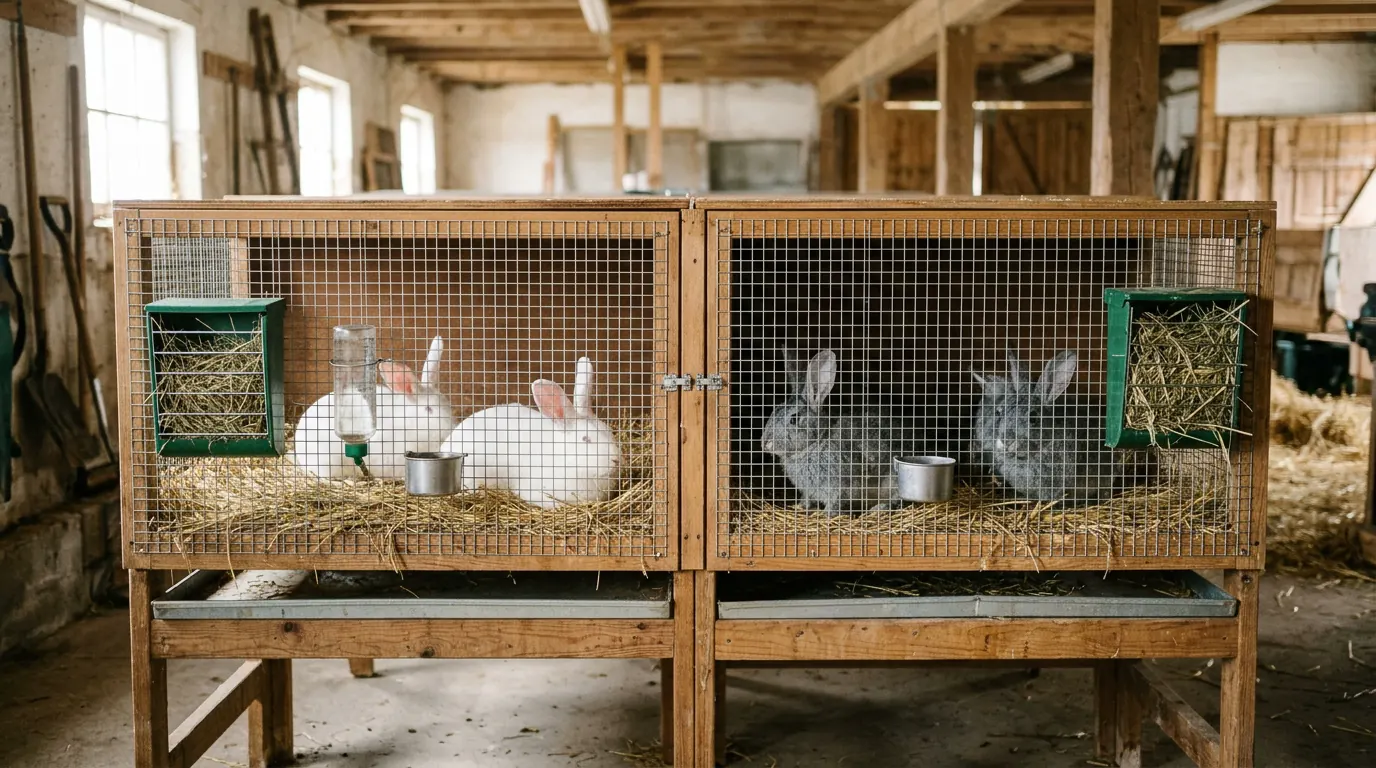
Start by deciding why you want to keep rabbits: for meat, fur, wool or your own table. That choice sets the breed, the type of hutch and the scale. For meat you need meat breeds such as the New Zealand or the Californian. For wool you pick the Angora. Only then do you count costs and profitability.
What you will find in the rabbit section
Below we describe the steps in order: choosing breeds, building hutches, feeding, breeding, diseases, rules and selling meat. Each topic has its own page with details. This page is a map of what to check before you buy your first animals and what to watch in your first year.
Rabbit farming for beginners: where to start
Choose a direction and a scale
Most beginners start with a small breeding herd and learn breeding, feeding and animal observation on it. The guide from IZ PIB (Poland's National Research Institute of Animal Production) for breeders and meat-rabbit producer cooperatives works out the numbers for a farm with 100 breeding does, but to start you can keep just a few does and one buck. The direction you choose affects everything after it: breed, hutch size, feed and how you sell. Write down right away how many animals you want after one year, because that sets the number of hutches and your feed stock.
Prepare the space and hutches
Rabbits need a dry, airy room without drafts, and hutches or pens of the right size. We describe sizes, materials and fittings in our article on hutches and pens for breeding rabbits. Choose drinkers and feeders separately, because round-the-clock access to clean water is the basic rule. For start-up costs, the IZ PIB guide lists breeding stock, hutches and hutch equipment as separate items, and it is worth using the same split in your own plan.
Breeding rabbits: which breed to choose
Meat breeds
For an overview of all directions, read our article on rabbit breeds, and for meat details see meat breeds and growth rate. Popular meat breeds include the New Zealand, Californian, Termond White and Burgundy Fawn. Wiadomości Zootechniczne (a Polish animal science journal, 2011) also describes crosses of the Giant Pied (olbrzym srokacz) with the New Zealand White, kept in pens on litter. Crossbreeding is a common practice in live-weight meat production.
Giants, fur breeds and wool breeds
Large breeds such as the Flemish Giant (olbrzym belgijski), the Giant Pied (olbrzym srokacz) or the French Lop (baran francuski) need bigger hutches and more feed. Meat-and-fur and fur breeds include the Giant Chinchilla (szynszyl wielki) and the Vienna rabbit. For wool, people keep the Angora, which needs regular shearing and grooming. Pick a breed only after you work out how much space and time you can give the herd.
Feeding rabbits
The basics are hay, pellets and constant access to water. We cover amounts and ingredients in our article on feeding rabbits. According to W. Potępka in Wiadomości Zootechniczne (2011), swings in feed prices change the profitability of rabbit meat production: in 2010, after buyer prices went up, farming became more profitable, and later sharp rises in feed prices cut farm profits again. On small farms it pays to compare feed offers, plan purchases and keep records of consumption.
Mating, pregnancy and kindling
We describe timing, animal age and pair selection in our article on mating rabbits. You will find the course of pregnancy and nest preparation in the text on doe pregnancy, and litter care and weaning in the article on kindling and rearing the young. Note the dates of mating, kindling and weaning, and the number of kits per litter. After a few months these records show which does give the best litters and which are worth keeping in the herd.
Rabbit diseases and vaccination
For a general overview of symptoms and prevention, see our article on rabbit diseases. Two viral diseases need special attention: rabbit hemorrhagic disease (RHD) and myxomatosis. Among parasitic and bacterial diseases, coccidiosis and pasteurellosis (including snuffles) are common. A vet always chooses the medicine and dose, and after treatment a withdrawal period applies, so record every treatment.
Costs and profitability of rabbit farming
The IZ PIB guide splits the calculation into assumptions and production results, value of final production, costs of live-weight production, cost of 1 kg of live weight and a profitability index. Use the same split on your farm. Buyer and feed prices change, so check current rates with buyers and feed suppliers. Remember that costs are not only feed: hutches, equipment, vaccinations, litter, electricity and your own time all count.
Meat, sales and regulations
Rules on slaughter, selling carcasses and dealing with buyers are covered in our material on rabbit meat. We have collected the requirements on registration, welfare and sales in our guide to regulations for rabbit farms; check the legal state as of 23.11.2026 in ISAP (Poland's online database of legal acts, Internetowy System Aktów Prawnych) and with the county veterinary inspectorate (powiatowy inspektorat weterynarii). Consumption data are estimates: according to Kowalska et al. (2016) it was 1.2 kg per person in 2015, and according to Kmiecik et al. (2016) 0.9 kg. The authors note that exact figures are hard to set because many hobby keepers raise rabbits only for their own use.
Frequently asked questions
How do I start rabbit farming?add
Start by choosing a direction (meat, fur or wool) and a breed. Then prepare a dry room, hutches, drinkers and feeders, and buy animals last. A few does and one buck are enough to begin.
Is rabbit farming profitable?add
It depends on feed prices and buyer prices, which change. According to IZ PIB, profitability rose after buyer prices went up and fell after feed prices rose. Work out your own cost per 1 kg of live weight and compare it with the current buyer price.
What is the best rabbit breed for meat?add
For meat, people most often choose breeds such as the New Zealand, Californian, Termond White and Burgundy Fawn. The choice depends on your conditions and scale. You can compare breeds in our article on meat rabbit breeds.
What hutches do you need for rabbit farming?add
Hutches must be dry, ventilated and sized for the breed and category of animal. Large breeds need more space. We describe sizes and materials in a separate article on hutches.
What do you vaccinate rabbits against?add
The basic vaccinations cover rabbit hemorrhagic disease (RHD) and myxomatosis. Agree the dates and schedule with a vet, who will choose the vaccine for the situation in your area.
Do you need to register to keep rabbits for meat in Poland?add
Requirements depend on scale and how you sell. Check current rules in ISAP and with the county veterinary inspectorate. We give an overview in our article on regulations for rabbit farms.
Sources & resources
- linkIZ PIB — Rabbit meat production technology under raised animal welfare standards. Guide for breeders and members of meat-rabbit producer cooperatives (ed. Z. Kryński)
- linkIZ PIB — Wiadomości Zootechniczne — Problems and options in feeding rabbits on small farms (W. Potępka), WZ XLIX(2011)2:37–42
- linkIZ PIB — Wiadomości Zootechniczne — The rabbit: economic importance, choice of breeds and lines for meat production (J. Składanowska-Baryza), WZ LV(2017)3:13–23
- linkWODR Poznań — Rabbit keeping: basic rules and housing conditions
- linkInternetowy System Aktów Prawnych (Poland's online database of legal acts) — isap.sejm.gov.pl
Prepared by: DlaFerm Team based on data from the sources listed · Publisher: INSTA-TECH sp. z o.o.
Look after biosecurity on your rabbit farm
The biosecurity plan generator in DlaFerm helps you write down farm entry and hygiene rules, and the treatment and withdrawal period module keeps your treatment records in order. Create a free farm account or get in touch, and we will show you how to use it with your herd.
Phone
+48 796 258 151