Veterinary Inspection: what it checks on your farm and how to prepare
Poland's Veterinary Inspection (Inspekcja Weterynaryjna) checks that your farm meets requirements for animal health, hygiene, identification and treatment records. Veterinarians under the Chief Veterinary Officer (Główny Lekarz Weterynarii) carry out the checks. Below we describe what is usually inspected and how to put your documents in order before a visit.
verifiedFrom the team that has organised work on poultry farms for years.
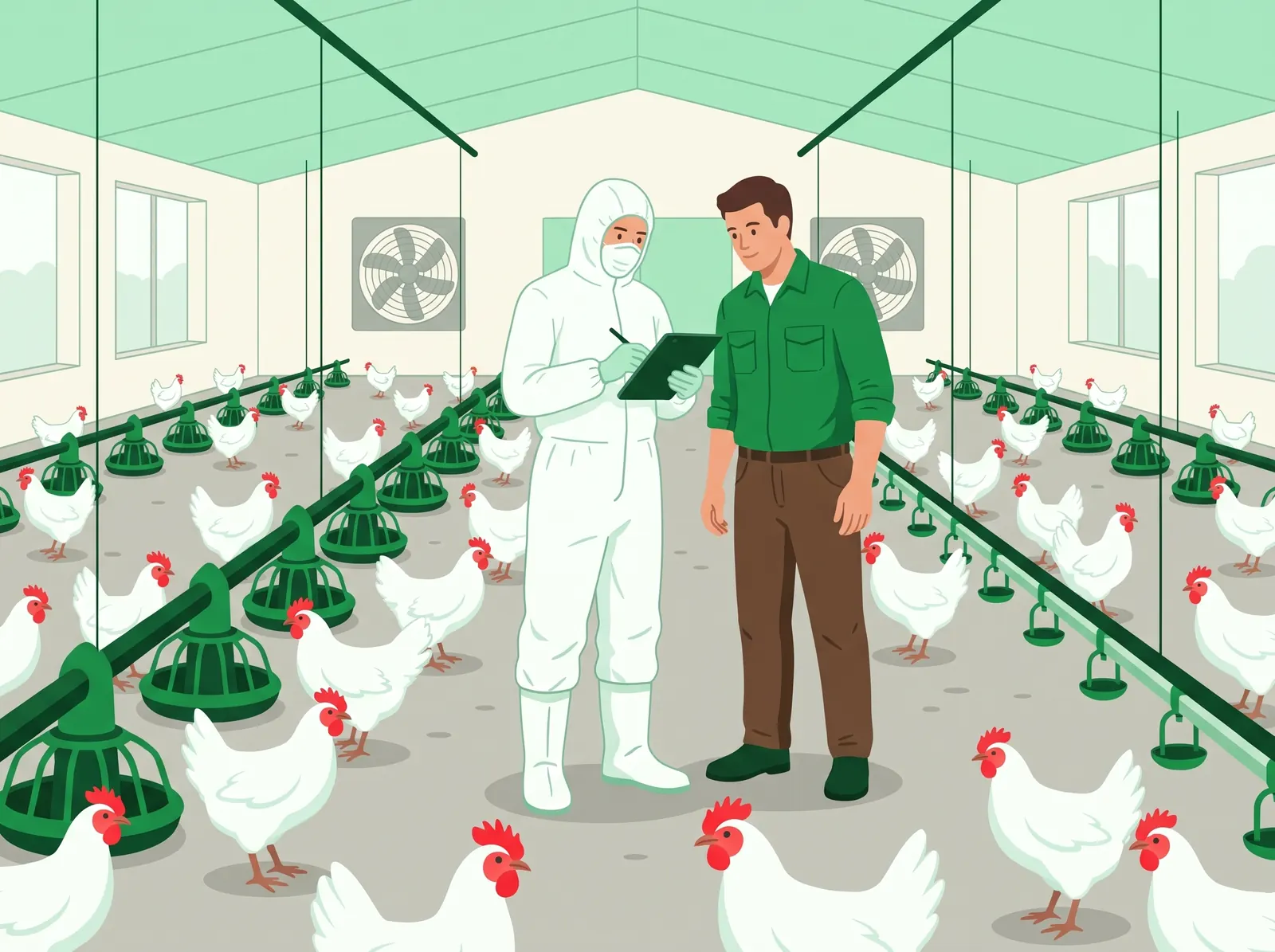
The Veterinary Inspection checks that your poultry farm produces in line with the rules on animal health, hygiene, welfare and flock identification. On the farm this usually means looking at where the birds are kept, treatment records, transport documents and biosecurity rules. The supervising authority is the Chief Veterinary Officer, and the office is the Chief Veterinary Inspectorate (Główny Inspektorat Weterynarii, GIW). The inspection's powers come from the Act on the Veterinary Inspection. We describe the legal state as of 22.11.2026.
Why this matters for you
The inspector looks not only at production results but mostly at whether the rules are applied day to day. The most common problems on farms are missing current records, incomplete medicine documentation and no clear division into zones. Records kept well all year can shorten the inspection and reduce the number of follow-up recommendations. Treat the inspection as a moment to show the order you already have, not a one-off preparation for a visit.
Who inspects and on what basis
Oversight structure
Veterinary oversight has several levels. At the center is the Chief Veterinary Officer, who heads the GIW. Under the Salmonella control programs published in Poland's Journal of Laws, there are 16 provincial veterinary officers and 305 county veterinary officers. The county veterinary officer and the team are the ones who actually visit your farm. The local inspector usually checks where birds are kept, records and documents, and passes up matters that need a decision. If you do not know who covers your county, ask the county office or check the GIW website.
Legal basis
The scope of inspections is set by the Act on the Veterinary Inspection and by implementing rules on animal health, production hygiene and identification. Rules change, so before an inspection check the current wording in ISAP, Poland's online legal database (Internetowy System Aktów Prawnych). This article describes the legal state as of 22.11.2026 and does not replace reading the act. If a requirement is unclear, ask the veterinarian who looks after your flock. He or she can tell you how to apply it on your farm. You can also browse the list of acts and regulations for poultry keepers.
What the inspector checks on your farm
Documents and identification
The first thing the inspector asks for is documents: the farm's veterinary number, stocking records, data on where chicks came from and records of bird movements. Keep them in one place, preferably in digital form, with entry dates. You keep flock records in the house records module, and you can check how to get your farm number in veterinary number registration. One missing document usually does not end an inspection, but an incomplete set makes it longer and brings more questions.
Hygiene and biosecurity
The inspector checks whether the farm has set zones and whether people and vehicles carry infections between them. In practice this means the crossings between the clean and dirty zone, footwear and work clothing, disinfection at the entrance, and protection against wild birds and pests. EFSA, the European Food Safety Authority, among others, describes rules for monitoring zoonotic agents. Agree the details with your veterinarian, because solutions depend on your buildings and farm layout.
Welfare and flock condition
The inspection also covers housing conditions: access to feed and water, ventilation, litter condition, stocking density and visible signs of disease. The inspector may enter the house, look at the birds and talk to staff. It helps to have records of ventilation and flock observations during the cycle. If you notice a problem before the inspection, report it to your veterinarian and describe what you did. That is a better position than hiding the problem.
Treatment records and withdrawal periods
What you need to record
Every medicine administration should have an entry: date, product name, batch number, dose, route, number of birds, the person who treated them, and the veterinarian's prescription details. The veterinarian always chooses the medicine and dose. We only describe how to keep the records. You keep treatment records in the treatment and withdrawal module, so entries are in one place and easy to find.
Withdrawal periods in records
The withdrawal period is the time from the last administration of a medicine until the birds or products from them can go to slaughter or sale. The length is given in the product leaflet and the veterinarian's prescription, so do not write it from memory. The record should show the withdrawal end date calculated for the specific flock. The inspector usually compares the administration date with the slaughter or shipping date, so any mismatch shows right away.
Veterinary number and registration
Veterinary number
A poultry farm should be registered and have a veterinary number that identifies it in oversight systems. The application goes to the office responsible for the farm's location. ARiMR (Poland's Agency for Restructuring and Modernisation of Agriculture) guidance says bodies under Veterinary Inspection supervision must hold a Veterinary Identification Number (WNI), which the Veterinary Inspection issues on request to the county veterinary officer. Before an inspection, make sure the number is on your flock documents and matches the register. We explain it step by step in the article on the veterinary identification number application.
Data in ARiMR systems
Farm documents are also needed in ARiMR systems. According to ARiMR, poultry establishments can report their activity only electronically in IRZplus, ARiMR's online animal register. Differences between the register and an application can raise questions during an inspection. Before you log in to the e-Wniosek (online application), check that your farm data is current. We explain how in the guide ARiMR e-Wniosek: how to log in.
How to prepare your farm for an inspection
Before the visit
Go through your flock documents and check that entries are complete and legible. Keep the zones tidy, especially at building entrances, and check that disinfection works. If you have a biosecurity plan, have a printable copy ready. You can build one in the biosecurity plan generator. Also prepare the farm's entry and exit log so you can quickly show who was on site and when. See also the list of documents to prepare for a veterinary inspection.
During the inspection
Choose one person to walk with the inspector who has access to documents. Agree in advance who signs the inspection report and who answers questions about treatment and feeding. Write down roles on the farm so it is clear who has access to which data. Answer to the point and do not guess. If you do not know the answer, say you will check and come back with the data.
After the inspection
The report contains findings and any recommendations with deadlines. Read it carefully and put the deadlines in the farm calendar. If a recommendation is unclear, ask the inspector how to carry it out before you start work. Keep a copy of the report together with proof the recommendations were done, such as photos of repairs and log entries. At the next visit the inspector may check whether earlier comments were addressed.
Frequently asked questions
Who carries out a veterinary inspection on a poultry farm?add
Veterinarians and inspectors of the Veterinary Inspection do it, supervised by the Chief Veterinary Officer. At county level it is usually the county veterinary officer with a team. You can find the office that covers you on the Chief Veterinary Inspectorate website.
Can the veterinary inspection arrive without notice?add
Notice rules depend on the type of inspection and the rules that govern it. We do not give specific requirements here because they can change. The surest way is to check the current legal act or ask the veterinarian who looks after your flock. Keep your documents up to date either way.
What documents should I have ready for an inspection?add
The most important are the farm's identification documents, records of stocking and bird origin, treatment records with withdrawal dates, and your biosecurity plan. Disinfection entries and mortality records are also useful. Adjust the set to your type of production and your veterinarian's requirements.
Do I have to keep treatment records?add
Records of medicines given and withdrawal periods are among the most frequently checked items. Describe each administration with date, medicine, batch number, dose and the person who gave it. The veterinarian sets the medicine and dose, so agree your records with him or her.
How do I prepare my farm for a biosecurity inspection?add
Check zones, crossings, entrance disinfection and protection against wild birds. Prepare your biosecurity plan and the record of entries to the farm. Agree with your veterinarian which elements are required in your case.
Where can I check the current rules?add
Current legal acts are in ISAP, Poland's online legal database. Announcements and guidance are published by the Chief Veterinary Inspectorate and the Ministry of Agriculture and Rural Development. This article describes the legal state as of 22.11.2026, so before an inspection check whether anything has changed since.
Sources & resources
- linkChief Veterinary Inspectorate: gov.pl/web/wetgiw
- linkARiMR: gov.pl/web/arimr
- linkMinistry of Agriculture and Rural Development: gov.pl/web/rolnictwo
- linkEFSA: efsa.europa.eu
- linkInternet System of Legal Acts (ISAP): isap.sejm.gov.pl
Prepared by: DlaFerm Team based on data from the sources listed · Publisher: INSTA-TECH sp. z o.o.
Want your farm documents at hand before an inspection?
The QR entry and exit log module and treatment records keep entries in one place, and the farm management program links them with the rest of your documentation. Create a free farm account and see how it looks on your farm.
Phone
+48 796 258 151