Directive 2008/120/EC on pig welfare: pen space, group-housed sows, tails
Council Directive 2008/120/EC sets minimum standards for the protection of pigs and is in force as of 23.11.2026. We cover floor space, group housing for sows, rules on tails and weaning piglets. Each requirement comes with its article or annex number.
verifiedFrom the team that has organised work on poultry farms for years.
Updated:
Legal status as of 23 November 2026. Council Directive 2008/120/EC of 18 December 2008 laying down minimum standards for the protection of pigs (codified version, CELEX 32008L0120) applies to anyone who keeps pigs. The act is in force and has applied since 10.03.2009. We describe the consolidated text of 14.12.2019.
What this summary is based on
We work from the Polish text of the directive on EUR-Lex, the EU's official law portal. The table of dates is in the section "Amendments and deadlines". General rules for all species are on our page about Directive 98/58/EC. For the full list of EU acts, see EU regulations for farmers.
Who it applies to
The directive covers the keeping of pigs: boars, sows and gilts, piglets, weaners and rearing pigs. Annex I contains the general rules, and its Chapter II contains specific rules for each category of pig. Article 4 requires member states to make sure husbandry conditions comply with Annex I. There is one exception for small sow herds: the first subparagraph of Article 3(4) does not apply to holdings with fewer than 10 sows (Article 3(9)). Do you keep pigs only for yourself? See Can you keep pigs for your own use in Poland. We also collect the rules for pig keepers in Rules and documents for pig keepers.
What it requires
Article 3(1)(a): floor space for rearing and fattening pigs
For each rearing or fattening pig kept in a group, the directive sets a minimum unobstructed floor area by body weight. Under Article 3(1)(a) it is: up to 10 kg, 0.15 m²; over 10 and up to 20 kg, 0.20 m²; over 20 and up to 30 kg, 0.30 m²; over 30 and up to 50 kg, 0.40 m²; over 50 and up to 85 kg, 0.55 m²; over 85 and up to 110 kg, 0.65 m²; over 110 kg, 1.00 m². You can use these figures to work out the minimum pen area for a finishing pig. Our pig pen stocking calculator helps with that. The weight units in the table come from the context of the provision, because the text passage had no column heading.
Article 3(1)(b) and (2): space for sows and gilts in groups
The total unobstructed floor area for each gilt after service is at least 1.64 m², and for each sow 2.25 m² (Article 3(1)(b)). In groups of fewer than six animals, you increase the area by 10%. In groups of 40 or more, you may reduce it by 10%. Under Article 3(2)(a), at least 0.95 m² per gilt and 1.3 m² per sow must be solid floor, and no more than 15% of that may be set aside for drainage openings.
Article 3(4): sows in groups
You keep sows and gilts in groups from four weeks after service to one week before the expected farrowing (Article 3(4)). The group pen has sides longer than 2.8 m, or longer than 2.4 m for a group of fewer than six animals. Holdings with fewer than 10 sows may keep them individually during this period, if the animals can turn around easily in the pen. Article 3(3) bans tethering sows and gilts and building such housing, and tethers have not been allowed since 1.01.2006.
Annex I, Chapter I, point 8 and Chapter I: tails and teeth
Procedures for purposes other than therapeutic or diagnostic ones are banned, with exceptions. One is docking part of the tail, another is uniform tooth reduction in piglets by grinding or clipping, no later than the seventh day of life (Annex I, Chapter I, point 8). You do not dock tails or reduce teeth routinely. You may do so only when there is evidence of injuries to sows' udders, or to other pigs' ears or tails. Before that, you must take other measures to prevent tail biting, looking at the environment and stocking density, and change inappropriate conditions or management systems. A veterinarian or a trained person carries out the procedure (Article 6). After the seventh day of life, tail docking requires anesthesia and additional prolonged analgesia given by a veterinarian. We describe the causes of the problem in Tail biting in pigs.
Annex I, Chapter I, points 2 to 7: conditions in the pig house
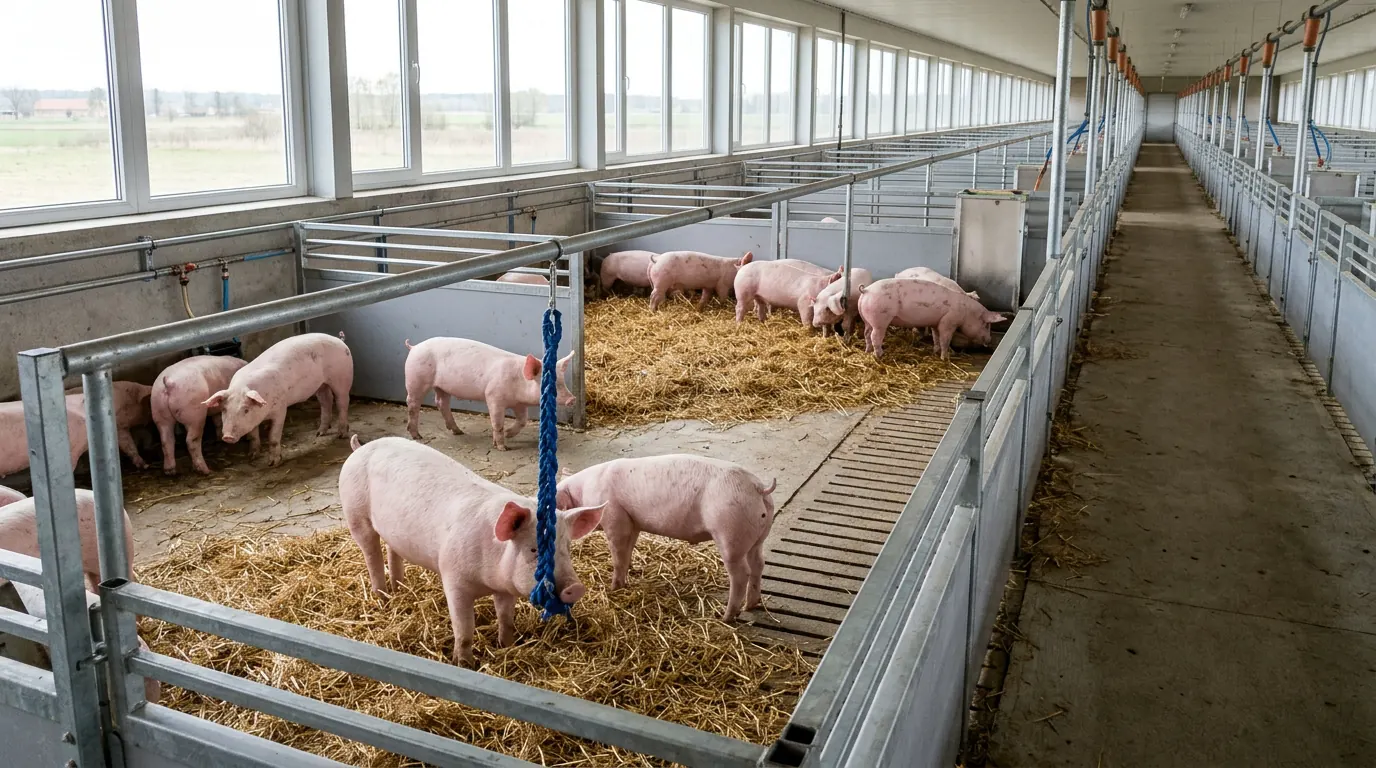
You keep pigs in buildings with light of at least 40 lux for eight hours a day (point 2). Every pig must have a clean lying area where all the animals can lie at the same time (point 3). Permanent access to rooting material such as straw, hay, wood, sawdust or peat is mandatory (point 4). Floors are smooth but not slippery (point 5). You feed pigs at least once a day, and when they are fed in groups without free access to feed, each pig has access to feed at the same time (point 6). Pigs over two weeks of age have permanent access to fresh water (point 7).
Farrowing and weaning
Annex I, Chapter II, parts B and C: sows before farrowing
In the week before the expected farrowing, sows and gilts get enough nesting material, as long as the slurry system allows it (Chapter II, part B, point 3). Behind the sow there must be free space to ease the birth (point 4). Pens with loose sows must have protection for piglets, such as bars (point 5). Pregnant sows put in stalls must be thoroughly cleaned of parasites (point 2). This answers questions about farrowing pen rules: the directive sets general requirements and gives no numerical dimensions for the farrowing pen.
Article 3(7) and Chapter II, part C: weaning
You must not wean piglets from the sow before 28 days, unless the welfare or health of the sow or piglets is at risk (Chapter II, part C, point 3). Piglets may be weaned up to seven days earlier if they go to specialized housing, emptied, cleaned and disinfected before a new group arrives and kept separate from the sow housing. Pregnant dry sows get a large amount of bulky or high-fiber feed, plus high-energy feed, to satisfy hunger and the need to chew (Article 3(7)).
When it applies
According to EUR-Lex, the directive entered into force and has applied since 10.03.2009, and it is in force as of 23.11.2026. Article 3(9) splits the deadlines for the space and pen requirements: for holdings newly built, rebuilt or first brought into use after 1.01.2003, the provisions of Article 3(1)(b), (2), (4), (5) and the last sentence of paragraph 8 applied immediately, and since 1.01.2013 they apply to all holdings. Tethers for sows and gilts have been banned since 1.01.2006 (Article 3(3)).
Amendments and deadlines
As of 23.11.2026, there are no European Commission proposals amending this directive.
| Date | What happens | Basis |
|---|---|---|
| 1.01.2003 | Deadline for transposing Directive 2001/88/EC into national law; start of the requirements for new and rebuilt holdings | Annex II, part B; Article 3(9) |
| 1.01.2006 | Ban on tethering sows and gilts | Article 3(3) |
| 18.12.2008 | Date of the directive | EUR-Lex |
| 10.03.2009 | Entry into force and application | EUR-Lex |
| 1.01.2013 | Requirements of Article 3(1)(b), (2), (4), (5) and the last sentence of (8) apply to all holdings | Article 3(9) |
| 15.03.2017 | Amendment by Regulation (EU) 2017/625 on official controls | EUR-Lex |
| 14.12.2019 | Date of the consolidated text | EUR-Lex |
How it works in Poland
Poland implements the directive through the regulation of the Minister of Agriculture and Rural Development (MRiRW) of 15.02.2010 on the requirements and procedures for keeping farm animal species covered by EU protection standards (Dz.U. 2010 nr 56 poz. 344, Poland's Journal of Laws), in force from 30.06.2010, and through the Animal Protection Act. The regulation gives minimum areas, lighting, ventilation, feeding and watering. An amendment, Dz.U. 2024 poz. 1919, applies from 1.01.2026 and adds other hens, with no changes for pigs.
Violations can bring detention or a fine (Animal Protection Act, Article 37), and non-compliance also breaches cross-compliance for subsidies. We describe the details on Subsidies and farmer obligations. Inspections are carried out by the Veterinary Inspection (Inspekcja Weterynaryjna), and information is provided by the Chief Veterinary Inspectorate (Główny Inspektorat Weterynarii).
This summary condenses the text of the act and is not legal advice. In a specific case, the text published in the Official Journal of the EU and Polish law decide, and the county veterinary officer (powiatowy lekarz weterynarii) or another competent authority can explain them.
What to do on the farm
The steps follow directly from the requirements above. First, measure the pens and compare the area per animal with the table in Article 3(1)(a) and the sow values in Article 3(1)(b). Second, check that sows are in groups from the fourth week after service to one week before farrowing, and that pen sides have the required lengths (Article 3(4)). Third, provide permanent access to straw or other rooting material (Annex I, Chapter I, point 4). Fourth, before any tail docking, write down the evidence of injuries and the measures you took beforehand. Fifth, do not wean piglets before day 28 without justification. You can work out farrowing dates with the sow farrowing date calculator.
Frequently asked questions
When did Directive 2008/120/EC come into force?add
It entered into force and has applied since 10.03.2009. The requirements of Article 3(1)(b), (2), (4), (5) and the last sentence of (8) have covered all holdings since 1.01.2013 (Article 3(9)).
What is the minimum pen space for a finishing pig?add
It depends on weight: over 85 and up to 110 kg is 0.65 m² per pig, and over 110 kg is 1.00 m² (Article 3(1)(a)). The full values are in the section "What it requires".
Is routine tail docking allowed in pigs?add
No. Tail docking is allowed only when there is evidence of injuries, and after other measures against tail biting have been taken (Annex I, Chapter I). After the seventh day of life, it requires anesthesia given by a veterinarian.
Do sows have to be kept in groups?add
Yes, from four weeks after service to one week before the expected farrowing (Article 3(4)). Holdings with fewer than 10 sows may keep them individually if the animals can turn around easily.
At what age can piglets be weaned?add
Not before 28 days, unless the welfare or health of the sow or piglets is at risk. Weaning up to seven days earlier is allowed when piglets go to separate, cleaned and disinfected housing (Chapter II, part C, point 3).
Which Polish law implements the directive?add
The MRiRW regulation of 15.02.2010 (Dz.U. 2010 nr 56 poz. 344) and the Animal Protection Act. Violations can bring detention or a fine (Article 37 of the Act) and a breach of cross-compliance for subsidies.
Sources & resources
- linkEU Publications Office (EUR-Lex): Council Directive 2008/120/EC of 18 December 2008 laying down minimum standards for the protection of pigs (codified version)
- linkMRiRW regulation of 15.02.2010 on the requirements and procedures for keeping farm animal species covered by EU protection standards (calves, pigs, laying hens, broilers, other hens from 2026) (Dz.U. 2010 nr 56 poz. 344)
- linkChief Veterinary Inspectorate (Główny Inspektorat Weterynarii): gov.pl/web/wetgiw
- linkARiMR (Agency for Restructuring and Modernisation of Agriculture): gov.pl/web/arimr
Prepared by: DlaFerm Team based on data from the sources listed · Publisher: INSTA-TECH sp. z o.o.
Record procedures and treatments in the Treatment and withdrawal module
The <a href="/ewidencja-leczenia-i-karencja-lekow">Treatment and withdrawal</a> module helps you keep animal treatment records in one place. You can also use the <a href="/generator-planu-bioasekuracji">biosecurity plan generator</a>. Create a free farm account in DlaFerm or get in touch.
Phone
+48 796 258 151