Dead animals on the farm: reporting, collection, commercial document
You move dead poultry to a container at least once a day, and you report mortality in IRZplus (ARiMR's online animal register) as a weekly total. You hand carcasses to a rendering plant with a commercial document. Burying or burning carcasses on the farm is banned. We describe each duty with its deadline and the status of the rules as of 22.11.2026.
verifiedFrom the team that has organised work on poultry farms for years.
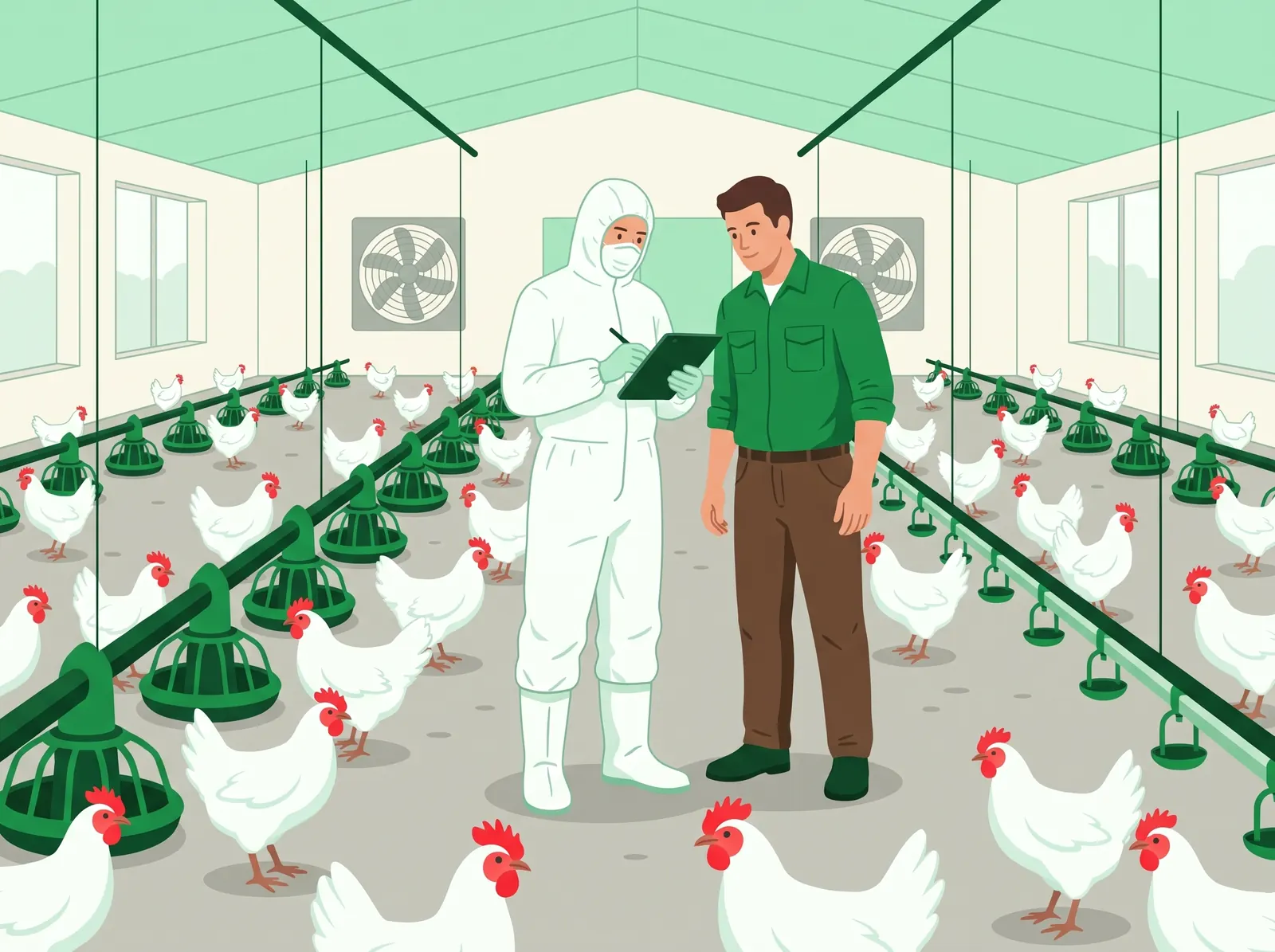
On a poultry farm, dead birds come with four duties: daily removal to a container, a weekly mortality report in IRZplus, a report on handing carcasses to a rendering plant, and a commercial document at collection. You do not bury or burn carcasses on the farm. We also cover collection and waste types in our article on disposal of dead animals.
Why your mortality records must match
Your mortality log is the starting point for every report. From it you take the date, the number of birds and the cause, and then the weekly total. If you keep the log on paper, the numbers reported to the database can drift from what actually went into the container. Record deaths on the day you spot them, and at the end of each week compare your totals with the collections.
Container and daily removal of dead poultry
Container by the poultry house
Dead animals go to a container or a separate room. Transport equipment should work separately for the clean and dirty parts of the building. In the dirty part you set aside a place for taking samples for tests and veterinary post-mortems, easy to wash and disinfect. This layout comes from the base document of the GIW (Poland's Chief Veterinary Inspectorate) on farm biosecurity. Dead poultry goes to the container at least once a day.
Daily log entries
Each day you write down the date of death, the number of birds and the cause, if you know it. The duty to keep a log of deaths and collections comes from Dz.U. 2026 poz. 335 (Poland's Journal of Laws) § 3 ust. 3 pkt 4, 7–8 and from Regulation 2016/429 art. 102 ust. 1 lit. d. You keep the log for 3 years. Make entries right after you collect the birds, not at the end of the week. For removing all litter, see removing litter from the poultry house.
Weekly report of poultry deaths
What you report and when
The report to the computer database covers deaths and other losses of birds, except killing ordered by the county veterinary officer. You give the total number of birds lost from the poultry establishment during the week. The basis is the act on the animal identification and registration system, art. 44 ust. 2, and Dz.U. 2026 poz. 1076 § 23. The deadline is 7 days. We could not confirm whether it runs from the end of the week, so check this with ARiMR (Agency for Restructuring and Modernisation of Agriculture) before your first report.
How to put the week together
Add up the log entries for seven days and compare the result with the flock count. Art. 44 ust. 1 of the act also requires you to report increases or decreases in the number of birds on the establishment, so one record should cover all losses and additions. You keep flock numbers in the digital flock record, and we describe the link to the database in integrations with IRZplus and sensors.
Reporting the handover of carcasses for disposal (2026)
What the report contains
The report on handing carcasses of birds or hatching eggs to a rendering plant contains the plant's name, the period of the deaths and the handover date. The basis is Dz.U. 2026 poz. 162 (§ 23a), consolidated text Dz.U. 2026 poz. 1076. The report is paired with the weekly mortality reports, so the total of carcasses handed over in a period should match the total of deaths reported. Have the same data in your log before the collection truck arrives.
Deadline and conflicting dates
For poultry, two dates appear: the rule in force from 18.03.2026, and 18.06.2026, given by ARiMR as the start of the duty for poultry. The reporting deadline is 7 days. With such a gap, do not take one date on trust. Before your first handover, ask ARiMR or the county veterinary officer from when the report applies, and write the answer in your log.
Commercial document at collection
When dead animals are collected, the rendering plant's carrier issues a commercial document in the national format from Dz.U. 2026 poz. 280. The regulation of 3.03.2026 applies from 18.03.2026. The document shows the number and weight of carcasses, and you keep a copy. Regulation (EC) No 1069/2009 requires such a document to accompany the collection. A retention period of at least 2 years is not confirmed at the moment, so keep copies longer until you have checked.
Cattle: notifying the county veterinary officer of a death
Notice to the county veterinary officer
From 18.03.2026, every death of cattle, a sheep or a goat must be reported without delay to the county veterinary officer, in addition to the IRZplus report. The basis is the animal health act, art. 10 ust. 1 pkt 3. The rule names only cattle, sheep and goats, so poultry is not covered by this report. A farm with mixed species keeps reports for each species separately.
Cattle carcasses in IRZplus
In the ARiMR brochure, reporting the disposal of cattle and sheep carcasses appears next to the death report as a separate item. We do not have the full wording of the rule with deadlines for these species, so check them in the ARiMR brochure on the new IRZ act, updated 06.03.2025. If the same worker files cattle and poultry reports, keep separate lists so species do not get mixed up.
Ban on burying and burning carcasses on the farm
Why you may not bury them
Regulation (EC) No 1069/2009 requires dead animals to go to a rendering plant. You may not bury or burn carcasses on the farm. Dead animals are category 2 material, and they are collected with a commercial document. You are liable for breaches under the animal health act. If deaths are higher than usual, tell the veterinary officer, who decides on further steps and any testing.
Storage until collection
Until collection, carcasses stay in a closed container or room in the dirty part, away from the rooms where birds are kept. You disinfect the spot after each pickup. At handover, write the date and document number in your log. If collection is delayed, do not take carcasses to a field or forest. Tell the rendering plant and the vet. A sudden rise in deaths is also a cue for early detection of poultry diseases.
Frequently asked questions
Can I bury dead birds on my own land?add
No. Regulation (EC) No 1069/2009 does not allow burying or burning carcasses on the farm. You hand carcasses to a rendering plant, and the commercial document confirms the collection.
How often should I remove dead poultry from the house?add
Dead poultry goes to the container at least once a day. Enter deaths in the log on the day you spot them, with the date, number of birds and cause, if you know it.
When do I report poultry deaths in IRZplus?add
Deaths are reported as a total number of birds for the week, under art. 44 ust. 2 of the act on the animal identification and registration system. Check with ARiMR when the 7-day deadline starts to run.
Do I have to report cattle deaths to the veterinary officer?add
Yes. From 18.03.2026 every death of cattle, a sheep or a goat is reported without delay to the county veterinary officer, in addition to the IRZplus report. This duty does not apply to poultry.
What must a commercial document for fallen stock contain?add
The rendering plant's carrier issues it in the national format from Dz.U. 2026 poz. 280. It shows the number and weight of carcasses, and you keep a copy. Check how long to keep it, as the period is not confirmed.
What penalties apply for not reporting a death?add
Penalties come from the animal health act. For breaches involving cattle, sheep and goats, the rule sets 0.3–6 times the average salary (art. 98 ust. 1 pkt 8). The authority running the case sets the amount and procedure.
Sources & resources
- linkARiMR — Information brochure on the new IRZ act (updated 06.03.2025)
- linkSejm RP / Journal of Laws — Act of 4.11.2022 on the animal identification and registration system, consolidated text (Dz.U. 2026 poz. 591)
- linkGIW — Base document: farm biosecurity rules (exemption from testing), v. 5.0
- linkChief Veterinary Inspectorate — gov.pl/web/wetgiw
- linkInternet System of Legal Acts — isap.sejm.gov.pl
Prepared by: DlaFerm Team based on data from the sources listed · Publisher: INSTA-TECH sp. z o.o.
Do you keep mortality records in several places?
The DlaFerm.pl <a href="/program-do-zarzadzania-ferma-drobiu">farm management software</a> helps you keep flock records and poultry reports in one place. Create a free DlaFerm.pl farm account or get in touch, and we will show you how it looks on your farm.
Phone
+48 796 258 151