Hear coughing in the poultry house before birds die: microphone and flock data
Sneezing, rales and a change in the tone of the flock are signs of respiratory disease. But you spend little time in the house, and fans drown out the birds. We bring house data and mortality together in one place, and we are researching and rolling out a microphone as a trend indicator. We build on studies that showed when sound really tells you about flock health.
verifiedFrom the team that has organised work on poultry farms for years.
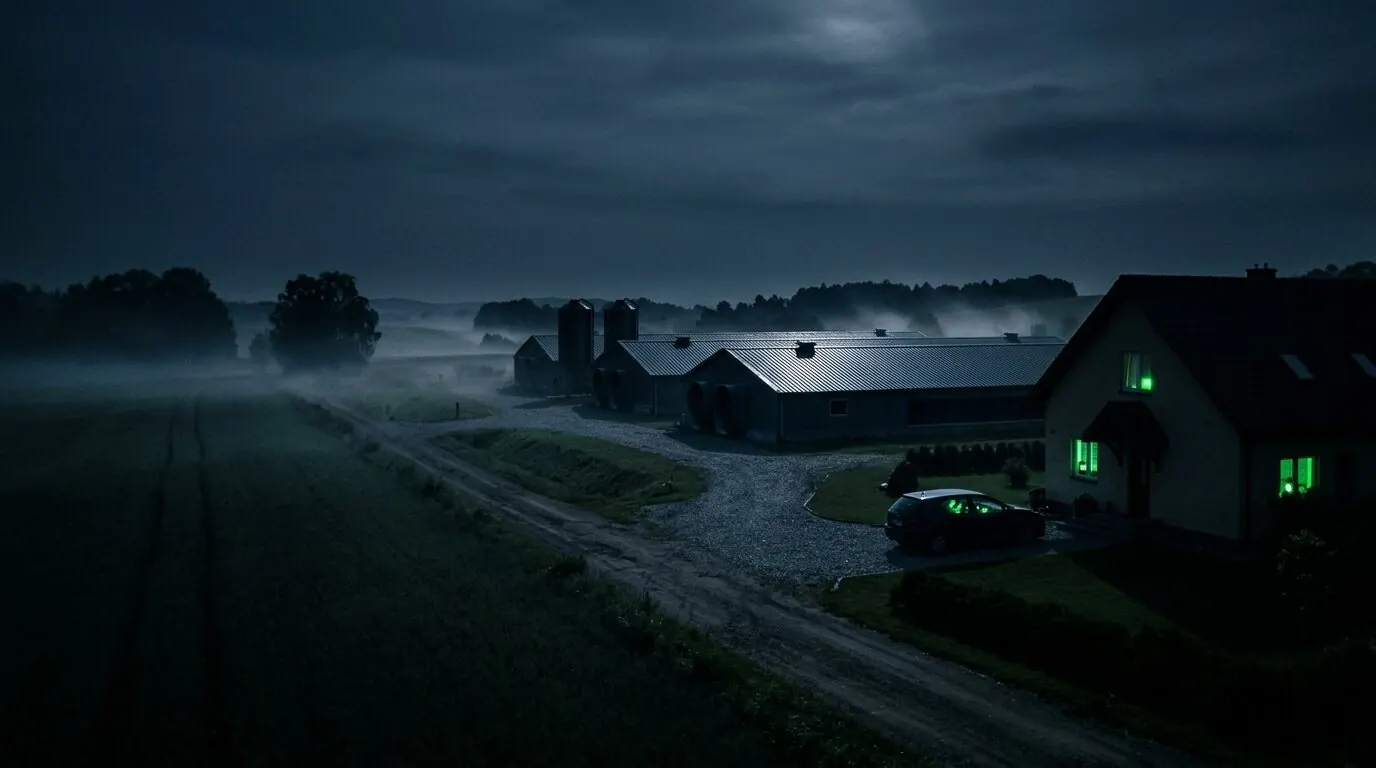
You can hear respiratory disease before you see it
Sneezing, rales and a change in the tone of the flock's voices are signals farmers have always reacted to. The problem is that you are in the house only briefly, and the noise of fans and feeders drowns out the birds. At night nobody listens at all.
A late reaction means more medication
Respiratory disease caught a day later means more sick birds, longer treatment and a worse flock result. A microphone records nonstop, but it recognizes nothing by itself. You need a model that tells bird sounds from machines and compares the flock with itself.
How we solve it
1. House background data in one place (works today)
DlaFerm collects data from the house controller (temperature, humidity, water and feed use), mortality from the flock record and alarms. We write more about combining data in our article on early detection of poultry diseases.
2. Microphone as a trend indicator (we research and roll it out)
We research sound monitoring and roll it out as a trend indicator: is the flock louder or quieter than usual at this time of day, and are there more sounds typical of coughing? A practical description of the technique is in our article on bioacoustics in poultry monitoring.
3. Sound set against ventilation status
Alongside the recording we log the ventilation status from the controller, to check whether a change in sound simply coincides with a change in fan speed. We cover how ventilation works in our article on ventilation in broiler houses.
4. Comparison with the same flock
We compare the indicator with the same flock at the same age and at the same time of day, not with one fixed norm.
5. A veterinarian makes the diagnosis
A microphone signal is a reason to walk into the house and call your vet. If respiratory disease is suspected, a laboratory confirms the diagnosis. We describe the symptoms in our article on mycoplasmosis in poultry.
What the research says
Disease sounds can be recognized
Guo's team (2026) recorded caged hens with diseases confirmed by PCR testing: infectious laryngotracheitis, mycoplasmosis and Newcastle disease. After separating noise from bird voices, disease sounds were recognized with 96.17% accuracy, and a microphone array located the sick bird with an error of 0.085 m.
The model must listen to birds, not fans
Madabushi's team (2026) checked which parts of farm recordings "healthy or sick" classifiers look at. It turned out that models can learn the constant hum of ventilation as a shortcut. A new measure detected such false explanations with 80.6% precision. That is why we log ventilation status alongside sound.
Age and time of day change the voice of the flock
Soster's team (2026) recorded 176 Ross 308 broilers in pens from day 14 to day 41 of life, some infected with Eimeria or infectious bronchitis virus. The categories of voices depended mainly on the birds' age and the time of day. That is why we compare a flock with itself at the same time of day, not with a fixed norm.
Types of voices can be recognized on many farms
Laleye and Mousse (2024) recorded laying hens on ten commercial farms in Benin and recognized behavior categories with an F1 of 92.75. Manikandan and Neethirajan (2024) told distress, feeding and mating calls apart with 92% accuracy. For comparison, in pigs the SoundWel dataset of 6887 recordings from six teams in Europe gave 59.4% accuracy on animals outside the training set (Yaghoubi and Haselbeck, 2026), which shows how important it is to train on data from the site itself.
What the farm gains
A house that is heard at night too
The microphone is meant to catch a change when nobody is in the house. In the morning you see whether the flock sounded different than usual.
Fewer false alarms
Sound read together with ventilation, water and temperature is easier to tell apart from a change in how machines run.
A fuller history for your vet
Mortality, water, temperature and the sound trend are in one place. Your vet can see when the change began.
Let's talk about your houses
We are happy to show you how this work is progressing on your farm. Just send us a message through the form at the bottom of the page.
Frequently asked questions
How does sound monitoring work in DlaFerm?add
Today we collect data from the controller, mortality and alarms. We research a microphone in the house and roll it out as a trend indicator, compared with the same flock at the same time of day and set against ventilation status.
What equipment do I need?add
The house controller you already have and a phone with the app. We set up microphones and the sound analysis device together with your farm.
How much work does setting up a microphone take?add
Installing it in the house, then a period in which the system learns the usual sound of the flock on each day of rearing and at each time of day.
What if there is no signal in the house?add
You make entries in the app offline, and the app sends them once the phone picks up a signal.
Can a microphone recognize disease instead of a vet?add
No. A microphone gives a signal of change. Coccidiosis, mycoplasmosis or Newcastle disease need a diagnosis by a veterinarian and a laboratory.
Won't the fans drown out the birds?add
That is the most common trap. Studies showed that models can learn ventilation noise instead of bird voices. That is why we log ventilation status from the controller alongside sound.
What data do we collect?add
Data from the controller, the flock record and alarms, and with a microphone also sound from the house, from which the trend indicator is calculated.
How do you know sound tells you about flock health?add
Guo's team (2026) recognized respiratory disease sounds in caged hens with 96.17% accuracy. Soster's team (2026) showed on 176 broilers that age and time of day change the flock's voice more than a past infection, and Madabushi's team (2026) showed that models can listen to fans. Our approach follows from these results: a trend compared with the same flock and set against ventilation.
Sources & resources
- linkGuo X. et al. (2026). Chicken disease detection and localization using multi-noise separation and acoustic recognition. Poultry Science 105(7), 106949
- linkSoster P. et al. (2026). AI-based monitoring of broiler vocal repertoire dynamics reveals robust developmental and diurnal patterns but limited disease sensitivity. Poultry Science 105(7), 106837
- linkLaleye F.A.A., Mousse M.A. (2024). Attention-Based Recurrent Neural Network For Automatic Behavior Laying Hen Recognition. arXiv:2401.09880
- linkManikandan V., Neethirajan S. (2024). Decoding Poultry Vocalizations: Natural Language Processing and Transformer Models for Semantic and Emotional Analysis. arXiv:2412.16182
- linkMadabushi S., Dogan A., Liu J. et al. (2026). AGRI-Fidelity: Evaluating the Reliability of Listenable Explanations for Poultry Disease Detection. arXiv:2603.18247
- linkYaghoubi E., Haselbeck F. (2026). Uncertainty-Aware Crossmodal Fusion for Classification of Animal Behavior. arXiv:2608.02104
Prepared by: DlaFerm Team based on data from the sources listed · Publisher: INSTA-TECH sp. z o.o.
Hear a change in your flock sooner
We will show you how house data and mortality come together in the <a href="/program-do-zarzadzania-ferma-drobiu">DlaFerm farm management app</a>, and how we roll out a microphone as a trend indicator. Create a free farm account or get in touch.
Phone
+48 796 258 151