Wild birds and avian flu: outbreak map, visitor control and deterrents as one part of protection
Wild waterbirds bring avian influenza virus close to farms, and a person or a vehicle can carry it inside. We offer an outbreak map, an alert for visitors from an outbreak area and a record of your farm's safeguards, where bird deterrence is one entry among others. We base this on research into acoustic goose deterrence and on the description of the BirdAlert 2.0 device.
verifiedFrom the team that has organised work on poultry farms for years.
The virus arrives with wild birds
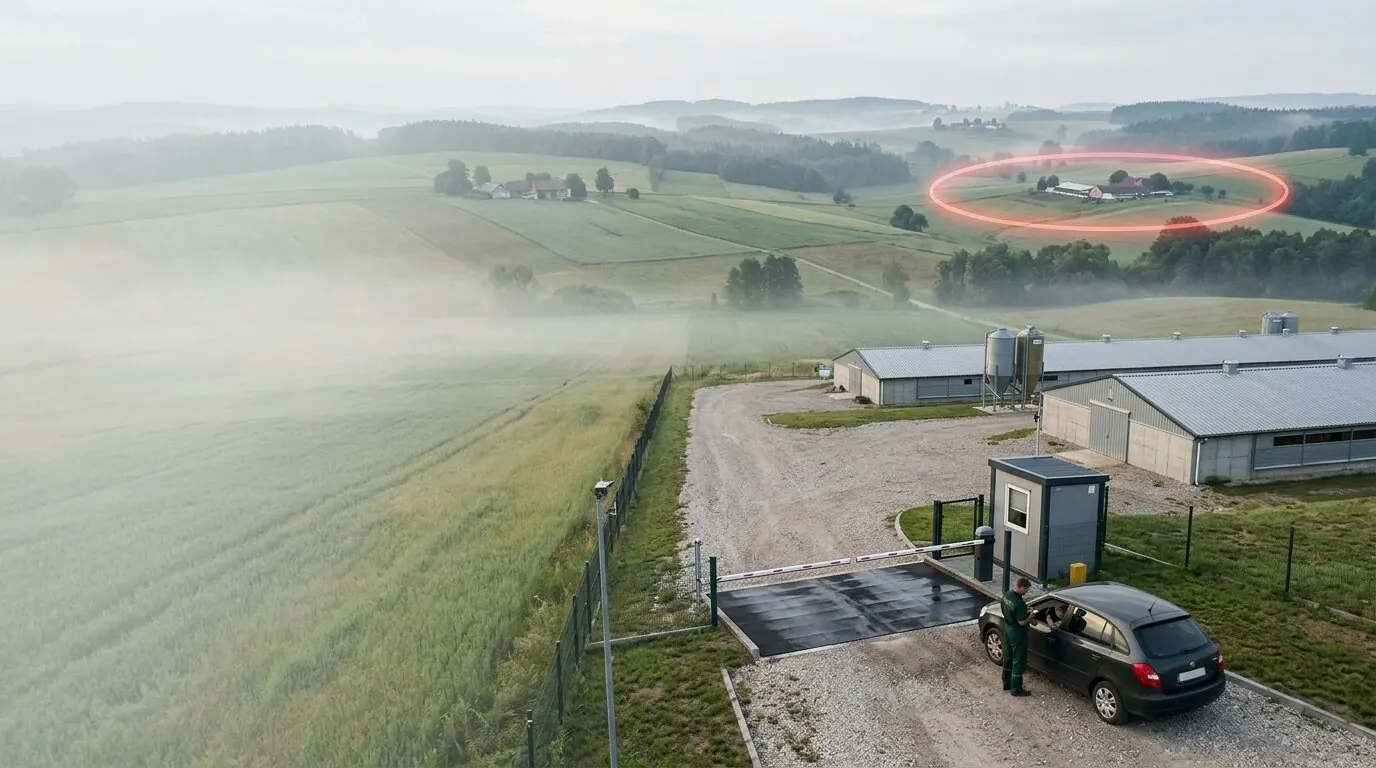
Wild birds, mainly waterbirds, are the recognized source of avian influenza virus around farms. Birds landing on fields, ponds and roofs around poultry houses bring the virus closer to the flock, and a person or vehicle can then carry it inside. An outbreak means the flock is culled and restriction zones are set up around the farm. We describe the background in our article on avian flu and wild birds.
Birds get used to scarers
Gas cannons, recorded calls and scarecrows usually work only for a short time. Birds quickly learn that the sound means no danger and come back. Even effective deterrence only reduces the number of birds nearby. The virus can still reach a farm in droppings on wheels or boots, or in feed and litter stored uncovered. So deterrence makes sense only as part of wider protection.
How we approach it
1. Avian flu outbreak map
DlaFerm provides an HPAI outbreak map based on data from Poland's Chief Veterinary Inspectorate (Główny Inspektorat Weterynarii). You can see whether an outbreak has appeared in your region. This works today. Read more about the disease and zones on our page about avian influenza.
2. Alert for a visitor from an outbreak area
The farm entry log with a QR code alerts you when a visitor was recently on a farm close to an active avian flu outbreak. You decide whether to let them in. This also works today.
3. Farm safeguards logged per flock
In DlaFerm you record the safeguards your farm has: netting, disinfectant mats and ways of deterring wild birds, plus DDD program documentation (Poland's hygiene and disinfection record), all next to the flock record. A deterrent, if you have one, is one entry alongside netting and entry control.
4. Weekly wild bird risk map and sightings
We are researching, and building into the app, a weekly wild bird risk map with a stricter checklist, and logging of wild bird sightings at your farm. Those sightings will also let you check on your own farm whether deterrence works.
What the research says
Goose behavior can be recognized by voice
Steen and colleagues (2012) from Aarhus University recorded flocks of wild barnacle geese with a directional microphone and trained a model to recognize three behaviors from their calls: feeding, taking off and landing. The model recognized feeding well (sensitivity 86–97%, precision 89–98%), and taking off (79–86% and 66–80%) and landing (73–91% and 79–92%) a little less well. The authors point out that such recognition could be part of a device that changes its stimuli before the birds get used to them.
A deterrent that changes strategy works longer
Steen and Karstoft (2014) described an adaptive deterrent: the device recognizes the species and behavior, checks whether the stimulus worked and changes strategy when it notices the start of habituation. In field trials, goose activity was, according to the authors, strongly reduced for 5–6 weeks, although the abstract does not say by how much. On the project page, the university describes such a deterrent set up in fields in Denmark and once in Germany, effective according to the university against barnacle geese, greylag geese and rooks, also without figures. Varying the stimulus is a good direction, but you need to measure the effect.
BirdAlert 2.0: the device as described by its distributor
The description of BirdAlert 2.0 comes from an interview with a representative of the Polish distributor in the magazine "Hodowca Drobiu" no. 2/2026, published on portalhodowcy.pl on 18 May 2026. It is a Danish device, reportedly developed as part of a doctoral thesis at Aarhus University and made by WildDetect ApS. A microphone listens for birds, the device recognizes the species and plays sounds that deter that species, at varying intensity and in irregular sequences. It has an artificial intelligence module, a SIM card for remote updates of the sound library, GPS and a web app. We could not confirm that the device comes directly from the studies above, although the description of how it works is similar. DlaFerm does not sell this device.
The distributor gives BirdAlert's effectiveness without figures
According to the distributor, effectiveness was checked by an agricultural university in Kiel, for deterring crows, and by a Dutch company, for deterring wild geese. Both assessments were described as very positive, but no figures or links to reports are given. It is not known by how much bird numbers fell, what area one device covers or how long the effect lasts. There is also no data on the effect on the risk of infection in a flock. In Poland, sales began in January 2026 according to the distributor. That is why in our approach deterrence is one entry among the farm's safeguards, not the main protection.
What your farm gains
You know earlier that the virus is nearby
The outbreak map shows whether an outbreak has appeared in your region. It is a signal to house the birds, check the netting and tighten entry rules before the virus gets closer.
A risky visitor stopped at the gate
The alert about a visitor who was recently near an outbreak arrives at the entrance. You have time to refuse entry or take them through the full procedure.
Safeguards ready for inspection
Netting, mats, deterrence and DDD documentation are recorded next to the flock record. When the inspection asks about biosecurity, you have everything in one place. We describe the basic rules in our article on pest and wild bird control.
Let's talk about your farm
Is your farm near water or fields where wild birds feed? Write to us through the contact form at the bottom of the page. We will show you the outbreak map, the entry log and the safeguards record.
Frequently asked questions
What wild bird protection works in DlaFerm today?add
The HPAI outbreak map using data from Poland's Chief Veterinary Inspectorate, an alert about a visitor who was recently near an outbreak, and a record of farm safeguards and DDD documentation next to the flock record. We are researching and building the weekly wild bird risk map.
Does DlaFerm sell bird deterrents?add
No. We describe BirdAlert 2.0 based on a trade source. In DlaFerm you record the safeguards your farm has, including deterrence if you use it.
How much work is the setup?add
The entry log works with a printed QR code on the gate, and the visitor checks in from a phone without installing an app. You enter your farm safeguards once and update them when something changes.
What if there is no signal on the farm?add
The farmer app works offline. Entries are sent automatically once the phone picks up a signal.
Does scaring wild birds away protect against avian flu?add
It can reduce the number of wild birds at the farm, so one source of risk. There is no data showing by how much it reduces the risk of infection in a flock. The basics remain netting, housing birds when there is a threat, protecting feed and water, removing puddles near poultry houses and controlling people and vehicles coming in.
Will the system replace a vet or the inspection?add
No. Suspected avian flu must be reported, and the diagnosis is made by a vet. Zones and obligations are set by the Veterinary Inspection (Inspekcja Weterynaryjna).
How do you know varied deterrence makes sense?add
Researchers in Aarhus recognized goose feeding from calls with 86–97% sensitivity, and a deterrent that changed strategy reduced goose activity for 5–6 weeks, according to them. The studies do not say by how much bird numbers fell. For BirdAlert 2.0 the distributor describes tests as very positive, without figures. So we advise noting how many and which birds you see near the poultry houses before and after installation. With sounds people can hear, think of your neighbors too, and for protected species check the rules.
Sources & resources
- linkBirdAlert 2.0 – supporting biosecurity on poultry farms against avian flu. Interview with the distributor's representative. Hodowca Drobiu 2/2026, portalhodowcy.pl, 18.05.2026
- linkSteen K.A., Therkildsen O.R., Karstoft H., Green O. (2012). A Vocal-Based Analytical Method for Goose Behaviour Recognition. Sensors 12(3), 3773–3788
- linkSteen K.A., Karstoft H. (2014). The acoustic adaptive frightening device: framework and algorithms. 2014 IEEE Global Conference on Signal and Information Processing (GlobalSIP), 1117–1121
- linkAarhus University, Department of Electrical and Computer Engineering. Intelligent scarecrows: pattern recognition methods for reduction of human-wildlife conflicts (project page)
Prepared by: DlaFerm Team based on data from the sources listed · Publisher: INSTA-TECH sp. z o.o.
Let's talk about biosecurity in avian flu season
Want to see outbreaks in your region, control entries and keep your farm safeguards in one place? Try the <a href="/ksiega-wejsc-na-ferme">entry and exit log</a> in DlaFerm. Create a free farm account or get in touch, and we will show you the outbreak map, the entry log and the safeguards record.
Phone
+48 796 258 151