Flock weight without catching birds: scale, camera and flock record together
You decide on feed and pick-up date from the weight of a few dozen birds. We put the scale result next to flock age and the growth curve in the flock record. We also research and roll out camera weighing, based on studies from commercial farms that tested how accurately a camera estimates weight.
verifiedFrom the team that has organised work on poultry farms for years.
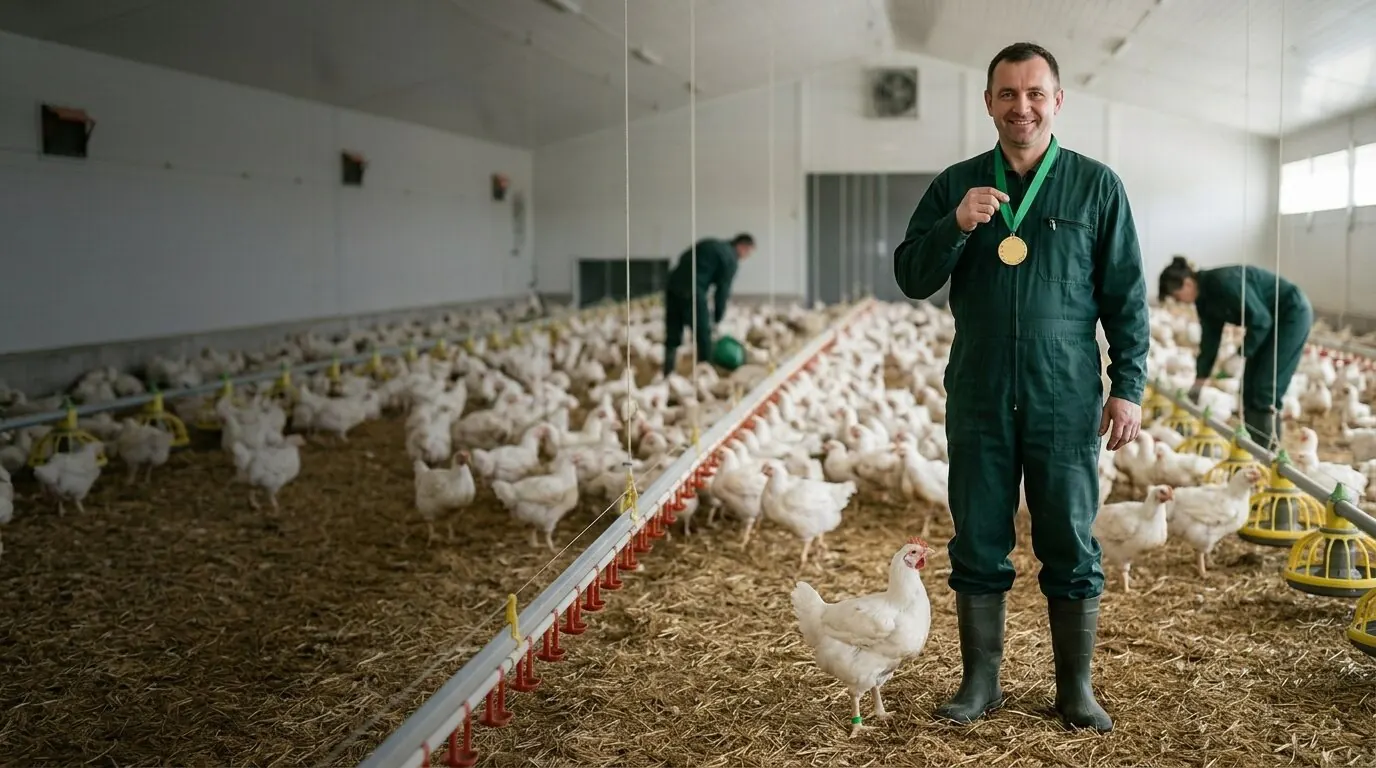
Flock weight known from a few dozen birds
On most farms you know broiler weight from hand-weighing a sample or from a platform scale. A hand sample means a few dozen birds once every few days, stress for the birds and work for people. A platform scale weighs all the time, but only the birds that step on it by themselves. Late in the cycle heavy birds step on less often, and often several birds stand on the scale at once.
A weight error costs you at pick-up
You base feed, lighting program and pick-up date on this one number. If the sample is too high or too low, the slaughterhouse gets different birds than you planned, and the difference shows up only on the settlement slip. So we calculate flock weight from more than one source and always judge it against the age of the birds.
How we solve it
1. Weight goes into the flock record (works today)
In the digital flock record you enter weight from a sample or from the scale, next to mortality, feed use and water use from the controller. You can make the entry from your phone in the house, even without signal. The app sends it when the phone finds a network.
2. The result against the growth curve (works today)
The system shows weight against the growth curve for the flock's age, so you see any deviation from the standard at once, with no counting on paper. This makes pick-up easier to plan, and the pick-up biomass calculator helps too.
3. Camera over the feeder (we research and roll out)
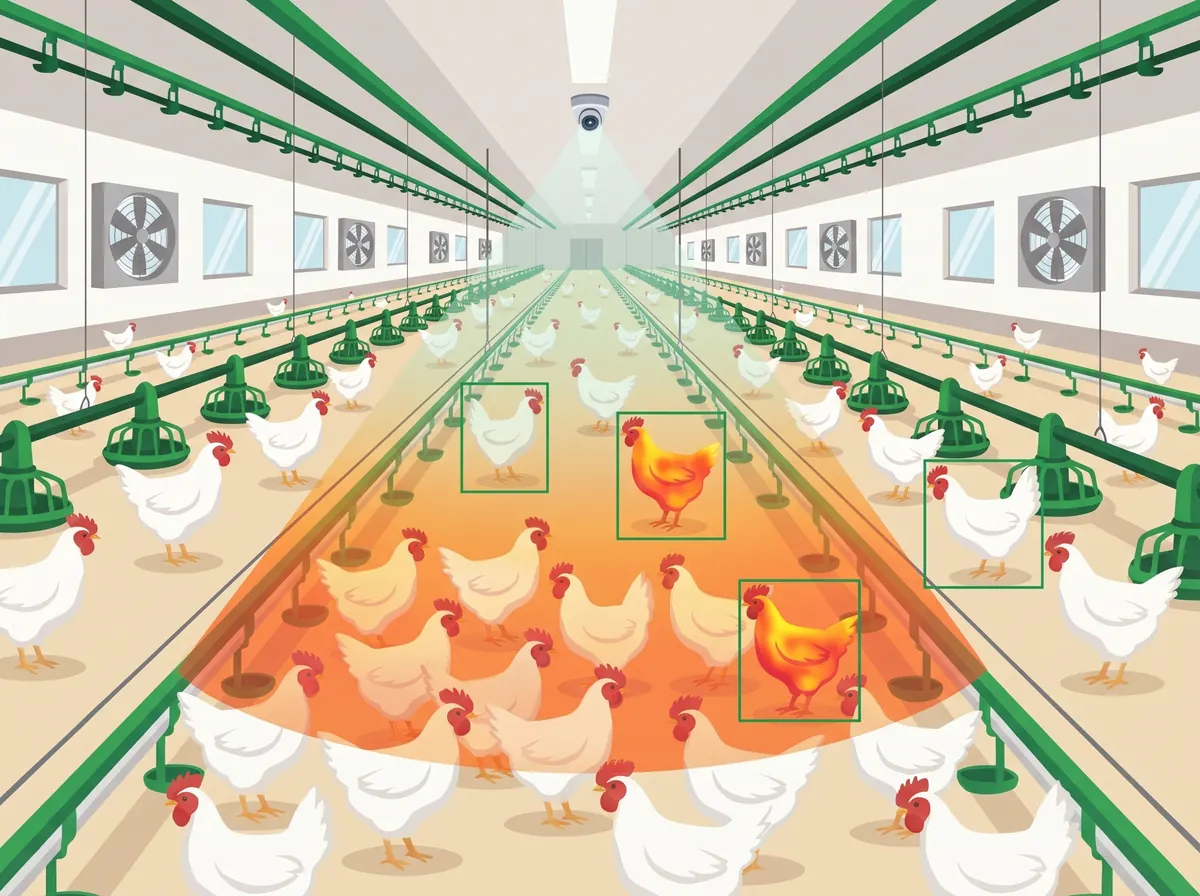
We research weight estimation from camera images and roll it out in poultry houses. The camera should cover far more birds than a sample, and the result should go to the same flock record. For a general description of the technique, see the guide to weighing poultry with a camera.
4. The scale checks the camera, the camera cleans the scale
We assume the scale stays in the house. It gives the measurements the camera learns from in that particular house, and each cycle it lets you check that the image-based estimate is not drifting. In turn, the image should help reject scale readings with several birds standing on it. For an overview of scale types, see the article on scales for weighing poultry.
5. You make the decision
The system shows weight, spread and deviation from the standard. The farmer decides on a feed change, a lighting program or the pick-up date, and a vet decides if disease is suspected.
What the research says
A plain camera over the feeder is enough to estimate weight
Campbell's team (2025) filmed broilers with a 2D camera above the feeding area of a commercial house. Software detected the birds by itself, and a model estimated weight from image features. On 222 weighed birds aged 5 to 35 days, the mean relative error was 7.0%. Kuzu's team (2026) got a similar result, 7.6% and 84.4 g on average, on a farm in Turkey, where broilers walked into a measuring cage fitted with cameras.
Flock age improves every model
In the same Campbell study, adding bird age as a feature improved every model tested. Five-day-old chicks were the hardest, with an error of 12.1%. That is why we read the camera result together with the age from the flock record and the growth curve.
The camera helps clean scale readings
Yoo's team (2026) worked on noisy platform scale readings from commercial farms. After filtering out wrong readings, the share of days when the weight of a typical bird could be read rose from 91.2% to 97.9%. The authors point out that the camera image helps reject readings with several birds on the scale.
Depth cameras and multiple views are other uses
Li's team (2023) estimated weight from a depth camera about 1 m above local-breed birds and got a mean error of 93 g, with the error growing as birds aged. Xiao's team (2025) studied 1023 Linwu ducks in a closed box with several cameras: R² for weight was 0.952 and the mean relative error 10.49%. These are breeding measurements, and each bird has to be put in the box. For daily flock weight we choose the camera over the feeder.
What the farm gains
Less catching and less stress
You see weight in the flock record as it happens, and as the camera is rolled out, the hand sample becomes a check, not your only source of knowledge about the flock.
You see the deviation before the slaughterhouse does
Weight against the growth curve shows the flock falling behind while you can still change something in feed, light or climate.
Records without retyping
Weight, mortality, feed and water are in one place, with the history of each cycle. It is easier to compare flocks and to talk to the slaughterhouse or integrator with numbers.
Let's test it in your house
Do you have a platform scale, or want to compare a camera estimate with your scale? Write through the contact form at the bottom of the page and we will show you what already works today.
Frequently asked questions
How does flock weighing work in DlaFerm?add
You enter weight from a sample or from the scale in the flock record. The system shows it against the growth curve for the flock's age, together with mortality, feed and water. We research camera weight estimation and roll it out in poultry houses.
What equipment do I need?add
For the flock record a phone or a browser is enough. We read feed and water use from the house controller, and you enter weight from the scale or a sample in the flock record. The camera over the feeder is something we install together with the farm.
How much work does setup take?add
You can go through the account and farm wizard in one afternoon, and enter your first flock from a photo of the delivery document. The camera needs mounting and a period when it learns the house from scale measurements.
What if there is no signal in the house?add
You make entries in the app offline. The app sends them by itself when the phone gets a signal.
Can a camera replace the scale?add
No. In every study we reviewed, the model was trained on birds weighed on a scale. The scale stays as the reference point, and the camera covers more birds.
What data do you collect?add
Weight from the sample or scale, flock age, mortality, feed and water use. With a camera, also the image from the house, from which the weight estimate is calculated.
How do you know a camera can weigh birds?add
In studies from commercial farms the mean relative error was 7.0% (Campbell's team, 2D camera over the feeder, 222 birds) and 7.6% (Kuzu's team, measuring cage, 84.4 g on average). Adding bird age improved every model, and for five-day-old chicks the error rose to 12.1%. We do not quote accuracy in our own houses until we have measured it.
Does camera weighing work for ducks too?add
One study covers ducks: on 1023 birds R² for weight was 0.952, but the measurement was made in a closed box. You keep a flock record and growth curve for every species.
Sources & resources
- linkCampbell M. et al. (2025). Automated precision weighing: Leveraging 2D video feature analysis and machine learning for live body weight estimation of broiler chickens. Smart Agricultural Technology 10, 100793
- linkKuzu H. et al. (2026). Broiler Live Weight Estimation through Image Processing and YOLO-based Deep Learning. Tarım Bilimleri Dergisi 32
- linkLi X. et al. (2023). An Improved Method for Broiler Weight Estimation Integrating Multi-Feature with Gradient Boosting Decision Tree. Animals 13(23), 3721
- linkYoo et al. (2026). Enhancing Broiler Weight Prediction via Preprocessed Kernel Density Estimation. Agriculture 16(2), 279
- linkXiao W., Han Q., Shu G. et al. (2025). Multimodal Feature-Driven Deep Learning for the Prediction of Duck Body Dimensions and Weight. arXiv:2503.14001
Prepared by: DlaFerm Team based on data from the sources listed · Publisher: INSTA-TECH sp. z o.o.
Flock weight without guessing
We will show you how scale weight goes into the flock record and growth curve, and talk about a camera in your house. Create a free farm account or get in touch with us.
Phone
+48 796 258 151