Rules and paperwork for pig farmers in Poland
A pig farmer in Poland must keep a census of animals at least once every six months, report events to IRZplus (ARiMR's online animal register) and apply biosecurity. In ASF zones (African swine fever zones) extra conditions apply. Below we explain which deadlines and documents apply to your farm and where to check current data. Legal state as of 22.11.2026.
verifiedFrom the team that has organised work on poultry farms for years.
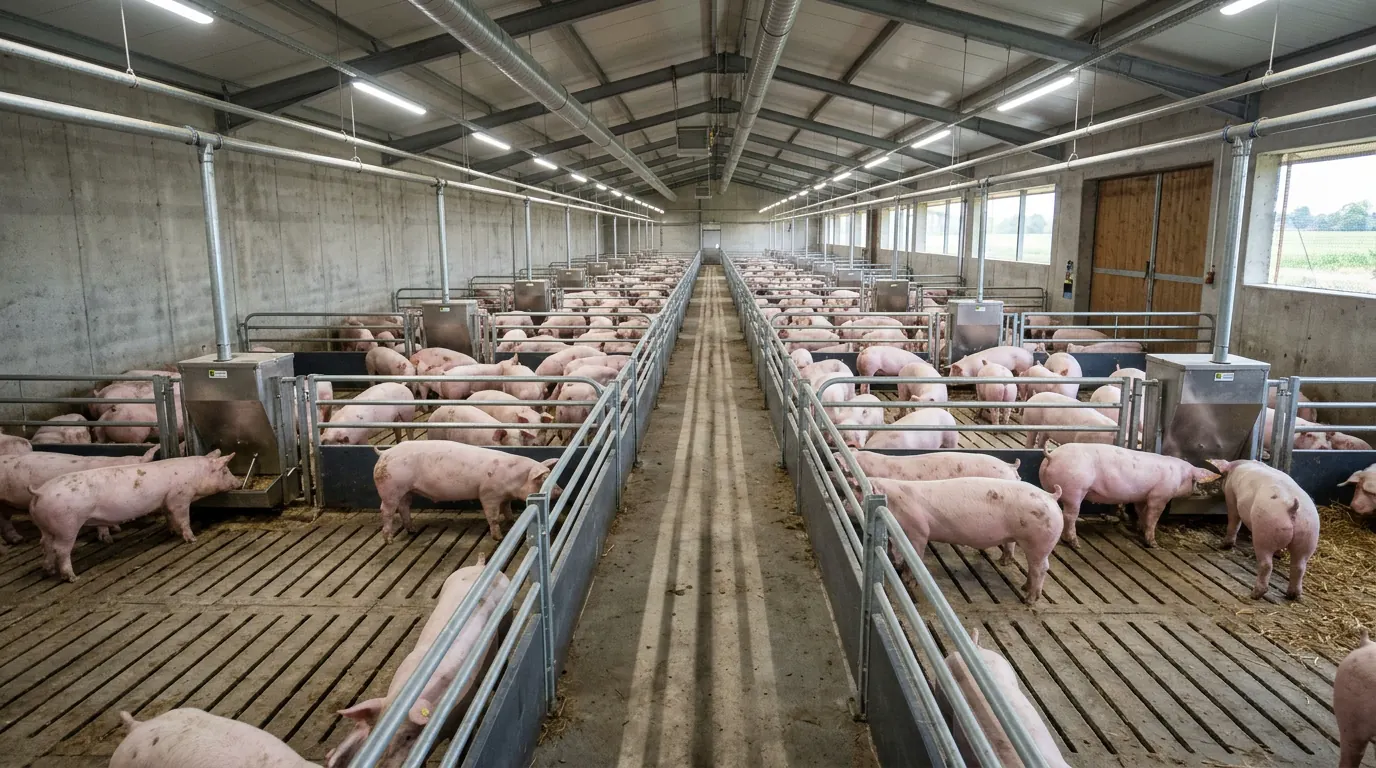
A pig farmer in Poland must first of all keep a pig census at the herd site and report events to IRZ, Poland's animal identification and registration system. You do the census at least once every six months, no later than 30 June and 31 December. You enter the result in the herd registration book and pass it to the ARiMR county office (Poland's Agency for Restructuring and Modernisation of Agriculture) within 7 days. On top of that comes biosecurity, whose scope depends on whether your farm lies in an ASF restriction zone. Below we describe each duty separately, with deadlines from the IRZ act and regulations, legal state as of 22.11.2026.
What the new IRZ act changed
The new act on the animal identification and registration system introduces financial penalties for failing identification and registration duties. ARiMR recommends filing the census through the IRZplus app. If you file electronically, you do not have to keep a paper book. The paper form is for exceptional situations. Forms are available for you to print yourself, and you file the census at the county office for the address in your producer register, or send it by post. If you want to automate this part, look at the IRZplus integration in DlaFerm.
Pig census and IRZ: deadlines and documents
What goes into the census
The census covers the number of marked pigs, including the individual ID numbers of sows, and the number of unmarked pigs up to 37 days of age. You enter the total in the herd registration book. The base document of the GIW (Poland's Chief Veterinary Inspectorate) on biosecurity assumes a weekly census update by category: piglets, weaners, finishers, sows, gilts, boars and young boars. Before each deadline, compare the census with the animals actually in the pens, because gaps between paper and pens are the most common reason for corrections.
Deadlines and filing channels
You draw up the census by 30 June and 31 December of the year at the latest. You pass it to the head of the ARiMR county office within 7 days of drawing it up. The easiest way is IRZplus; keep the paper form for exceptional situations. You can collect census data conveniently in the app for pig farmers, and follow your herd in the farm management software.
Moving pigs in ASF zones
Notifying your intent to transport
Before moving pigs to another herd or to a slaughterhouse, you notify your intent in IRZplus at least 4 days before transport. The county veterinary officer (PLW, powiatowy lekarz weterynarii) replies whether the movement is possible, especially in ASF zones. After approval, the pigs must leave within 48 hours if they were tested, or within 2 days if they were not. Moving pigs despite a refusal risks a fine. The PLW sets the testing conditions, so ask before shipping rather than assuming them from memory.
ASF restriction zones
Commission Implementing Regulation (EU) 2023/594 lays down special ASF control measures, including zones I–III. In restriction zones, moving pigs requires meeting conditions: testing, biosecurity and PLW permission. Annex I, which lists the zones, is amended often. EFSA reports that in 2025 the number of EU countries affected by ASF rose from 13 to 14, after the first outbreaks in wild boar in Spain. Check your municipality's status before every transport, because the zone map changes.
ASF biosecurity on every farm
Mandatory documentation
The GIW base document on farm biosecurity lists mandatory documentation: the pig census, a register of vehicles entering the farm, registers of people entering rooms with pigs, records of rodent and insect control, registers of cleaning and disinfection of vehicles, equipment and buildings, a register of deaths by category, the treatment book and the animal registration book. The Ministry of Agriculture regulation of 12.03.2026 (Dz.U. 2026 poz. 344, Poland's Journal of Laws) requires ASF registers to be kept up to date and stored for at least 3 years. Lacking them risks a penalty of 0.1 to 5 times the average monthly salary.
Farm plan and biosecurity plan
The GIW requires a farm plan showing boundaries, entrances and exits, buildings, routes for people, feed and waste, the water source, and a split into clean and dirty zones. The biosecurity plan also covers the number of cloven-hoofed animal farms within 1 km, 3 km and 10 km. You can prepare the plan in the biosecurity plan generator. Keep the register of people entering in the QR entry and exit book, so the record is always at hand during an inspection.
Sow ear tags and welfare payments
Ear tag with an individual number
The Ministry of Agriculture regulation of 9.03.2023 (Dz.U. 2023 poz. 567) sets how sows are marked with individual-number ear tags. If you want the welfare payment for sows, you tag each sow with an extra ear tag carrying her number and report her events to IRZplus: marking, movement, slaughter and death. You have 7 days to report, or 2 days in a category A disease zone (art. 24 ust. 7a–7b of the IRZ act). Record events right away, because a late report is easy to miss with many sows. See also pig payments 2026.
Payments for pigs, sows and piglets in 2026
Payments for pigs, sows and piglets for 2026 depend on the program conditions and on the application filed with ARiMR. We do not give rates, because they change from year to year. Check the current conditions with ARiMR before applying. With ear tags, make sure the numbers reported in IRZplus match the tags in the pens, because mismatches are most often found during inspections.
Pig welfare and IED: what to check
Documents for welfare payments
According to KPODR Minikowo materials (a regional agricultural advisory center), for welfare payments you send ARiMR a welfare improvement plan on increasing living space for sows, geotagged photos confirming bedding or a declaration that you maintain it, a register of keeping sows in farrowing crates around farrowing, and a register of piglet weaning. You file the crate register between 16 and 21 March, and the weaning register and bedding declaration from 15 to 21 March of the year after the year of the application. You file the plan within 25 days of the application deadline. ARiMR provides the forms.
Welfare in practice
Welfare also covers daily handling. Weaning piglets and moving animals are the moments of greatest stress, and EFSA describes the effect of transport on welfare in a separate opinion. Watch the herd's behavior and write down deviations. If you do not know the cause, consult a vet, who chooses any treatment.
IED: when the rules apply to your farm
Large farms are covered by the industrial emissions rules (IED). Whether your farm is covered depends on the number of animals and type of production set out in the rules. We do not give thresholds, because they change in the regulations. Check them with the environmental authority for your location before you increase stocking.
Frequently asked questions
When is the pig census due?add
You draw up the pig census at least once every six months, no later than 30 June and 31 December of the year. You enter the result in the herd registration book and pass it to the head of the ARiMR county office within 7 days. ARiMR recommends filing the census through IRZplus.
How many days before transport must I notify a pig movement?add
You notify your intent in IRZplus at least 4 days before transport. The PLW replies whether the movement is possible. After approval, the pigs must leave within 48 hours if tested, or within 2 days without testing.
Do I have to keep a paper herd book?add
No, if you file the census electronically through IRZplus, you are exempt from keeping a paper book. You file a paper census only in exceptional situations. Forms are available for you to print yourself.
How do I tag a sow for payments?add
You tag each sow with an extra ear tag with an individual number, under the Ministry of Agriculture regulation of 9.03.2023 (Dz.U. 2023 poz. 567). You report the sow's events to IRZplus within 7 days, or within 2 days in a category A disease zone.
Which records are mandatory for ASF?add
You keep up to date the pig census by group, a register of people handling the animals, and a register of vehicles and entries to the pig houses, under Dz.U. 2026 poz. 344. You store registers for at least 3 years. Add the treatment book and the register of deaths by category.
Do IED rules apply to every pig farm?add
Not to every farm. The duty depends on the number of animals and type of production set out in the rules. Check the thresholds with the environmental authority for your location, and do it before you increase stocking.
Where do I check current ASF zones?add
Zones change, because the annex to regulation 2023/594 is amended often. Check the GIW website (gov.pl/web/wetgiw) and ask your PLW before every transport. Ask the PLW for your municipality's current status before you notify a movement.
Sources & resources
- linkARiMR — Information brochure on the new IRZ act (updated 06.03.2025)
- linkGIW — Base document: farm biosecurity rules (testing derogation), v. 5.0
- linkMinistry of Agriculture / Journal of Laws — Regulation of 12.03.2026 on African swine fever control measures (Dz.U. 2026 poz. 344)
- linkEuropean Commission / EU Publications Office — Commission Implementing Regulation (EU) 2023/594 laying down special ASF control measures (original version)
- linkKPODR Minikowo — Pig behavior and welfare (P. Dorszewski et al.)
- linkEFSA — Epidemiological analysis of African swine fever in the European Union during 2025
Prepared by: DlaFerm Team based on data from the sources listed · Publisher: INSTA-TECH sp. z o.o.
Keep your census, registers and reports in one place?
The DlaFerm.pl <a href="/hodowca-trzody-chlewnej">app for pig farmers</a> and the biosecurity plan generator help you prepare the documents the rules require. Create a free farm account on DlaFerm.pl or get in touch, and we will show you how it looks on your farm.
Phone
+48 796 258 151