Pig subsidies in Poland 2026: sows, gilts, welfare, ASF
On 15 October 2026 Poland's Minister of Agriculture and Rural Development announced a payment of PLN 1000 per registered sow and aid of PLN 2000 for buying a breeding gilt. The "Animal Welfare" eco-scheme, cross-compliance and African swine fever (ASF) rules apply alongside them. We describe the conditions and the records you prepare on your farm. Legal status as of 23 November 2026.
verifiedFrom the team that has organised work on poultry farms for years.
Updated:
Legal status as of 23 November 2026. According to a notice from the Ministry of Agriculture and Rural Development (MRiRW) and ARiMR (Poland's Agency for Restructuring and Modernisation of Agriculture) dated 15 October 2026, pig farmers could apply for two forms of support: PLN 1000 for each registered sow and PLN 2000 for each breeding gilt bought. Applications ran from 22 October 2026 to 16 November 2026, so as of 23 November 2026 that window has closed. ARiMR will announce any later deadlines. For the full description of the aid, see our page on sow and gilt subsidies 2026. Permanent mechanisms apply alongside it: eco-schemes 2026 and cross-compliance for subsidies.
Why start with conditions, not amounts
Amounts and deadlines change from year to year, while the conditions for support are more stable. A farmer who knows which records to keep avoids the most common problem: a payment that was granted but cannot be documented. Check current announcements with ARiMR. Here we describe what you need to document.
Sow and gilt payments announced on 15 October 2026
PLN 1000 per registered sow
Minister Stefan Krajewski said farmers could apply for PLN 1000 for each registered sow from 22 October 2026 to 16 November 2026. Applications went through ARiMR's online system. According to MRiRW, the aim is to rebuild the national pig herd and raise production of Polish piglets. As of 23 November 2026 the application window has closed. If ARiMR announces another round, you will find the details in its notices. The number of sows in your herd should match the register, so check your records before the next application.
PLN 2000 for buying a breeding gilt
Aid for buying gilts is PLN 2000 per animal, paid in two installments of PLN 1000. The first goes to the producer straight after the application is filed, the second 8 months after filing. The gilt must be up to 12 months old, have a zootechnical certificate and come from a herd covered by pig performance recording. You must commit to keeping breeding gilts or sows at the herd's seat for 8 months from filing, in a number no lower than on the day of the application. The aid is granted as de minimis aid in agriculture.
The "Animal Welfare" eco-scheme and degressivity
How the eco-scheme works
According to a publication by KPODR Minikowo (a regional agricultural advisory center), the "Animal Welfare" intervention continues support from the RDP 2014–2020 for cows, pigs and sheep. It has been extended to more species and production groups. The eco-scheme is part of Poland's Strategic Plan and is meant to compensate for the cost of more space and extra practices that improve welfare. Not every pig house meets the conditions automatically, so always check the requirements in the current announcement.
Degressivity in livestock units (DJP)
The same publication describes degressive payments. Up to 100 DJP (livestock units) you get 100% of the payment, from 100 to 150 DJP 75%, and above 150 DJP no payment is due. In a larger herd each extra animal may pay less. Work out the DJP figure for your herd before you decide to expand. Rules can differ between years, so compare them with the current ARiMR document.
What pig welfare inspections assess
Basic elements of welfare
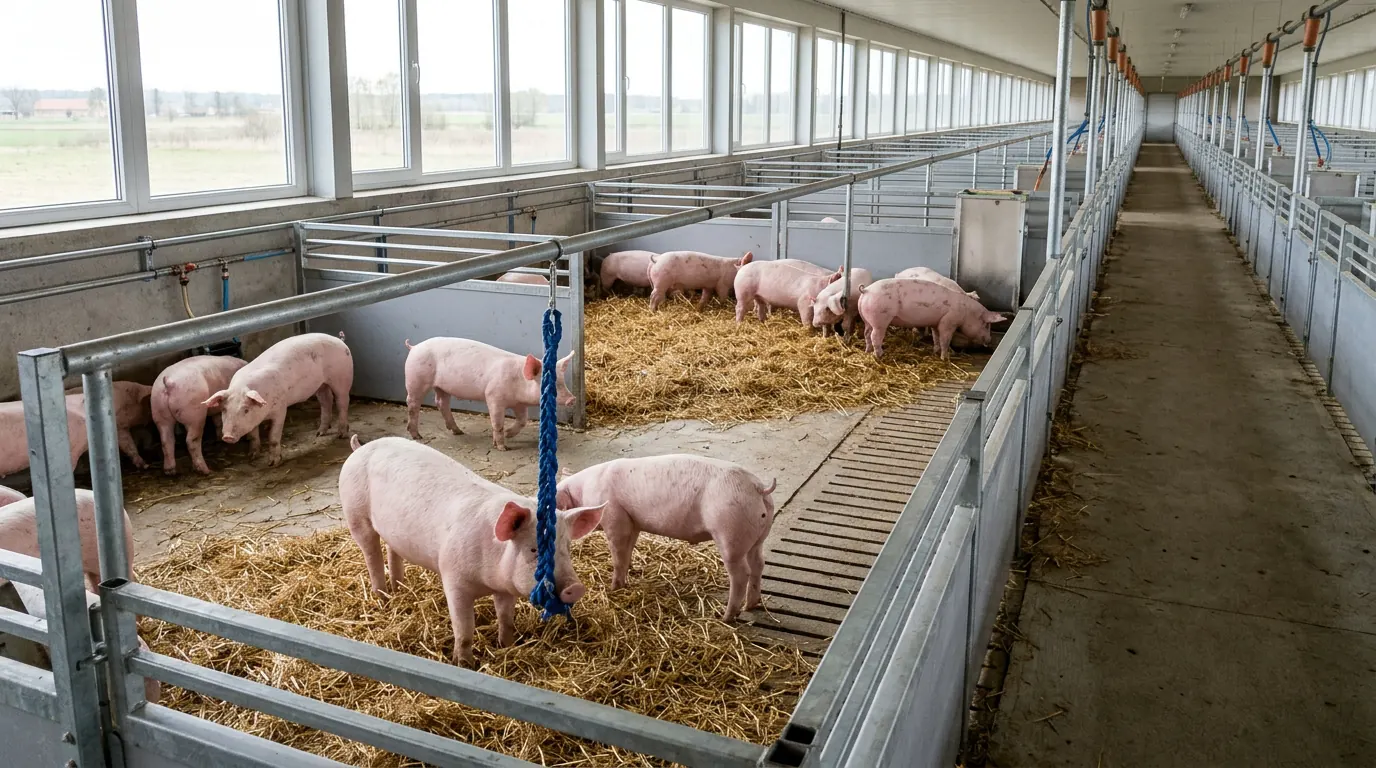
KPODR Minikowo names health, good nutrition, life without pain and fear, and the chance for normal behavior as the basis of welfare. In practice that means dry, clean bedding, access to water, enough space in the pen and watching how the herd behaves. Excess aggression or apathy is a signal to check conditions before a health problem appears.
Monitoring instead of guessing
The Institute of Animal Science PIB discusses welfare solutions for sustainable production in its 2026 monograph "Pig welfare in a sustainable animal production system". Observation data and pen records help show that conditions were under control. Camera footage lets you go back to a specific day. See how to solve this in records of pens and water.
African swine fever and the conditions for support
The 2026 legal basis
The MRiRW regulation of 12 March 2026 on measures to control African swine fever was published as Dz.U. 2026 poz. 344 (Poland's Journal of Laws). EU rules, including Commission Implementing Regulation (EU) 2023/594, set specific ASF control measures at EU level. We give the legal status as of 23 November 2026. Before you apply, check in ISAP (Poland's online legal acts database) whether the provisions have changed since that date.
What EFSA analyses
EFSA (the European Food Safety Authority) published an epidemiological analysis of ASF in the European Union in 2025. Its findings cover how the disease spreads between farms and which actions reduce the risk. The text shows that biosecurity and control of animal movements are essential. Write your biosecurity plan down and keep it at the entrance to the pig house. You will find a ready outline in the biosecurity plan generator, and we describe how to have data ready when ASF is suspected in pig house records.
Where to find current rates and deadlines
Where to check amounts and deadlines
ARiMR publishes current rates and application deadlines at gov.pl/web/arimr, and so does the Ministry of Agriculture and Rural Development. You can also check direct payment details in the ARiMR direct payments module. According to an MRiRW notice, this year advances on direct payments were raised from 70 to 75% of the amount due, while 85% was kept for area payments. Advances are paid until 30 November, and from 1 December ARiMR starts paying final payments.
Compliance checks
In an inspection, what counts is whether your records match what actually happened in the pig house. Herd records, animal movements and biosecurity records should agree. Differences between documents are a common reason for inspectors' questions, so keep one register rather than several sheets. With gilt aid, also watch the number of gilts and sows in the herd for 8 months after the application.
Documents worth keeping at hand
Treatment and withdrawal periods
A vet always chooses the medicine and dose. The farmer must still keep a record of products given, dates of administration and withdrawal periods. Missing data makes it hard to show compliance and can hold up the sale of animals. Keep these records in the treatment and withdrawal records.
Herd data
For sow and gilt aid, zootechnical certificates, purchase dates and the number of animals at the herd's seat all count. An app that collects herd data in one place makes it easier to prepare a summary. Check the app for pig farmers and see what data it collects. Keep documents as ARiMR requires.
Frequently asked questions
Are there new pig subsidies in Poland in 2026?add
Yes. According to the MRiRW and ARiMR notice of 15 October 2026, there is a payment for registered sows and aid for buying breeding gilts. Applications ran from 22 October 2026 to 16 November 2026. ARiMR will announce any later deadlines.
How much is the sow subsidy in 2026?add
According to MRiRW, the payment is PLN 1000 for each registered sow. Applications went through ARiMR's online system until 16 November 2026.
How much is the aid for buying a breeding gilt?add
The aid is PLN 2000 per animal, in two installments of PLN 1000. The first is paid after filing, the second after 8 months. The gilt must be up to 12 months old with a zootechnical certificate, and the producer keeps the herd for 8 months.
How does degressivity work in the welfare eco-scheme?add
According to KPODR Minikowo, up to 100 DJP you get 100% of the payment, from 100 to 150 DJP 75%, and above 150 DJP no payment is due. Rules can change, so compare them with the current document.
Does ASF affect subsidy conditions?add
ASF control rules are set by the MRiRW regulation of 12 March 2026 (Dz.U. 2026 poz. 344) and EU rules. Good biosecurity and full movement records make it easier to show compliance in an inspection.
What does a pig welfare inspection check?add
It assesses health, nutrition, pen conditions and the chance for natural behavior. Herd observation records and pig house data help show that conditions were under control.
Where can I find current rates and deadlines?add
ARiMR publishes current rates and deadlines at gov.pl/web/arimr. The Ministry of Agriculture and Rural Development publishes news of changes at gov.pl/web/rolnictwo.
Sources & resources
- linkKPODR Minikowo — Pig behavior and welfare (P. Dorszewski et al.)
- linkIZ PIB — Pig welfare in a sustainable animal production system (eds. A. Rekiel, G. Żak)
- linkEFSA — Epidemiological analysis of African swine fever in the European Union during 2025
- linkMRiRW / Dziennik Ustaw — MRiRW regulation of 12 March 2026 on measures to control African swine fever (Dz.U. 2026 poz. 344)
- linkARiMR — gov.pl/web/arimr
- linkARiMR — MRiRW: announcement of further support for pig farmers
- linkMinistry of Agriculture and Rural Development — Sow and gilt payments. Minister Krajewski presented new forms of support for Polish pig farming
Prepared by: DlaFerm Team based on data from the sources listed · Publisher: INSTA-TECH sp. z o.o.
Run a pig farm and want your data at hand when you apply?
The DlaFerm <a href="/hodowca-trzody-chlewnej">app for pig farmers</a> keeps herd, treatment and biosecurity data in one place. Create a free farm account and see how it works on your farm.
Phone
+48 796 258 151