Salmonella and antimicrobial resistance: read test results together with flock history
A negative lab result does not always mean the flock is clean, and a single change on the farm rarely does the job. We propose one record of results, treatment and practices for every flock, so the vet and the farmer see the full picture. We build on studies that link test results with farm data.
verifiedFrom the team that has organised work on poultry farms for years.
Every result judged on its own
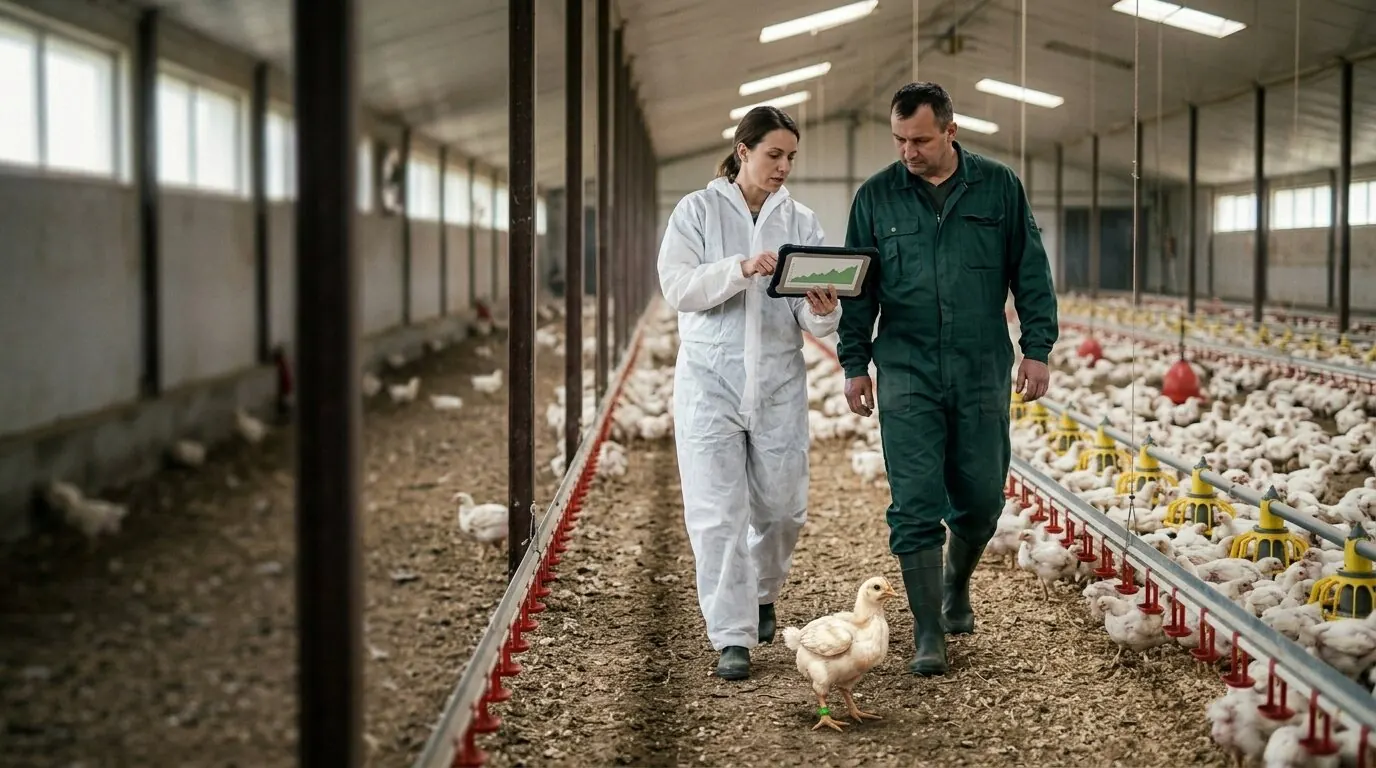
On poultry farms in Poland, Salmonella samples are taken under the national control program, and a vet orders sensitivity tests (antibiograms) when treatment fails. Usually each result is read alone: positive or negative, sensitive or resistant. Yet whether a test detects an infection also depends on farm conditions, flock history and how the sample was taken. A positive result means extra testing, sales restrictions and losses. We cover the basics of the disease on our page about Salmonella on a poultry farm.
Results in a binder, treatment in a notebook
Pressure to cut antibiotic use is growing, and resistant bacteria pass from farms into food. To check whether a change in washing, the downtime between flocks or feed withdrawal before slaughter made any difference, you need to put results from many cycles next to what was done on the farm. On most farms, lab results sit in a binder, treatment sits in a notebook, and house washing is not written down anywhere.
How we solve it
1. Visits and results go into the flock record
The vet enters the visit, diagnosis and medicines given straight into the flock record. Samples and lab results go into the flock history. This works today. The farmer copies nothing from paper.
2. The treatment log calculates the withdrawal period
The treatment log records the medicine, dose, date and number of birds, and calculates the withdrawal period itself. You can see how many times and with what a flock in a given house was treated over successive cycles. This also works today.
3. Practices recorded next to results
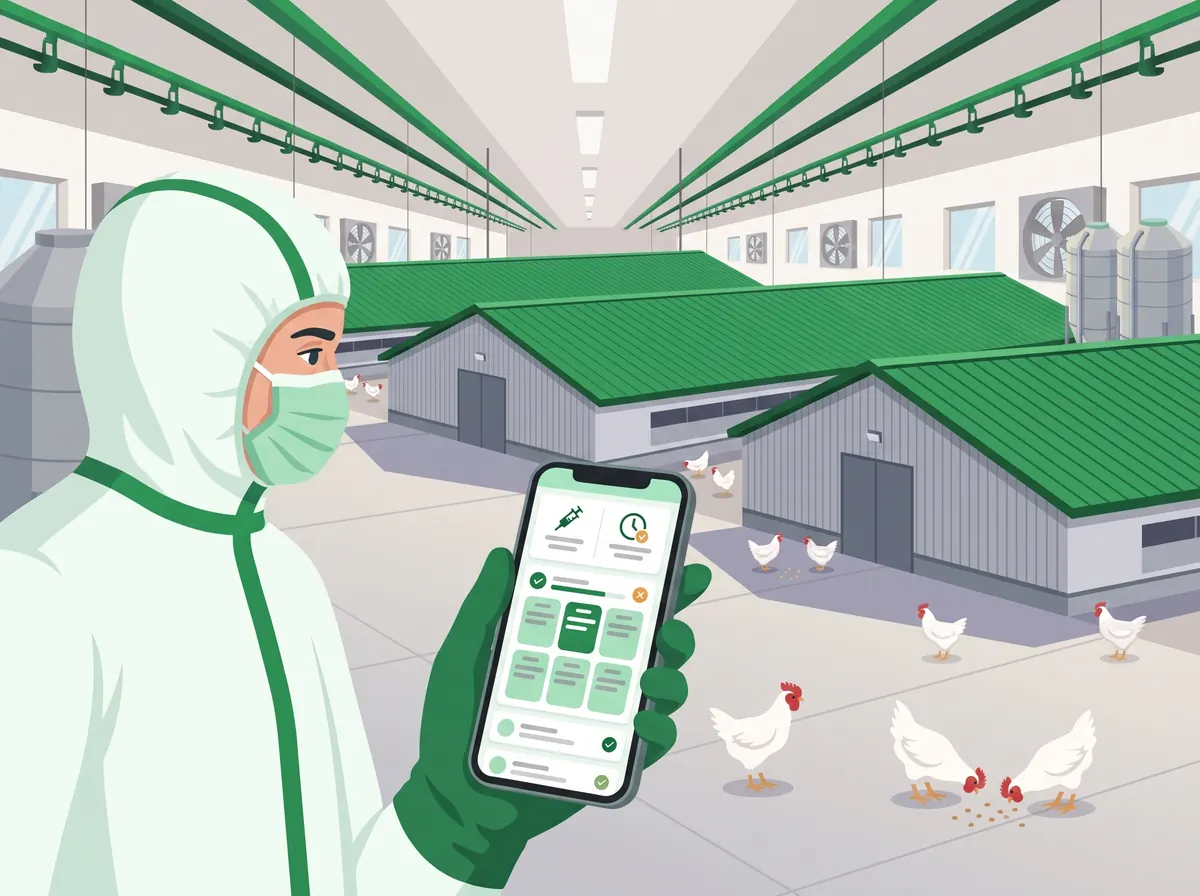
Biosecurity procedures, house washing and disinfection, rodent control and entries to the farm are recorded in the farm log next to treatment. Procedures with a checklist get a result of "compliant" or "non-compliant". This lets you compare cycles where washing was done in full with those where something was skipped.
4. Flagging flocks for an extra sample
We are researching, and putting into the app, a way to assess the risk of a false negative result and to list practices linked to lower pathogen levels. A flag like this is meant as a hint for the vet. We do not replace Poland's national Salmonella control program or the vet's decision.
What the research says
A test result plus flock history finds more infections
Banks and colleagues (2024) combined all cattle skin tests for tuberculosis in Great Britain from 2012–2021 with data on herds, earlier test results and animal movements. The test alone detected 63.9% of infected herds at herd level, with specificity of 90.3%. A model that adds risk context to the result raised sensitivity to 69.0% at the same specificity. That is about 240 additional infected herds found per year with no rise in false alarms. A differently set model could have reduced unnecessary restrictions in more than 5000 herds. This is a species other than poultry, but the method is the same: a negative result in a high-risk herd means something different from a negative result in a low-risk herd. That is why we keep results together with flock history.
Practices work as a set
Pillai and colleagues (2024) proposed a method that searches for a whole combination of farm settings at which several pathogens drop at the same time. The data came from poultry farms: pre-slaughter practices linked to multidrug resistance in bacteria, and slaughterhouse practices linked to Salmonella, Listeria and Campylobacter. The three pathogens were considered together, because conditions that favor one can favor another. The method found good combinations in fewer steps than the comparison method. This is why we keep a practice log instead of a single "washing: yes" box.
Specific practices show up in multi-year data
Gireesan and colleagues (2024) analyzed data from 11 pasture-raised poultry farms in the southeastern USA, collected over four years. Fecal and soil samples were taken at three points during rearing, and at the slaughterhouse they tested cecal contents and carcass rinses. Moving the flock to a new part of the pasture always lowered resistance and pathogen levels. Flocks of about 1500 birds had lower pathogen levels than larger ones. Of the 8–24 hours of feed withdrawal before slaughter that were studied, 18 hours was the best window. These are pasture farms, not intensive houses, but they show that the link between a practice and a result only appears after years of records.
One farm has too few positive results
In the data from 11 farms, negative samples outnumbered positive ones six to one. On a single farm there are even fewer positives. That is why we base practice comparisons on records from many cycles, not on one result.
What the farm gains
Full history for the vet
The vet sees earlier results, treatment and completed procedures in one place. It is easier to judge whether a negative result is reliable and where to take an extra sample.
Treatment records without paper calculations
Medicine, dose, date and withdrawal period are recorded with the flock. At an inspection and when sending birds to the slaughterhouse, the data is ready.
Check whether a change on the farm worked
Did you switch disinfectant or lengthen the downtime between flocks? Compare results and treatment across successive cycles instead of relying on a hunch. Read more about cutting medicine use in our article on raising poultry without antibiotics.
We will show it on your flocks
Want to see a flock record with results, treatment and a practice log using data from your own farm? Write to us through the contact form at the bottom of the page.
Frequently asked questions
How do test results get into the system?add
The vet enters the visit, diagnosis and medicines into the flock record, and samples and lab results are added to the flock history. The farmer sees them in the web panel and in the app.
Do I need extra equipment?add
No. A phone or a computer is enough. The vet has their own access to the flock record.
How much work is keeping a practice log?add
You tick off a procedure on a checklist on your phone, point by point. The system works out the "compliant" or "non-compliant" result itself. The vet or the farmer enters treatment once, and the withdrawal period is calculated automatically.
What if there is no signal in the poultry house?add
The farmer's app works offline. Entries send themselves when the phone picks up a signal.
Will the system replace the vet or the Salmonella control program?add
No. Rules and the vet decide on official samples. The system organizes the data the vet bases decisions on.
What data do you collect?add
Visits, diagnoses, treatment with dose and withdrawal period, samples and test results, completed biosecurity procedures, washing and disinfection, rodent control and entries to the farm.
How do you know that combining results with flock data makes sense?add
In a study on cattle tuberculosis in Great Britain, using all tests from 2012–2021, adding herd data raised the sensitivity of detecting infected herds from 63.9% to 69.0% at the same specificity. That is about 240 more herds a year. In data from 11 pasture-raised poultry farms in the USA, collected over four years, the link between practices and pathogen and resistance levels could only be identified from many cycles. The poultry studies cover pasture farms, so we do not transfer the results directly to intensive houses, only the method.
Sources & resources
- linkBanks C.J., Sanchez A., Stewart V., Bowen K., Doherty T., Tearne O., Smith G., Kao R.R. (2024). Machine learning augmented diagnostic testing to identify sources of variability in test performance. arXiv:2404.03678
- linkPillai N., Gireesan G., Rothrock M.J., Nanduri B., Chen Z., Ramkumar M. (2024). Towards Interpreting Multi-Objective Feature Associations. arXiv:2403.00017
- linkGireesan G., Pillai N., Rothrock M.J., Nanduri B., Chen Z., Ramkumar M. (2024). Deep Sensitivity Analysis for Objective-Oriented Combinatorial Optimization. arXiv:2403.00016
Prepared by: DlaFerm Team based on data from the sources listed · Publisher: INSTA-TECH sp. z o.o.
Let's talk about a flock record with results and treatment
Want test results, treatment and farm practices in one place, ready for your vet? Try the <a href="/cyfrowa-karta-stada-brojlera">digital flock record</a> and the <a href="/ewidencja-leczenia-i-karencja-lekow">treatment log</a> in DlaFerm. Create a free farm account or get in touch and we will show you.
Phone
+48 796 258 151