Building a farm, from the plot to the first placement
A new farm means a dozen or so decisions, notifications and contracts before the first animals enter the building. We describe them in the order they reach the authorities: from the extract of the local plan, through the environmental decision and the building permit, to registrations and the first placement. The legal position is described as of 22.11.2026.
verifiedFrom the team that has organised work on poultry farms for years.
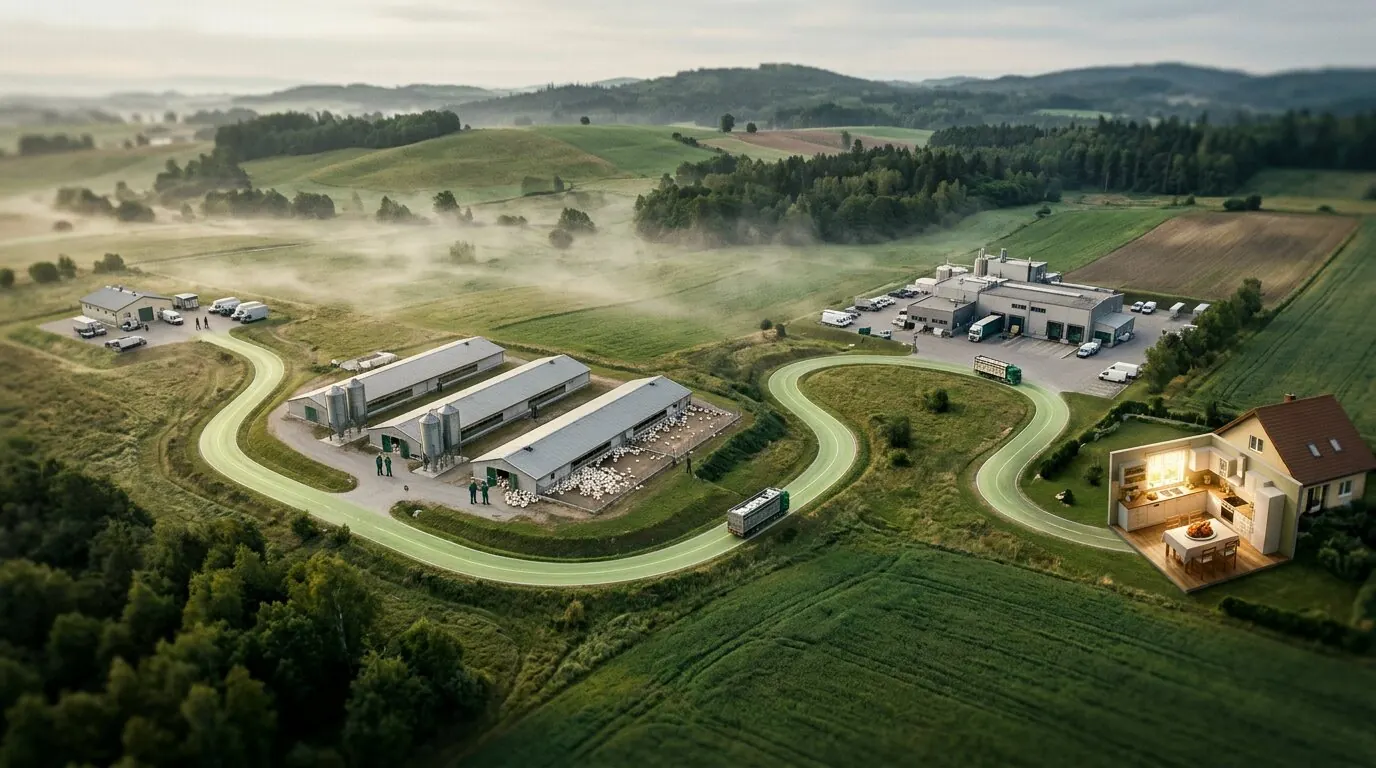
This guide is for you if you are building a new poultry farm (broilers, layers, turkeys), a pig finishing house or a barn for beef cattle, or expanding a facility you already have. We describe the order of the steps, the offices that receive your applications and the thresholds that decide how much paperwork you face. The farm planner calculates a full list for your scale, with the number of buildings, equipment and sensors, and we send the finished PDF to your email address.
Before you start: calculate your scale in LU
The scope of formalities depends on the number of livestock units (DJP in Polish, large conversion units) calculated from maximum stocking. The regulation on projects likely to have a significant environmental impact (Dz.U. 2019 poz. 1839, Poland's Journal of Laws) gives the conversion factors: hen and duck 0.004 LU, turkey 0.024 LU, finishing pig 0.14 LU, sow 0.35 LU, cow 1 LU. When you expand, the LU add up with your existing farm. For beef cattle the regulation gives no separate factor, so confirm how to count them at your municipal office.
Land and the local plan
Extract and map from the local plan
Start with an extract and a map from the local spatial development plan, available at the municipal office (urząd gminy). The plan decides whether you can put a livestock building on the plot and at what scale. Do this before you buy or lease the land, because verbal assurances will not protect your investment.
No plan: development conditions
Without a plan you need a development conditions decision (decyzja o warunkach zabudowy). From 1.09.2026 a new application can be decided only by a municipality that already has a general plan, and only within an infill development area. A new decision expires after 5 years. Manure pads and slurry tanks do not need development conditions until 31.12.2027. Ask your municipality whether the general plan has already been adopted.
Environmental decision
When a decision, when a report
From 210 LU a farm always needs an environmental decision with an environmental impact report. From 40 LU, when buildings stand closer than 210 m to housing or in a protected area, and from 60 LU elsewhere, a decision is needed, and a report only if the authority requests it. The decision is issued by the wójt, mayor or city president. A farm that needs an impact assessment always goes on to a building permit.
Changes from 1.01.2027
The amendment to the act on environmental impact assessments (Dz.U. 2026 poz. 875) introduces from 1.01.2027, among other things, a duty to attach a resolution amending the plan when the current plan does not allow a farm, and the transfer of the decision to the buyer of the property. If you apply around the turn of the year, check which rules will apply to you.
Financing before the design
What is available today
As of 22.11.2026 ARiMR (Poland's Agency for Restructuring and Modernisation of Agriculture) has no open grant call for building or modernizing livestock buildings. Still available are preferential loans with an ARiMR interest subsidy granted by banks, guarantees from Bank Gospodarstwa Krajowego (BGK) and subsidies to animal insurance premiums. We keep a current list of programs with deadlines, conditions and links to announcements in the Grants tab, where you can also sign up for alerts about new calls. See also farm modernization 2026.
Why financing comes before the design
Most programs require the application to arrive before the investment starts, and costs incurred earlier are not eligible. So decide on your sources of funding before you sign a contract with the designer and the builder.
Design and building permit
Livestock buildings
A poultry house, pig house and cattle barn need a building permit under the Construction Law (Dz.U. 2026 poz. 524). The act exempts farm outbuildings (budynki gospodarcze) from the permit but distinguishes them from livestock buildings, so this is our interpretation: confirm it with the county office (starostwo) and your designer. You submit the application to the county office together with the design, the environmental decision (if one was required) and the plan extract or the development conditions decision. More in building and expanding a farm: offices and permits.
Structures that only need notification
A manure pad, a slurry or liquid manure tank and a feed silo of up to 250 m³ and up to 15 m high need notification, not a permit. Distances of tanks and pads from homes, windows and the plot boundary are set by the regulation on technical conditions for agricultural structures (Dz.U. 2023 poz. 297), for example 25 m from rooms for people for a manure pad and an open tank.
Water and large farms
Abstracting groundwater above 5 m³ a day on annual average needs a water-law permit from Wody Polskie (Polish Waters); a well deeper than 30 m does too. A farm with more than 40,000 poultry places, 2000 places for finishing pigs over 30 kg or 750 for sows needs an integrated permit. The new IED 2.0 directive thresholds counted in LU are not yet implemented in Poland; they will apply to farms from 2030–2032, depending on size. For building details see poultry house construction and pig house construction.
Construction and completion
Finishing the build
When the works are finished you notify the county building supervision inspectorate (powiatowy inspektorat nadzoru budowlanego). It has 14 days to object. An occupancy permit is needed only for the categories of structures listed in the act; farm buildings and their silos are not among them, unless you start using the building before the works end.
Registrations, contracts and the first placement
Registrations
You need a producer number (EP) from ARiMR, registration of the herd or flock location and a notification of activity to the county veterinarian (powiatowy lekarz weterynarii). From 1.01.2027 notifications to IRZ, Poland's animal identification and registration system, are filed electronically only. For poultry above 350 birds a biosecurity plan with a vaccination program against Newcastle disease is required. You can prepare the plan for your farm in the biosecurity plan generator. The order of numbers and registrations is in starting a farm: registrations step by step.
Contracts before the first placement
Before you start, sign contracts with the integrator or buyer, the slaughterhouse, the feed mill, the hatchery or animal supplier, the veterinarian, the rendering plant and the taker of manure or slurry. Add insurance for buildings and animals, and energy and gas contracts. The farm planner shows the full list with a description of what each contract covers.
What DlaFerm.pl gives you on a new farm
A system from the first placement
From the first placement you run your farm in DlaFerm: a flock card with FCR and EPEF, IRZplus notifications calculated from farm data and sent by the system, treatment records with withdrawal periods, an entry log with a QR code, feed monitoring in silos, invoices in KSeF (Poland's national e-invoicing system) and an app for employees. The flock card, treatment records and entry log fill in with every entry, so you copy nothing before the inspector's visit.
Rollout and partners on request
The farm planner shows which contractors, equipment suppliers and advisers a project of your scale needs. If you want help launching the system on a new farm, training your team or choosing partners, write to us. We will reply with what we can help with.
Help with documents on request
You can prepare the biosecurity plan and the list of formalities yourself in our generators. Help with applications and notifications is agreed individually. Write to us at kontakt@dlaferm.pl: describe the species, the scale and the stage of the project, and we will reply with a proposal for the next steps.
Free tools at every stage of the build
The farm planner calculates buildings, equipment, sensors, formalities and contracts for your scale and emails the summary as a PDF. The biosecurity plan generator prepares a plan for poultry, pigs or cattle to agree with your veterinarian. The disease maps show HPAI and Newcastle disease outbreaks and ASF zones near your plot. Regulations collects legal acts with a legal-state date. Under Grants you find current calls and can sign up for alerts.
Frequently asked questions about building a farm
Is a notification enough for a poultry house?add
A poultry house, pig house and cattle barn need a building permit. The exemptions in the Construction Law apply to farm outbuildings, and the act distinguishes them from livestock buildings. This is our interpretation, so confirm it with the county office and your designer.
How many animals trigger an environmental decision?add
From 60 LU, and from 40 LU when buildings are closer than 210 m to housing or in a protected area. From 210 LU always with a report. For example, 210 LU is 52,500 hens or 1500 finishing pigs.
Are there grants for building a poultry or pig house now?add
As of 22.11.2026 ARiMR has no call for building or modernizing livestock buildings. Preferential loans, BGK guarantees and insurance subsidies are available. We keep the current list in the Grants tab.
What if the municipality has no local plan?add
You need a development conditions decision. From 1.09.2026 only a municipality with an adopted general plan can issue it, and only within an infill development area. Ask the municipality about the state of its general plan before you buy the land.
Do I need an occupancy permit for a livestock building?add
Usually not. When construction ends you notify the county building supervision inspectorate, which has 14 days to object. An occupancy permit applies only to the categories of structures listed in the act.
When do I need a water-law permit?add
When average annual groundwater abstraction exceeds 5 m³ a day or the well is deeper than 30 m. You apply to Wody Polskie.
How do I start working with DlaFerm?add
Write to kontakt@dlaferm.pl with the species, the scale and the stage of your project. You can attach the summary from the farm planner. Before the first placement, create a free farm account and enter your first flock.
Sources & resources
- linkConstruction Law — consolidated text, Dz.U. 2026 poz. 524 (ISAP)
- linkRegulation on projects likely to have a significant environmental impact — Dz.U. 2019 poz. 1839
- linkTechnical conditions for agricultural structures — Dz.U. 2023 poz. 297
- linkAct on environmental impact assessments — amendment Dz.U. 2026 poz. 875
- linkWater Law — consolidated text, Dz.U. 2026 poz. 1335
- linkDirective (EU) 2024/1785 (IED 2.0) — EUR-Lex
- linkARiMR — gov.pl/web/arimr
Prepared by: DlaFerm Team based on data from the sources listed · Publisher: INSTA-TECH sp. z o.o.
Building a farm? Write to us
Describe the species, scale and stage of your project at kontakt@dlaferm.pl. Attach the summary from the farm planner if you have one. We will reply with what we can help with on documents and launching the system for the first placement.
Phone
+48 796 258 151