Poultry farm vet inspection: documents to have ready
A veterinary inspection of a poultry farm in Poland starts with paperwork, not a walk through the house. The inspector checks logs of visitors, vehicles, disinfection and mortality, the biosecurity plan and the treatment book. Below we separate what the rules require from what is good practice.
verifiedFrom the team that has organised work on poultry farms for years.
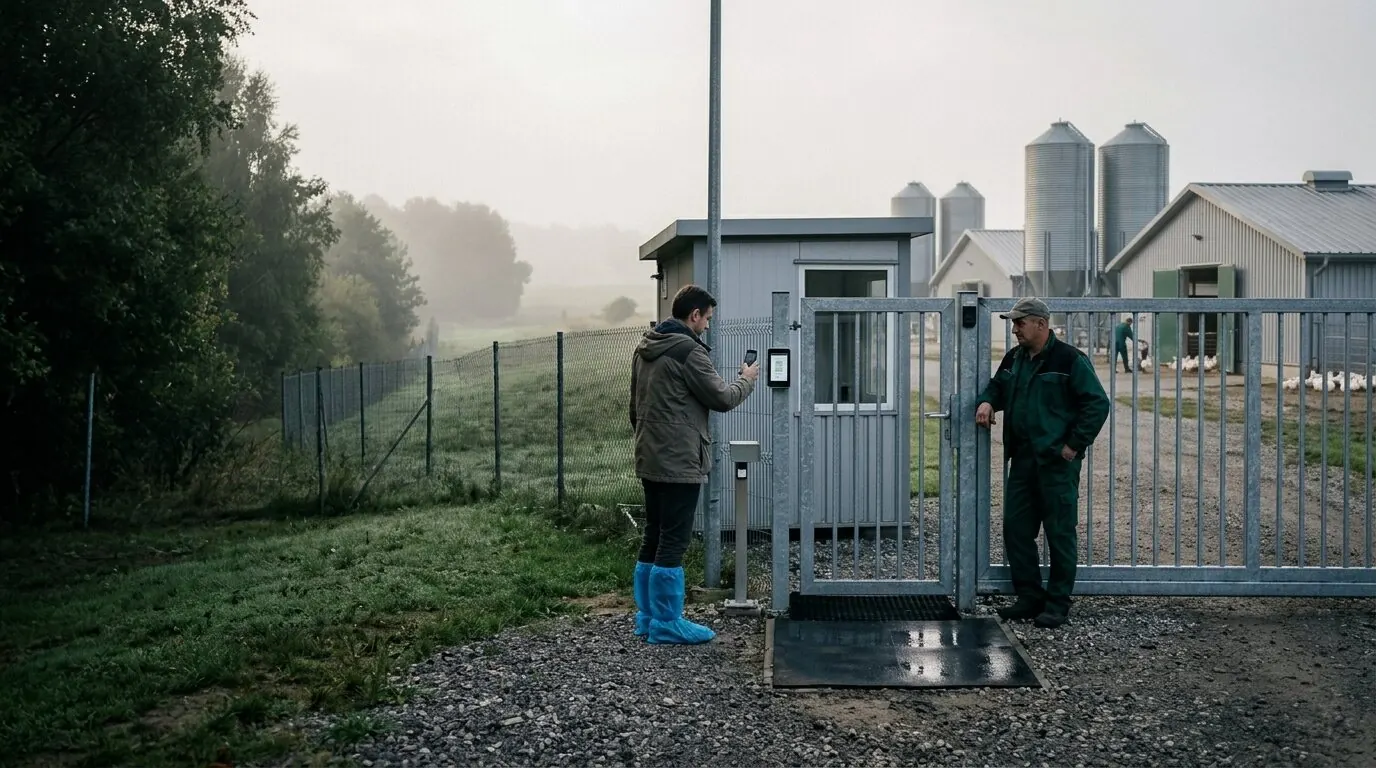
At a veterinary inspection of a poultry farm, you show ready documents, not spoken explanations. The duty to keep logs and a biosecurity plan comes, among others, from Dz.U. 2026 poz. 335 (Poland's Journal of Laws), legal state as of 22.11.2026. The list covers logs kept on an ongoing basis, the biosecurity plan, the treatment book, and test results for Salmonella and Newcastle disease (ND). You must give inspectors access to the farm and documents under Regulation (EU) 2017/625.
How to read this list
We mark each item with one of three levels. The first is a requirement confirmed in the rules. The second is a partly confirmed duty, where details come from the practice of county veterinary officers (PLW, powiatowy lekarz weterynarii). The third is good practice with no basis in the rules, but useful as evidence at an inspection. For each log we say how many years to keep the document. Agree the interpretation for your own farm with your vet or the PLW.
Visitor and vehicle logs
Visitor book for buildings
The log of people entering buildings with animals comes from Dz.U. 2026 poz. 335 § 3 ust. 3 pkt 6 and Dz.U. 2026 poz. 344 § 1 ust. 1 pkt 1 lit. e. It applies to poultry farms that sell birds or eggs. Record who entered, when, which building, and why. Keep entries up to date and store them for at least 3 years. A paper book is enough, but entries kept in one place are easier to show an inspector. You can do this in the QR entry and exit book.
Vehicles entering the farm
The transport log covers vehicles carrying birds, eggs, feed and by-products. Record the date, registration number, purpose of the visit and whether the vehicle was disinfected. Keep the document for 3 years. Set the unloading point for feed and litter outside the zone where the poultry houses are. We describe the rules for entries and deliveries in vehicle entry and deliveries.
Disinfection, rodent control and cleaning
Disinfectants
Document the purchase, receipt and use of disinfectants. Dz.U. 2026 poz. 335 § 3 ust. 3 pkt 4 and 9 requires a stock for at least 7 days of disinfection, and replacement of mats and foot baths. Keep the usage record up to date and store it for 3 years. If stock falls below one week, top it up at once and note it in the log. We describe cleaning and disinfecting a house before placement and after collection in cleaning and disinfecting the poultry house.
Rodent and insect control
DDD records (pest control: disinfection, rodent and insect control) cover treatment dates in buildings, the products used and a map of bait stations (Dz.U. 2026 poz. 335 § 3 ust. 3 pkt 4–5; Dz.U. 2026 poz. 344 § 1 ust. 1 pkt 1 lit. m). The base document from GIW (Poland's Chief Veterinary Inspectorate), written for pig farms, lists the same kinds of logs: cleaning and disinfection, and a rodent and insect control program. A pest control company or your vet chooses the products, and you enter the product name from its data sheet.
Generator and breakdowns
The rules require a working alarm and backup power where ventilation is mechanical. They do not require a separate generator test log; that comes from standards and integrators, so treat test records as good practice. The same goes for a breakdown log: there is no separate duty, but Directive 98/58/EC requires faults to be fixed without delay and animals to be protected until repair. A recorded breakdown is proof that you reacted.
Mortality log and flock card
Mortality and collection log
Keep the log of dead birds and their collection up to date: date, number of birds and cause. At collection, record the number of carcasses handed over for disposal together with the commercial document (Dz.U. 2026 poz. 335 § 3 ust. 3 pkt 4, 7–8; Reg. 2016/429 art. 102 ust. 1 lit. d). Dead poultry goes to the container at least once a day. Keep the documents for 3 years. Enter mortality during the walk-through, not at the end of the week.
Broiler house checks
Art. 12f of Poland's Animal Protection Act requires a record for each house: number of chicks placed, area, dead birds at each check with causes, culled birds, number remaining and the hybrid name. Keep the documents for 3 years from placement. For missing records the Act provides detention or a fine (art. 37). The flock card, a summary of placement, mortality, weight, feed, water, treatment and vaccination, combines the art. 12f requirements with art. 25 of Reg. 2019/2035. The term "flock card" is an industry name. A digital broiler flock card lets you enter data once.
Deliveries of feed, litter and manure
Delivery records
For feed, record the date, supplier, batch and quantity, since this is the basis of traceability (Reg. 178/2002 art. 18; Reg. 183/2005 annex I). The scope of feed records for a farmer is only partly confirmed, so check it with your vet or adviser before an inspection. Record litter at each delivery. Manure taken off the farm needs a transfer agreement, and you keep the documents for 3 years after the agreement expires. We describe litter condition and replacement in litter management in the poultry house.
Biosecurity plan for a poultry farm
When the plan is mandatory
The biosecurity plan for a poultry farm comes from Dz.U. 2026 poz. 335 § 3 ust. 4. You prepare it before stocking, update it after changes and when the PLW recommends it. Smaller farms have no such duty, but they can keep the same hygiene and records. We describe a ready template and an example in the poultry biosecurity plan.
What it should contain
The plan describes clean and dirty zones, the introduction of birds, feed and equipment, cleaning and disinfection, pest control, separation of flocks and the ND vaccination program agreed with your vet. The GIW base document also requires a farm plan showing boundaries, entrances and the routes of people and animals. In practice, PIW (county veterinary inspectorates) expect a site map and a procedure for suspected disease. The rules do not list these elements, so treat them as good practice and ask your PLW for a template.
Treatment book, Salmonella and ND
Treatment book
Record every medicine use at once: date, name and batch number, quantity, supplier, birds treated, vet, prescription and withdrawal period (Reg. (EU) 2019/6 art. 108). Keep the documents for 5 years. The vet always chooses the medicine and dose, while you keep the record and observe the withdrawal period. You can check medicines in the URPL register (Poland's register of medicinal products). The AMEG classification (A–D) is an EMA guideline, not a rule. Keep your records in treatment and withdrawal period records.
Salmonella and ND results
Keep Salmonella and ND test results in one place with flock history and placement dates. We give no thresholds or numbers here, because they depend on the program and type of test. Discuss a result with your vet before deciding what to do. We describe how to read results together with flock risk in Salmonella and bacterial resistance tests.
Frequently asked questions
What documents does a vet inspection check on a poultry farm?add
The inspector checks the visitor log, the vehicle log, the disinfectant use record, the mortality and collection log, house check records, DDD documentation, the biosecurity plan and the treatment book. You must give inspectors access to the farm and documents under Regulation (EU) 2017/625.
How long should you keep visitor and vehicle logs?add
Keep the log of people and vehicles for at least 3 years (Dz.U. 2026 poz. 335 § 3 ust. 3 pkt 6). Keep entries up to date, not just before an inspection. For breaching the visitor log duty, the rules provide a penalty of 0.1–5 times the average wage. Keep the treatment book for 5 years.
Does a small poultry farm need a biosecurity plan?add
The biosecurity plan for a poultry farm comes from Dz.U. 2026 poz. 335 § 3 ust. 4 and applies to farms with more than 350 birds a year on average. Smaller farms have no such duty, but it is worth keeping the same hygiene rules and records.
Is a generator test log mandatory?add
The rules do not require a separate generator test log. They require a working alarm and backup power where ventilation is mechanical. Test records are good proof that the equipment works, and integrator standards may require them outright.
What is the penalty for missing mortality records?add
Art. 12f of the Animal Protection Act requires documentation for a broiler house, and art. 37 provides detention or a fine for missing it. Enter the mortality and collection log at every walk-through, and keep the documents for 3 years from flock placement.
Do staff and service visitors have to be entered in the visitor log?add
Every entry of a person into a building with animals goes in the log: who, when, which building and why. This applies to poultry farms that sell birds or eggs. It is good practice to log service visitors and suppliers too.
Who decides on the medicine and withdrawal period?add
The vet chooses the medicine and dose. You keep the treatment book with the date, batch number, quantity and withdrawal period. Record that the withdrawal period was observed before you sell birds or eggs.
Sources & resources
- linkGIW — Base document — farm biosecurity rules (test derogation), ver. 5.0
- linkChief Veterinary Inspectorate (Główny Inspektorat Weterynarii) — gov.pl/web/wetgiw
- linkInternet System of Legal Acts (ISAP) — isap.sejm.gov.pl
Prepared by: DlaFerm Team based on data from the sources listed · Publisher: INSTA-TECH sp. z o.o.
Want your inspection documents in one place?
The farm management software from DlaFerm.pl combines house records, <a href="/ewidencja-leczenia-i-karencja-lekow">treatment and withdrawal records</a> and an entry book. Create a free farm account and see which logs you can start keeping right away.
Phone
+48 796 258 151