Poultry house robots: equipment, mortality and sensors in one place
Walking the house, finding dead birds and picking up floor eggs take time, and every entry into the house risks bringing in disease. We record house equipment, mortality and sensors next to the flock record, so you can check whether a robot really helps. We are also working on linking robot measurements to the same data. We draw on a review of research into robotics in poultry farming.
verifiedFrom the team that has organised work on poultry farms for years.
The same jobs every day
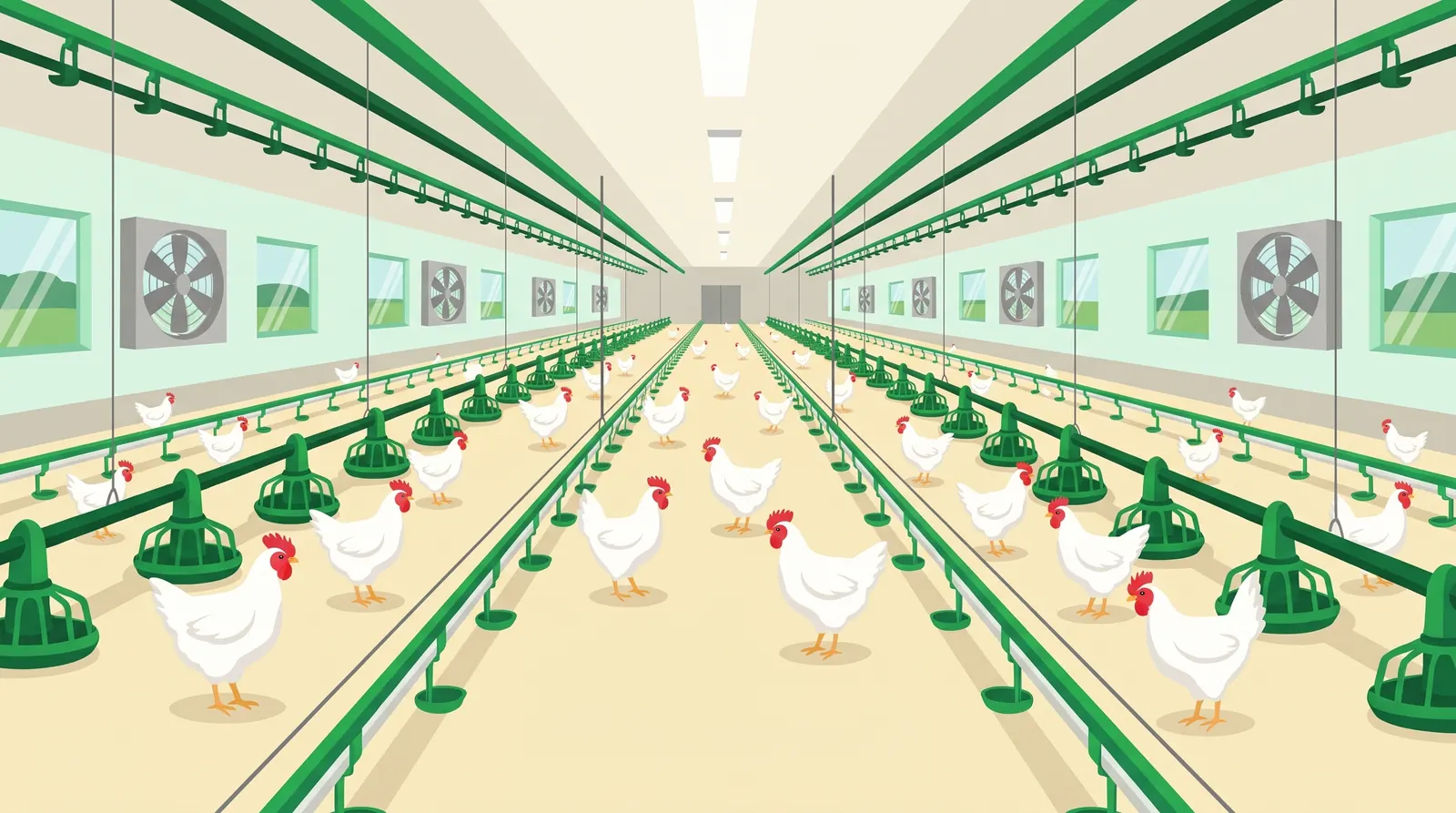
Many farm jobs repeat daily: walking the house, finding and removing dead birds, collecting eggs laid outside the nest, checking litter. The work is tedious and people to do it are hard to find. Each time a person enters the house, there is also a risk of bringing in disease. Robots are a natural candidate to take over part of these tasks.
A promise in the catalog, a result in the house
More robots are on offer, and the marketing describes them with great confidence. A farmer who buys one wants to know whether, after a few cycles, fewer dead birds are missed on the walk-through, fewer eggs are laid on the floor and the litter is better. Without recording these numbers before and after the purchase, all you have is an impression. For a practical description of the robots available, see poultry house robots and what they can already do.
How we handle it
1. House equipment recorded with the building
In the "Technical equipment of the building" step you record which robots, sensors and monitoring systems are in the house, next to the flock record. This works today.
2. Mortality and the mortality trend
You note the number of dead birds every day in the flock record and see the mortality trend. You can compare cycles before and after you introduced a robot. This also works today.
3. Sensors in the app
Readings from gas sensors, temperature and humidity go into the app, and threshold alarms warn you when limits are exceeded. They give you a reference point for the measurements a robot collects.
4. Measurements and events from robots
We are researching how to accept measurements and events from robots, for example the number of dead birds found or a map of wet spots, and we are building this into the app. A robot's result is meant to appear next to the flock record, and the farmer decides what to do with it.
What the research says
Check a robot's performance on your own farm
Ozenturk and colleagues (2023), from Queen Mary University of London and Atatürk University, reviewed robots for monitoring conditions, disease control, collecting floor eggs, disinfection, litter handling and encouraging birds to move. The main caveat concerns commercial robots: companies usually do not publish data, and independent studies are few. Functions such as detecting sick and dead birds or wet litter spots rest mostly on product specifications. That is why recording equipment and mortality for each house is the basis for your own assessment.
A test result and a result in your house are two different numbers
According to the review, a robot with a spiral spring collected over 95% of floor eggs in early tests. On a commercial farm it drove over 3000 m on its own but collected only 46% of 300 eggs. Another robot with image recognition collected 60–88% of eggs on a flat floor. Robots with an arm and a gripper or suction cup reached 91.6% and 92–94%, but under test conditions. This gap is the best argument for counting results in your own house.
Detecting dead birds works, removing them does not yet
A robot that recognized dead hens from images reached 97.5% accuracy, 95.24% precision and 100% recall in a test. But a dead bird in a sitting or lying position looks very much like a healthy one. A robot arm with a camera and grippers picked up dead hens lying on a table in 53.3% of attempts in the weakest light and 90% in the strongest, but it was not tested in a house. Most robots that detect sick birds cannot remove them. That is why we are working on bringing robot events into the app, where the farmer judges them.
Birds get used to robots if they start early
In a study where a robot drove through a broiler house three times a day for 6 weeks, bird activity rose less than when a person walked through, and there were few startle reactions. Before day 9 of life, no flapping or jumping was seen. In laying hens, a robot working for 1–2 weeks did not change corticosterone, the stress hormone, or production results. A disinfectant-spraying robot delivered enough product, but for navigation it needed markers placed by hand in the house. So the review shows that a robot does not harm the flock, but its benefit has to be measured.
What the farm gains
You know whether a robot pays off
Mortality, sensors and house equipment are in one place. You compare cycles before and after introducing a robot instead of relying on the catalog.
Fewer entries into the house
When robot and sensor measurements show up on your phone, some walk-throughs made "just to check" are no longer needed. Every entry you can avoid lowers the risk of bringing in disease.
Order in your equipment
A list of robots, sensors and systems in each house helps at service time, at inspections and when planning further purchases.
Let's talk about your house
Do you have a robot in your house, or are you still thinking about one? Get in touch through the contact form at the bottom of the page. We write more about finding dead birds in our article on automatic detection of dead birds.
Frequently asked questions
How do I record a robot in DlaFerm?add
In the "Technical equipment of the building" step you record the robots, sensors and monitoring systems working there. The list is visible next to the flock record.
Does DlaFerm sell robots?add
No. You record the equipment you already have. We are researching how to accept measurements and events from robots and building this into the app.
How much work does record keeping take?add
You enter the equipment once. Mortality is noted daily in the flock record, from your phone, and the mortality trend calculates itself.
What if there is no signal in the poultry house?add
The farmer's app works offline. Entries send themselves once the phone picks up a signal.
Will a robot collect all the floor eggs?add
No. In early tests one robot collected over 95% of eggs, but on a commercial farm only 46% of 300. Other prototypes reached 60–94%, mostly under test conditions.
Can a robot replace the walk-through and the vet?add
No. A robot can point out a dead or sick bird and collect measurements, but most robots cannot remove a bird, and a veterinarian diagnoses disease.
How do you know robot results need checking on your own farm?add
A 2023 research review notes that makers of commercial robots usually do not publish data, and independent studies are few. Where tests exist, lab and house results differ clearly: over 95% of eggs in the first test versus 46% on a commercial farm, and a robot arm picked up dead hens in 53.3% of attempts in weak light and 90% in strong light. Birds also moved away from the robot farther than from a human they knew, which the authors link to the robot's sound and speed.
Sources & resources
Prepared by: DlaFerm Team based on data from the sources listed · Publisher: INSTA-TECH sp. z o.o.
Let's talk about robots and data from your poultry house
Want to check whether a robot in your house really helps? Get in touch. We will show you how DlaFerm records equipment, mortality and sensors, and how we are working on robot data. You can also create a free farm account in the <a href="/program-do-zarzadzania-ferma-drobiu">DlaFerm farm management app</a>.
Phone
+48 796 258 151