Agricultural land tax in Poland 2026: rates and who pays
In 2026, agricultural land tax in Poland is paid by owners, perpetual usufructuaries and independent possessors of farmland. The amount depends on converted area and the rate set in law, not on how many birds you keep. Farm buildings such as poultry houses, feed stores and silos are taxed separately, under property tax. The legal state described here is 22.11.2026.
verifiedFrom the team that has organised work on poultry farms for years.
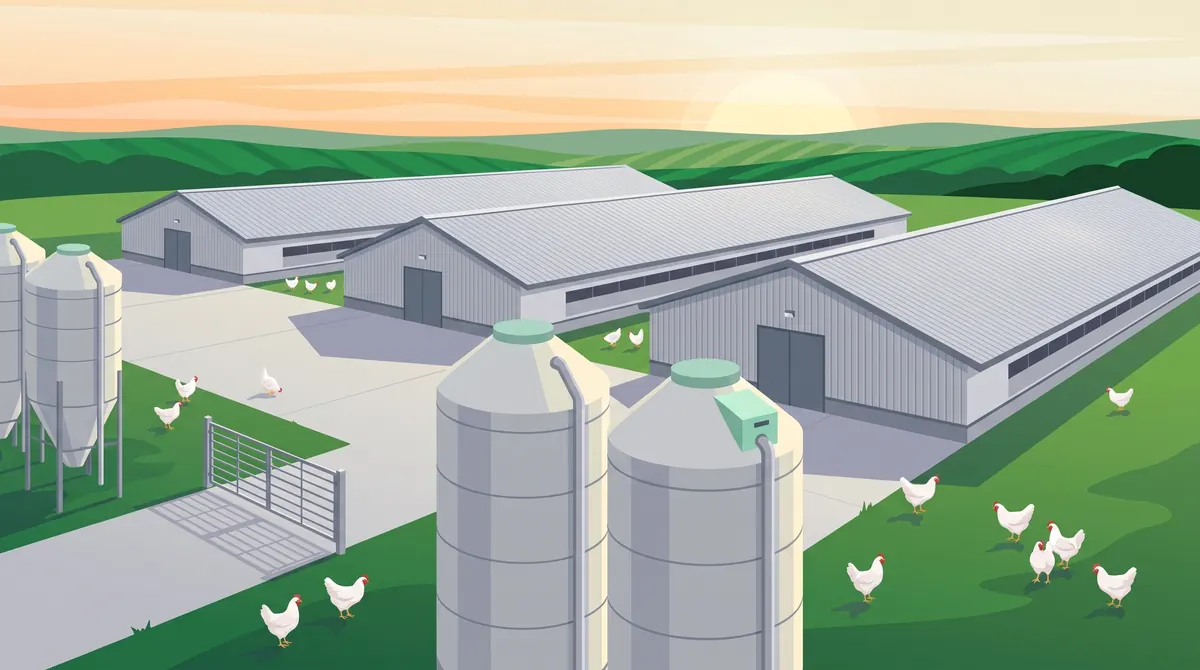
In 2026, agricultural land tax in Poland is paid by owners, perpetual usufructuaries and independent possessors of land that is registered as agricultural. The amount does not depend on the number of birds in the house or on your output. It depends on your agricultural area converted into conversion hectares (hektary przeliczeniowe) and on the rate set in the law. Before you pay, check whether the rules have changed since 22.11.2026.
Who pays and who does not
The duty falls on whoever owns the land or holds a legal title to it that the law lists. A tenant usually does not pay tax on rented land, but a lease can pass the cost on to the tenant, so read the terms before you sign. If some of your land belongs to family and some you rent, each parcel is treated by its legal title. Keep the list of parcels and legal titles in one place, for example in farm management software.
What sets the amount of agricultural land tax
The conversion hectare
Tax is not calculated on raw area but on conversion hectares. The conversion factor depends on the soil class of the land, meaning its productive capacity. Good soils have a higher factor than poor ones, so two hectares of the same size can give different tax bases. You can find the classification in the land and buildings register kept by the county office (starostwo). If your papers lack data, ask the office for an extract.
Rye price and the statutory rate
The rate is expressed as the equivalent of the price of rye. The President of GUS (Poland's Central Statistical Office) announces that price each year, so the amount you pay changes with the rye price even when your acreage stays the same. Neither the municipality nor the farmer sets the rate. It comes from the act on local taxes and fees. Check the current text in ISAP, Poland's online legal acts system, because the act is amended from time to time.
Poultry houses and stores fall under property tax
Buildings are outside agricultural land tax
A poultry house, feed store or silo is not part of agricultural land tax. Farm buildings are taxed under property tax, usually calculated by floor area. The municipal council (rada gminy) sets the rates within a limit that the Minister of Finance announces every year. For a poultry farm this tax can be a bigger item than the land itself, because the houses are large. Check the amount with your municipal office, not by copying a neighbor's rate.
Land under the buildings
Land taken up by farm buildings may be taxed differently from the cropland around it. The split depends on how the land is classified in the register and whether it serves farming activity. For large projects, such as a new house or an extension, ask the municipal office before work starts. A change of use or classification affects your tax in the following years. Enter each building with its own area.
Exemptions worth asking about
Statutory exemptions
The act provides exemptions for certain types of land and certain taxpayers. The scope is often narrow and has conditions on the kind of use or the status of the holding. Do not assume you are exempt just because you run a poultry farm. Before you skip a payment, compare the conditions with the current text of the act in ISAP and confirm them with your municipal office, especially if part of your land is rented.
Documents you may need at the office
When the office asks for clarification, it most often wants an extract from the land register, documents showing your legal title to the land, and a list of areas split by parcel. Lease agreements and their annexes are often added. Keep the data in one place and update it after every purchase or sale of a parcel. A running list of areas and buildings lets you answer the office faster.
Get your papers in order before the payment date
Deadlines and receipts
Payment deadlines for agricultural land tax and property tax come from the decision or notice issued by your municipality. Do not rely on habits from earlier years, because the municipality may change the date or the way it delivers the notice. Put the dates in the farm calendar and keep a confirmation of every payment. If you receive a decision, check the area and classification, since wrong input data is a common reason for corrections.
Invoices for work on buildings
Costs for repairing a poultry house, replacing ventilation or paving a yard are documented by invoices. We describe how they are issued and received in our article on KSeF for poultry farms (KSeF is Poland's national e-invoicing system). One point matters here: the invoice should carry the correct property details, so the cost can later be assigned to the right building.
Area in tax and in subsidies
Same land, different rules
One parcel can be the basis for agricultural land tax and for an area payment application, but these are two separate systems with their own rules. Payments are granted by ARiMR (Agency for Restructuring and Modernisation of Agriculture) on the basis of your application, while the municipality sets the tax under the act. Differences in area between the two sets of documents raise questions from the offices, so compare them before you file. We describe eco-scheme conditions in our article on eco-schemes for 2026.
When your area changes
Selling, leasing or handing over a parcel changes the tax base. Before you report a change, find out from the municipal office from what date the new data applies. Update your farm records too. Many farms keep the poultry house register and the land register apart, which leads to mismatches. It helps to combine them in one place, for example in a poultry house register, where building data is always at hand.
Frequently asked questions
Who pays agricultural land tax in Poland in 2026?add
The tax is paid by the owner, perpetual usufructuary or independent possessor of agricultural land. A tenant usually does not pay it for rented land, but the lease may require you to repay the cost. Check the lease terms before you settle up.
Is a poultry house subject to agricultural land tax?add
No. Farm buildings, including poultry houses and feed stores, fall under property tax, not agricultural land tax. The land under a building may need a separate assessment by the municipal office.
What determines the agricultural land tax rate?add
Your area converted into conversion hectares, the land class and the statutory rate, which is expressed as the equivalent of the price of rye. The President of GUS announces the rye price. Work out the amount once you know your parcel data and the current notice for the year.
Where can I check current rules and rates?add
The current text of the act is in ISAP, Poland's online legal acts system, and GUS notices are on the website of the Central Statistical Office. Property tax rates are set by the municipal council within a limit announced by the Minister of Finance, so ask your municipal office.
Do ARiMR payments affect agricultural land tax?add
They do not change the tax directly, but both rely on your land area. Differences in data between your payment application and the land register are worth clearing up before you file.
Is it worth keeping a record of farm areas?add
Yes. Offices and ARiMR ask for data on parcels, legal titles and buildings. Records in one place let you answer quickly without searching through different folders.
Sources & resources
- linkInternetowy System Aktów Prawnych (Poland's online legal acts system) — isap.sejm.gov.pl
- linkMinistry of Agriculture and Rural Development — gov.pl/web/rolnictwo
- linkARiMR — gov.pl/web/arimr
Prepared by: DlaFerm Team based on data from the sources listed · Publisher: INSTA-TECH sp. z o.o.
Want your land and farm buildings in one place?
DlaFerm.pl farm management software keeps records of areas, buildings and documents on one account. Create a free farm account and see how it works in practice.
Phone
+48 796 258 151