Sensors in remote buildings without cables: LoRaWAN and a silent-sensor alert
Running a cable to every silo and building is expensive, and Wi-Fi rarely works inside a poultry house. We offer battery sensors that send data by radio to one gateway on the farm, plus an alert when a sensor goes silent. We base this on connectivity and accuracy measurements in real livestock buildings.
verifiedFrom the team that has organised work on poultry farms for years.
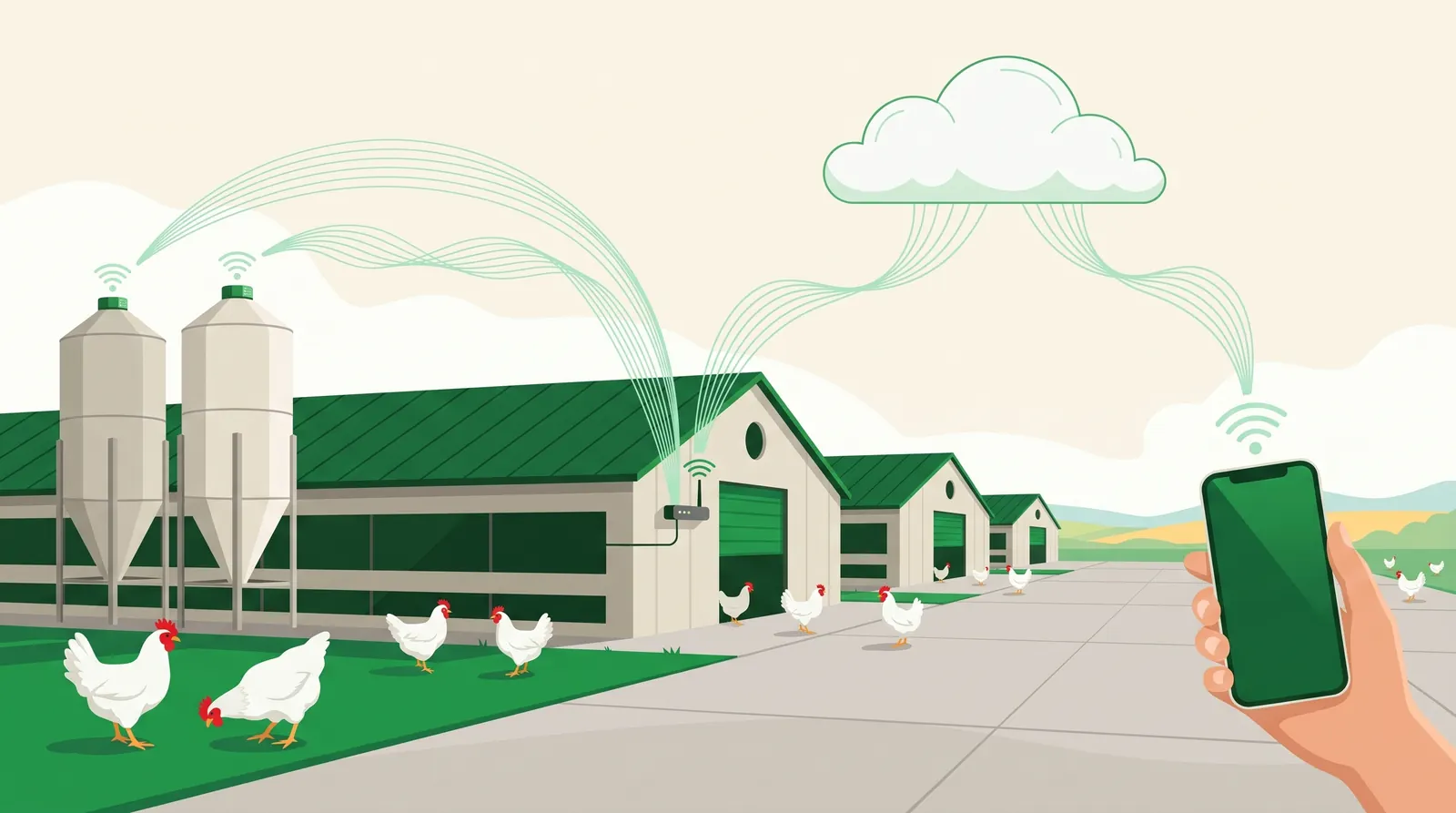
A cable to every silo costs money and work
A farm is several buildings and silos spread over a plot, sometimes over several plots. Running a cable to every measuring point is expensive, and Wi-Fi inside a metal poultry house usually does not work. So the silo often gets checked by eye, and a remote building gets checked on your rounds. We compare both routes in wired sensors vs LoRaWAN.
The alarm that never came
A sensor alarm only makes sense if data arrives on time and without gaps. The worst case is a sensor that stopped transmitting while the system shows what looks like a quiet day. Or a power cut that looks like a sudden drop in drinking in the data. You need to know whether silence means "all is well" or "we know nothing".
How we solve it
1. A battery sensor sends data by radio
LoRaWAN is a long-range radio network with very low power use. The sensor sends short data packets and needs no cable, socket or Wi-Fi. In silo monitoring, this is how the feed level sensor on top of the silo works today. The battery lasts for years.
2. One gateway for the whole farm
One LoRaWAN gateway, mounted in a building with power or on solar power, receives signals from all sensors and passes them to the DlaFerm server. The range reaches several kilometers, so it covers a farm spread over several plots.
3. An alert when a sensor is silent or the battery is weak
When a sensor stops transmitting, you get a notification. We warn you about a weak battery in advance. So silence in the data does not pass for an empty silo or a quiet day. This works today.
4. House climate from the controller
We currently pull temperature, humidity, ammonia, water and feed readings from climate controllers, in read-only mode, and show them with alarm thresholds for each house. You will find details on the page about sensor and controller integrations.
5. Our own wireless climate sensors
We are researching wireless climate sensors for poultry houses where the controller gives no readings, and we are rolling them out on farms. Before installing, you need to check the signal range in your specific building.
What the research says
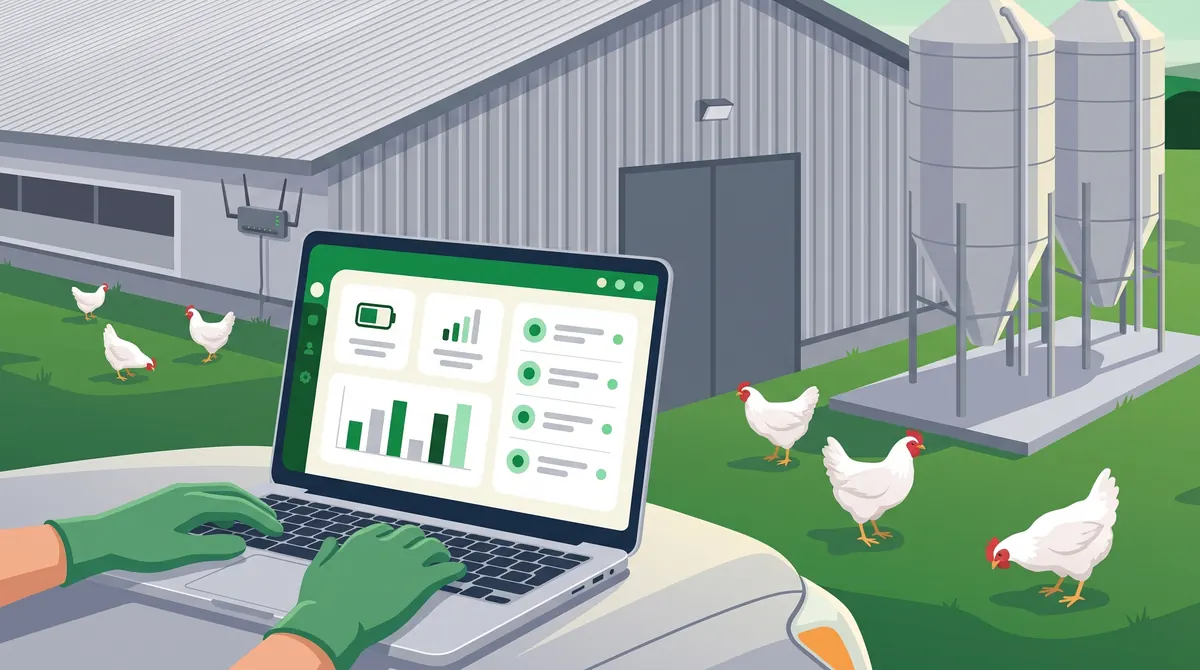
In a livestock building, almost every measurement gets through
Yi and colleagues (2026), in a paper in the journal Animals, built a node with sensors for temperature, humidity, carbon dioxide, ammonia, air speed and light intensity. The nodes transmitted over LoRa at the shortest transmission time, saving a record every minute, and a gateway passed the data on over the cellular network. Nine nodes ran on three commercial beef cattle farms for 14 days. Total data availability was 99.66%. This is the basis for choosing radio connectivity for remote measuring points.
A gap in the data means no data, not zero
Ocepek (2026), in a paper in Scientific Data, described an open dataset on the movement of 16 finishing pigs over the last 20 days before slaughter, collected with a system of RFID readers and LoRaWAN connectivity. The dataset has 1,048,573 records. Of 7,680 possible hourly blocks, 6,026 were complete, about 78%. Complete gaps appeared at the start and end of the study because of technical interruptions, and the author notes they should be treated as missing data, not as no movement. That is why we raise a separate alert for a silent sensor.
The weak link is power and hardware, not the radio
In both studies the radio was not the main problem. With a record every minute, 99.66% of data arrived, and the gaps in the pig dataset came from technical interruptions. Power, continuous hardware operation and the accuracy of the sensors themselves mattered more. Hence our alerts about battery and silence, not only about a crossed threshold.
Temperature is reliable, ammonia needs caution
On one of the cattle farms, node readings were compared minute by minute with commercial instruments. Temperature and humidity agreed best (coefficient of determination R² 0.995 and 0.994), then light (0.990), air speed (0.863) and carbon dioxide (0.773). Ammonia did worst: R² 0.604, improving after averaging readings to 10 minutes. Most ammonia readings below 5 ppm were extrapolated. So we assess gas sensors separately, and write more about them on the page about NH₃ and CO₂ sensors.
Metal walls dampen the signal, so check the range on site
The studies come from cattle buildings and a pig house. We found no LoRaWAN measurement in a metal poultry house, and a steel structure strongly dampens radio signals. So before installing a whole network, check the range inside the building and, if needed, plan an indoor antenna or a second gateway, which also gives you a backup if power is lost.
What the farm gains
Measurement where there is no power
A silo at the far end of the plot or a building with no mains gets a sensor without digging trenches for a cable. You mount it and do not come back to it for years.
You know when data is incomplete
A silent-sensor alert tells you plainly that data is missing. You do not make decisions based on a gap that looks like zero.
Fewer rounds made only to check
You see feed level and readings from remote points on your phone. You do your rounds to look after the flock, not to peek into a silo.
Let's talk about range on your farm
Want to know whether the signal will pass through the walls of your houses and where the gateway should go? Write to us through the contact form at the bottom of the page.
Frequently asked questions
How does a LoRaWAN sensor work?add
The sensor runs on a battery and from time to time sends a short packet with a reading by radio to a gateway on the farm. The gateway passes the data to the DlaFerm server, and you see it in the app.
What equipment do you need for LoRaWAN on a farm?add
Sensors at the measuring points and one LoRaWAN gateway per farm. The gateway is mounted in a building with power or on solar power. Internet is needed only at the gateway.
How much work is installation?add
The sensor needs no cable or socket. Once mounted, you assign it in the app to a silo or a poultry house. Before installing a whole network, check the signal range in your buildings.
What if there is no cellular signal in the poultry house?add
The sensor uses neither cellular nor Wi-Fi. It only needs radio range to the gateway, which reaches several kilometers in open terrain. You can also make entries in the farmer app without a connection, and they send when the phone gets a signal.
What happens when a sensor stops transmitting?add
You get a notification that the sensor is silent. We warn you about a weak battery in advance. Missing data is never shown as zero.
Can LoRaWAN send camera images?add
No. LoRaWAN carries small amounts of data, such as temperature or feed level. Cameras and microphones need a cable or another type of connection.
How do you know LoRaWAN works in livestock buildings?add
In a study of nine nodes on three cattle farms over 14 days, 99.66% of data arrived with a record every minute. Temperature and humidity matched commercial instruments almost perfectly (R² 0.995 and 0.994), and ammonia matched worst (R² 0.604). In a dataset on 16 finishing pigs with LoRaWAN connectivity, about 78% of hourly blocks were complete, and the gaps came from technical interruptions at the start and end of the study. We found no measurements in metal poultry houses, so check the range on site.
Sources & resources
- linkYi G., Wang X., Jiang S., Zhao J., He T., Chen Z. (2026). Field Verification and Multi-Site Deployment of a Multi-Sensor Node for Continuous Environmental Monitoring in Commercial Beef Cattle Facilities. Animals 16(18), 2862
- linkOcepek M. (2026). Within-hour incremental movement data of finishing pigs over 20 days using RFID–LoRaWAN technology. Scientific Data 13, 1202
Prepared by: DlaFerm Team based on data from the sources listed · Publisher: INSTA-TECH sp. z o.o.
Let's talk about cable-free sensors on your farm
Want to measure feed in a silo or conditions in a remote building without running cables? Try the <a href="/integracje-irzplus-czujniki">DlaFerm sensor integrations</a>. Create a free farm account or get in touch, and we will show you LoRaWAN sensors in DlaFerm and suggest where to put the gateway.
Phone
+48 796 258 151