Camera AI on a farm with a weak connection: the image stays on site, only the result goes to the system
A camera that streams video all day needs a connection many farms do not have, and footage of people in the biosecurity lock should not leave the farm. We propose analyzing the image on site, so only the result reaches DlaFerm. We build on studies showing that bird recognition fits into a small device next to the poultry house.
verifiedFrom the team that has organised work on poultry farms for years.
You have the camera, but not the connection
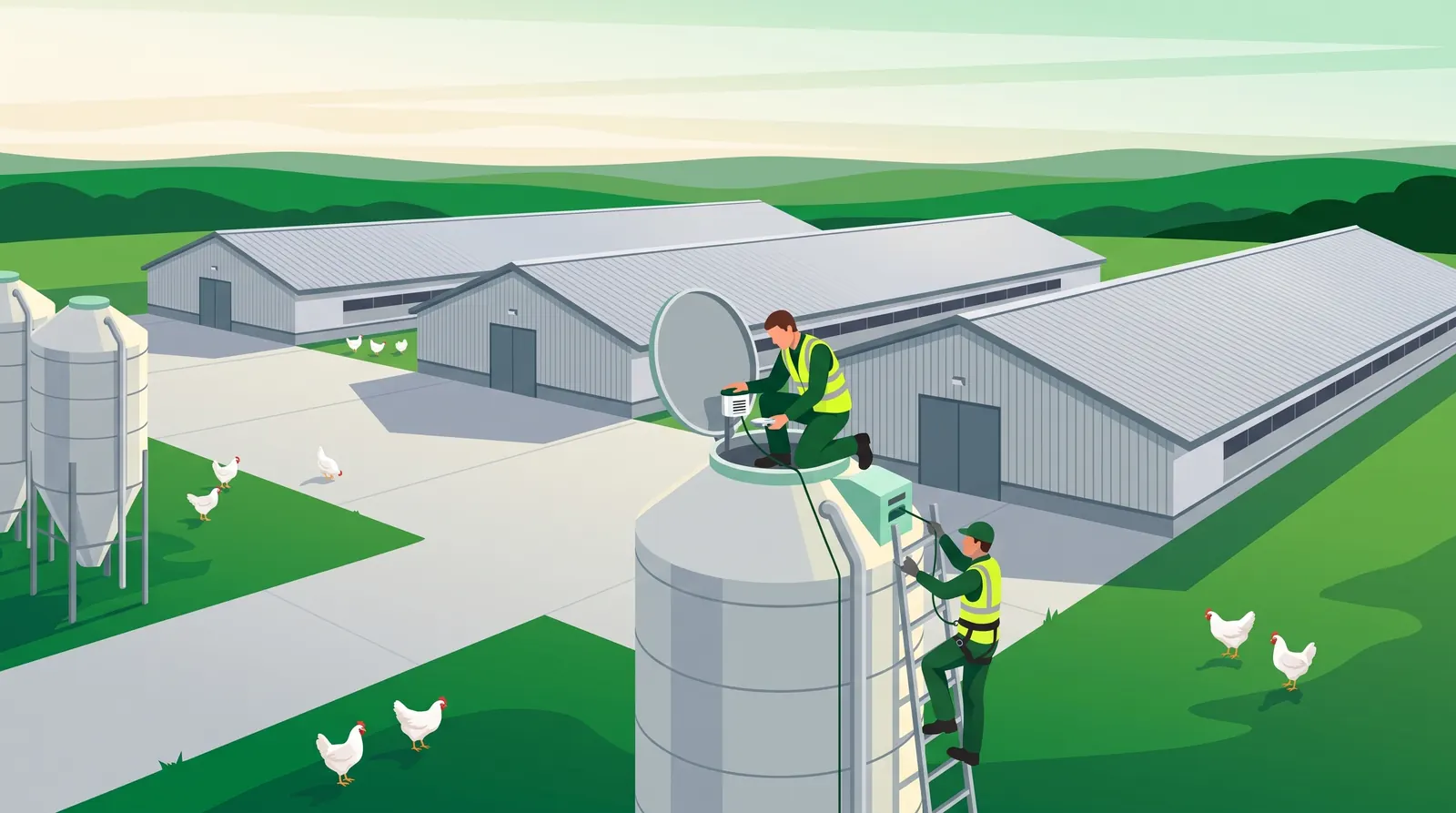
On many farms the internet barely covers a phone call in the office. A camera that streams video all day clogs that connection in minutes, and when the network drops, it analyzes nothing. On top of that, footage from the house and the lock shows people at work and should not leave the farm without need. For the bigger picture of what AI can do on a farm, see our guide to AI on a poultry farm.
A big model does not fit in a small box
Image recognition programs that run well on a server often do not fit in a small device by the poultry house. And inside the house you have dust, ammonia, moisture and heat. The farmer's question is simple: can you recognize birds on site, on hardware that survives in the building, and will the result be reliable?
How we solve it
1. Images analyzed on the farm
Edge computing means the image recognition program runs on site: in the camera or in a relay device on the farm. Only the result reaches DlaFerm, not the whole video. This is how farm entry control works today: a camera at the gate reads the license plate, and the system receives the plate, the direction and the time.
2. Reading from a photo, with a confidence score
In the flock record, AI reads the water meter from a photo and gives a confidence score for the reading. If the photo is unreadable, it does not guess. This also works today.
3. Counting birds and spotting birds with symptoms from house cameras
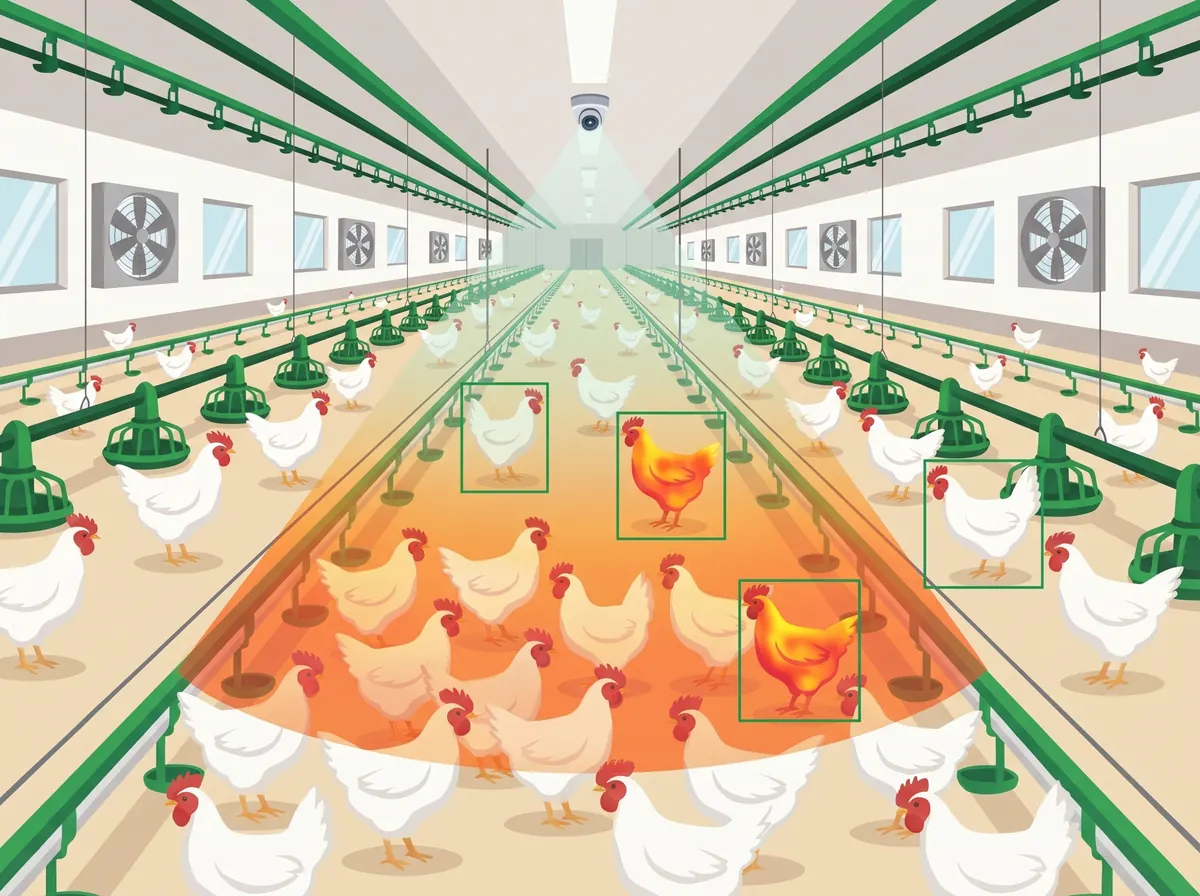
We are researching, and rolling out in poultry houses, bird counting, detection of birds with symptoms and assessment of flock behavior from cameras analyzed on site. The result is meant to reach the flock record as a hint for the farmer.
4. The decision stays with a person
A bird marked as showing symptoms is a signal to walk into the house and look. The farmer assesses it, and a veterinarian diagnoses the disease.
What the research says
Sick hens can be recognized inside the camera itself
Tong and co-authors (2024) mounted four small cameras on an automatic feed cart that runs several times a day along four-tier cage batteries of laying hens. Recognition ran inside the image sensor, with a built-in processor and 8 MB of memory. The dataset had 30,131 photos from poultry houses in China, including 19,993 from the cart cameras, collected over five months from more than 2700 hens. The simplified detector reached a mean average precision (mAP) of 95.1% and an F1 of 94.2%, at more than 20 frames per second. The camera sent only a few bytes with the result for sick birds.
A small computer can count broilers in a dense flock
Boniche and co-authors (2026), in a paper in the journal Poultry, compared three lightweight detection models on photos from an experimental farm and from a commercial house with high stocking density, where birds overlap. The best model reached a mean average precision of 0.95. Running on a small single-board computer, it analyzed one frame stably in 392 ms, roughly two and a half frames per second. The authors note that in real conditions such a device needs active cooling. So the analysis device should sit outside the bird area.
A big model can be shrunk with almost no loss
Yang and Hostens (2026) shrank a model that finds and tracks animals in video from 446 million to 40.66 million parameters in the vision part. On a public set of pig recordings, the simplified system tracked animals with a MOTA of 92.29% and an IDF1 of 96.15%, losing only 1.68 and 0.84 percentage points against the full model. Peak memory use fell from 19.52 to 6.49 GB, and recognition of nine behaviors reached an accuracy of 97.34%. The system fit on a module with a graphics processor and 16 GB of memory. This shows that harder tasks, such as behavior tracking, can also be moved onto the farm.
Results depend on the place, so the model must be retrained
Results around 95% came from photos of specific poultry houses, breeds and lighting. In the hen study, the real-conditions test set had 500 photos, and in real cages there are far more healthy birds than sick ones. On another farm accuracy may be lower until the model has seen examples from that site. So before camera alerts reach the farmer, the model must be checked on photos from that farmer's own houses.
What the farm gains
Works on the connection you already have
A result instead of a video is a few bytes. A weak farm connection is enough, and when the network drops, on-site analysis keeps working.
Recordings of people stay on the farm
A camera in the lock or at the gate does not send images of workers to the cloud. The system gets only what it needs: plate, time, result.
Less retyping
Water meter readings from a photo and plates from the camera are entered by themselves. You do not copy numbers from the meter or vehicle numbers from a notebook.
Let's talk about cameras in your houses
Do you have cameras in your poultry house, or are you thinking of installing them? Write to us through the contact form at the bottom of the page. For more on cameras in the house, see weighing poultry with an AI camera.
Frequently asked questions
How does on-site image analysis work?add
The image recognition program runs in the camera or in a small device on the farm. The image does not leave the farm, and only the result reaches DlaFerm, for example a plate and time, or the number of birds in the frame.
What equipment do you need?add
For entry control you need a camera with plate recognition at the gate and a relay device on the farm. For the water meter, a phone is enough. For analysis in the house you need cameras and an analysis device, ideally in the entrance area, in a sealed housing with an air filter.
How much work does setup take?add
Reading the water meter from a photo works from day one in the flock record. The gate camera is mounted once, and you enter a list of partners whose vehicles arrive regularly. Analysis in the house needs the model checked first on photos from your farm.
What if the farm loses its internet connection?add
On-site analysis does not need a constant connection. You can also make entries in the farmer's app without a network, and they send when the phone gets a signal.
Can a camera replace a veterinarian?add
No. A bird marked as showing symptoms is a signal to check the house. A veterinarian diagnoses the disease.
What data goes to DlaFerm?add
Results, not recordings: at the gate the plate, direction and time, and at the water meter the number read with its confidence score. Plate readings delete themselves after the number of days the farm sets.
How do you know this fits in a small device?add
In a study of a laying-hen house, recognizing sick birds inside the image sensor reached an mAP of 95.1% at more than 20 frames per second. In a study of broilers in a dense flock, a small single-board computer analyzed a frame in 392 ms at a mean average precision of 0.95, but needed active cooling. In a pig study, a shrunk model tracked animals almost as well as the full one (MOTA 92.29%), using 6.49 instead of 19.52 GB of memory.
Sources & resources
- linkTong Q., Wang J., Yang W., Wu S., Zhang W., Sun C., Xu K. (2024). Edge AI-Enabled Chicken Health Detection Based on Enhanced FCOS-Lite and Knowledge Distillation. arXiv:2407.09562
- linkBoniche K., Hidalgo-Rodriguez M., Acosta-Reyes A.M., Cruz E., Rangel J.C., Cazorla M., Gomez-Donoso F. (2026). A Lightweight Deep Learning Model for Broiler Population Monitoring on an Edge AI Platform. Poultry 5(3), 36
- linkYang H., Hostens M. (2026). Lightweight Distillation of SAM 3 and DINOv3 for Edge-Deployable Individual-Level Livestock Monitoring and Longitudinal Visual Analytics. arXiv:2604.27128
Prepared by: DlaFerm Team based on data from the sources listed · Publisher: INSTA-TECH sp. z o.o.
Let's talk about cameras and image analysis on your farm
Do you want to recognize vehicles at the gate, or are you thinking about cameras in the house but have a weak connection? Get in touch. We will show you what works today and how on-site image analysis looks. You can also create a free farm account in the <a href="/program-do-zarzadzania-ferma-drobiu">DlaFerm farm management system</a>.
Phone
+48 796 258 151