Bird flu between farms: faster reporting and a ready contact list
An outbreak creates zones, and neighboring farms wait to see whether the virus reaches them too. Detection time, and knowing who and what came onto the farm, decide how far an epidemic goes. We record mortality, visitors and vehicle entries, and we are researching and rolling out a contact list for suspected outbreaks, based on models of disease spread between farms.
verifiedFrom the team that has organised work on poultry farms for years.
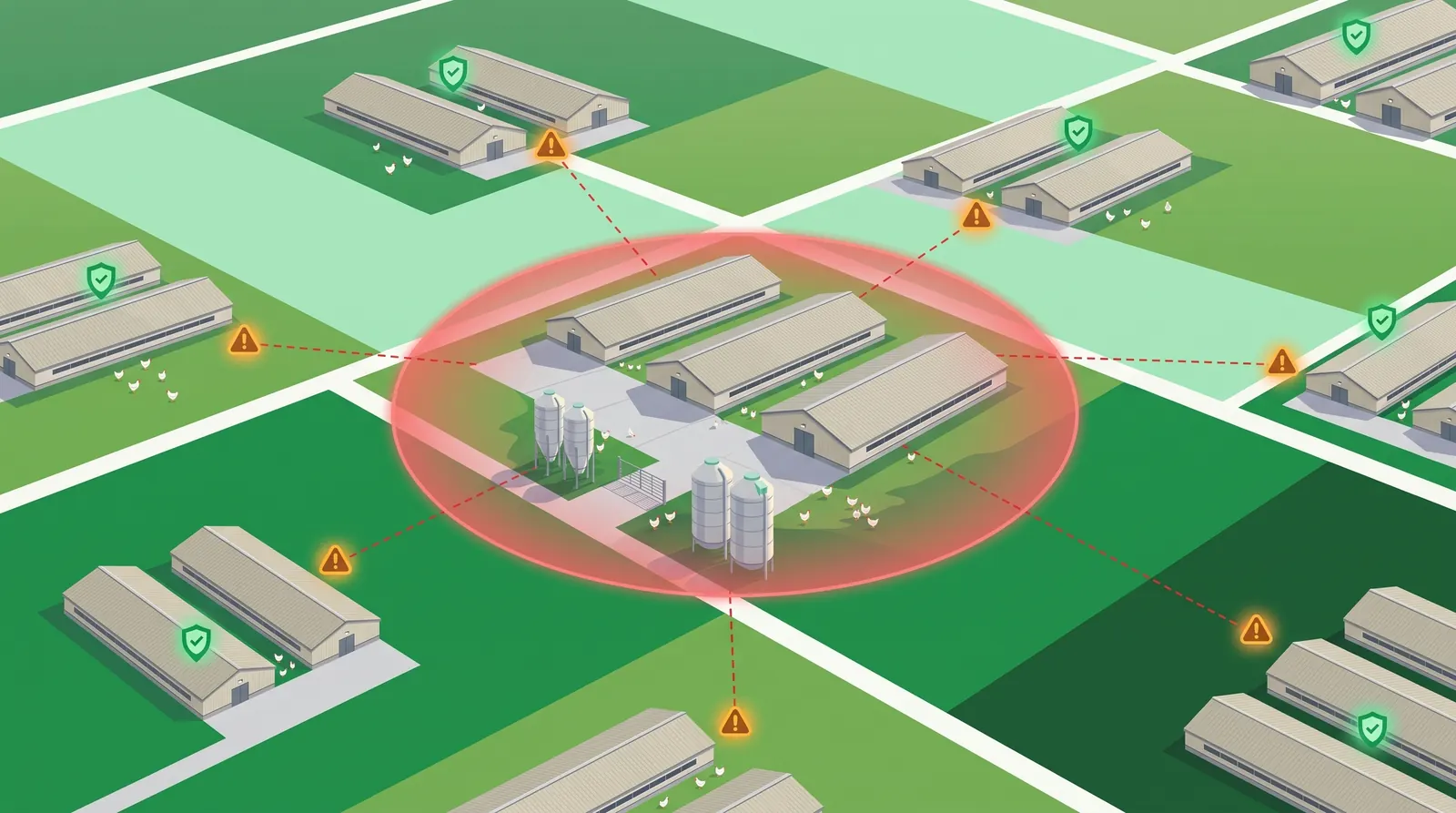
An outbreak is more than a lost flock
An outbreak creates zones, restricts the movement of animals and vehicles, and leaves neighboring farms waiting to see whether the virus arrives. In Poland the Veterinary Inspection (Inspekcja Weterynaryjna) decides on culling, zones and the date of restocking. Increasingly, these decisions rely on models that simulate how disease spreads between farms.
Every hour counts in the investigation
When an outbreak is suspected, the authorities ask who was on the farm, which vehicles came in and where they came from. If that information sits in a notebook or in managers' memory, rebuilding it takes days. Models show that time decides whether you get a few outbreaks or several dozen. We collected the general knowledge in our guide to avian influenza.
How we solve it
1. Mortality recorded daily (available now)
DlaFerm keeps a daily flock record with mortality. You see a rise in deaths right away, not a week later, and it is easier to decide whether to report a suspicion.
2. Visitors and vehicles recorded (available now)
The QR visitor log and vehicle entry control record who and what was on the farm. The visitor log alerts you when a guest recently visited a farm close to an active avian flu outbreak.
3. Contact list for a suspected outbreak (research and rollout under way)
We are researching how to quickly identify the farms your farm had contact with through vehicles and people in recent weeks, and how epidemic spread models work. We roll out the results in the app.
4. Plan for housing birds and restocking
Farms with free-range birds and duck farms should have a plan for housing birds quickly, ready before an order arrives. After an outbreak, gradual restocking is safer than returning to full stocking all at once.
5. The authorities decide during an outbreak
In an outbreak the veterinary authorities make the decisions, and we do not replace them. You report a suspicion to the county veterinary officer (powiatowy lekarz weterynarii), and the app data is meant to make that easier. See reporting a suspected HPAI case.
What the research says
Every day of delay multiplies outbreaks
Cardenas and colleagues (2025) described the first HPAI outbreak on a commercial breeder farm in Brazil in May 2025. The farm lost 15,650 birds. The virus probably entered 3–10 days before detection. A model built on 50,129 records of bird and egg movements gave a median of 4 secondary outbreaks when detection came after 3 days, 6 after 5 days and 34 after 10 days. A fast response let the outbreak die out in 32 days. In the control zone, 4197 vehicles were checked.
Contacts say more than distance alone
Gamża and colleagues (2024) compared the genetic relatedness of H5N1 viruses from outbreaks in Great Britain with data on birds and farms. In 2020–2022 relatedness was best explained by wild bird numbers, and in 2022–2024 by distance and sampling date. Rahul and Deardon (2024) showed, using data on 1079 farms from the foot-and-mouth epidemic in Cumbria, that a function learned from the data describes risk better than one formula chosen in advance. Akter and Deardon (2024) simplified fitting such models to ordinary logistic regression. A record of visitors and vehicle entries is the missing piece in these models.
Housing birds works when it is early
Fatoyinbo and colleagues (2026) built an HPAI model for a fictional island with broiler and duck farms. Delaying bird housing from 31 December to 14 February raised the epidemic peak by 91%. Preventive culling reduced the total burden by 16.7%.
Gradual restocking lowers the risk of recurrence
In the same model, restocking according to free farm capacity cut the risk of recurrence from 0.780 to 0.533. The same team, in a model of dairy cattle and wild birds (2025), showed that reducing infections between animals gives the biggest gain, and reducing environmental contamination alone gives less. Restocking dates are set by the authorities.
What your farm gains
Faster reporting
A daily mortality entry is the strongest tool a farm has for limiting an epidemic.
An investigation in hours, not days
Visits and vehicle entries are recorded with dates. The authorities get the list at once.
Calmer talks with neighbors and your integrator
Biosecurity records show what the farm did before and during the outbreak.
See your own farm's contact list
If you want to see how a contact list is built from your farm's data, write to us using the form at the bottom of the page.
Frequently asked questions
How does DlaFerm help when bird flu is suspected?add
You have a daily flock record with mortality, a QR visitor log and vehicle entry control. We are researching and rolling out the list of farms your farm had contact with.
What equipment do I need?add
A phone with the app and a QR code at the entrance, which guests scan with their own phones without installing an app. A camera with plate recognition at the gate records vehicle entries, and a drive-on scale can add the vehicle's weight.
How much work is the setup?add
You can complete the account and farm wizard in one afternoon. You print the QR code and hang it at the gate, and staff record mortality as it happens.
What if there is no signal on the farm?add
You make entries offline, and the app sends them when the phone gets a signal.
Does the app replace a vet or the authorities?add
No. You report a suspicion to the county veterinary officer. The veterinary authorities decide on culling, zones and restocking.
When can I restock birds after an outbreak?add
The veterinary authorities set the date. Models show that the risk of recurrence falls as the epidemic dies out, and gradual restocking is safer than full stocking all at once.
What data do you collect?add
Mortality from the flock record, visitor entries from the visitor log and vehicle entries, with date and time.
How do you know detection time matters so much?add
In the Brazil outbreak model, the median of secondary outbreaks was 4 with detection after 3 days and 34 after 10 days (Cardenas team, 2025). In the island model, delaying bird housing by about six weeks raised the epidemic peak by 91% (Fatoyinbo team, 2026). Data from Great Britain showed that risk depends on contacts and wild birds, not only on distance.
Sources & resources
- linkCardenas N.C. et al. (2025). First highly pathogenic avian influenza outbreak in a commercial farm in Brazil: outbreak timeline, control actions, risk analysis, and transmission modeling. arXiv:2509.08492 (also Preventive Veterinary Medicine, 2026)
- linkGamża A., Lycett S., Sanchez A., Kao R. (2024). Using sequence data to study spatial scales of interactions driving spread of Highly Pathogenic Avian Influenza in Great Britain. arXiv:2411.10424
- linkFatoyinbo H.O., Ghosh I., Tiwari P., Olanipekun P.O., Abidemi A., Ip R.H.L. (2026). Stochastic Spatial Metapopulation Modelling of HPAI Control and Poultry Restocking on Jolly Island. arXiv:2608.12956
- linkFatoyinbo H.O., Tiwari P., Olanipekun P.O., Ghosh I. (2025). A mathematical model of HPAI transmission between dairy cattle and wild birds with environmental effects. arXiv:2508.12201
- linkRahul C.R., Deardon R. (2024). Individual-level models of disease transmission incorporating piecewise spatial risk functions. arXiv:2405.00835
- linkAkter T., Deardon R. (2024). Conditional logistic individual-level models of spatial infectious disease dynamics. arXiv:2409.02353
Prepared by: DlaFerm Team based on data from the sources listed · Publisher: INSTA-TECH sp. z o.o.
Be ready before an outbreak arrives
We will show you how the flock record, visitor log and vehicle entry control work in the app, and how we are rolling out the farm contact list. Try the QR visitor log with a free farm account, or get in touch.
Phone
+48 796 258 151