Suspected disease and outbreak on a poultry farm: duties, valuation, compensation
If you suspect an infectious disease in your poultry flock in Poland, you report it to the district veterinary officer (PLW, powiatowy lekarz weterynarii) without delay. Until the officer arrives, you isolate the flock, move no animals or products off the farm and record the signs. Below we cover your duties, valuation and compensation, including reductions of 15–60%, and restocking after 21 days.
verifiedFrom the team that has organised work on poultry farms for years.
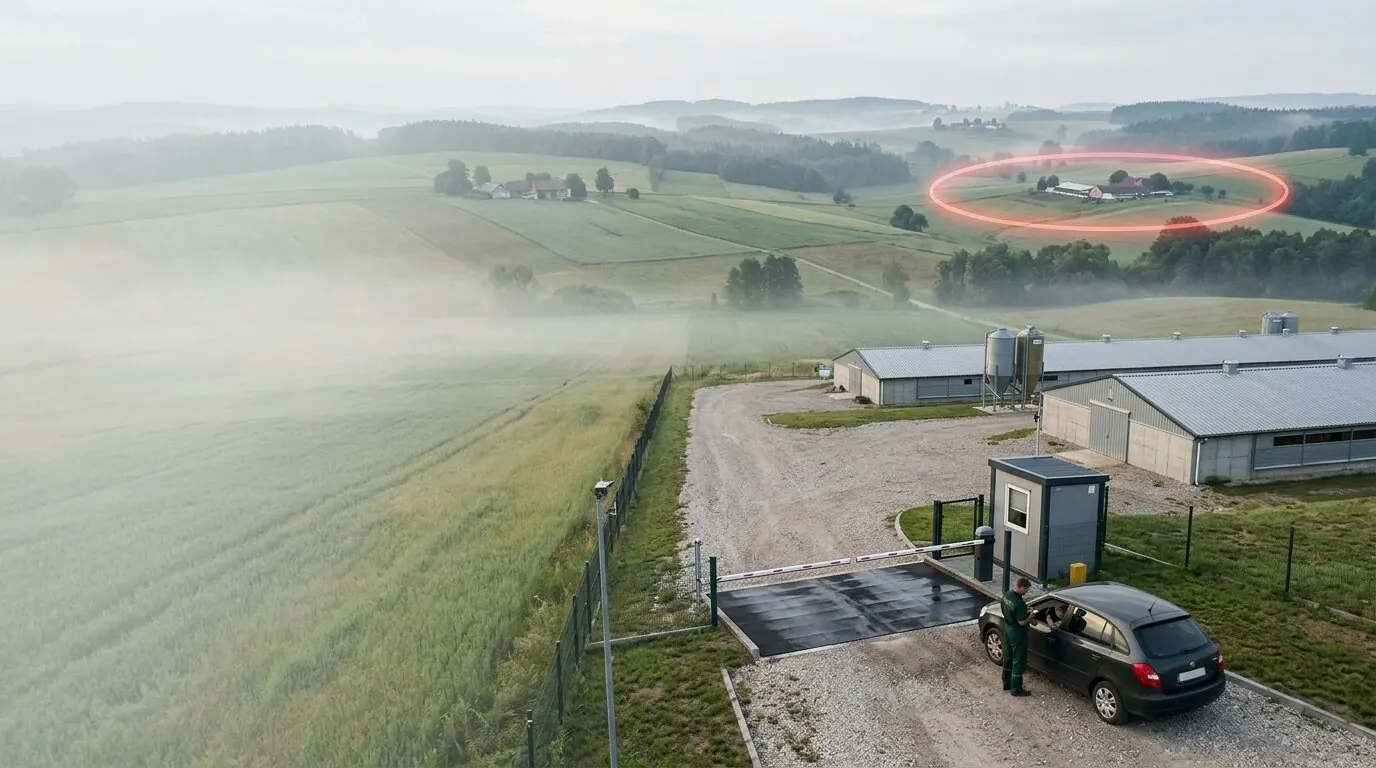
If your birds show signs that could point to an infectious disease, you must report it to the PLW at once. You do not wait for test results or for the cause to be confirmed. Until the officer arrives, you isolate the flock, stop all movements of animals and products, and write down what is happening. The duty comes from Poland's Animal Health Act (Dz.U. 2025 poz. 1795, Poland's Journal of Laws), in force since 18.03.2026. Failing to report a disease is punishable by a fine of 0.3 to 6 times the average monthly wage, and compensation after an outbreak can be reduced.
Why every hour counts
Infectious disease spreads through people, equipment, vehicles and clothing. So the rules ask not only whether you reported, but also what you did before the PLW arrived. A well-prepared plan speeds up your response and lowers the risk of penalties. The biosecurity plan generator helps you set the rules, and we explain how to divide a farm into zones in our guide to the clean and dirty zone.
When and how to report suspected disease
Signs that call for action
The rules list the signs you record every day during flock checks: mortality, lower feed and water intake, nervous signs, breathing difficulty, diarrhea, a drop in egg laying and abnormal eggs (Dz.U. 2026 poz. 335). If you see any of them, you notify the PLW or a veterinarian straight away. A single sign does not have to mean disease, but you decide to report when a sign keeps repeating or gets worse. For practical tips on reporting, see our guide on suspected HPAI (avian influenza): how to report.
How to make the report
You report to the PLW by phone, then write down the date, the time, the person who took your call and what you told them. The rules require notification without delay, and the deadline for changes at the holding is no later than 7 days. The report does not replace your own records, so also note the number of birds in the house and the number of deaths from the previous day.
What to do until the PLW arrives
Isolating the flock
If you suspect disease, you isolate the flock and move no animals or products off the farm (Delegated Regulation (EU) 2020/687, art. 5). Limit entry to the house, close the doors and assign one person to look after the birds. Do not move equipment between buildings and do not let outside vehicles onto the site. If the flock is split across several houses, treat each house as a separate unit.
Records and a list of visitors
Write down who has been on the farm in recent days, because the PLW will ask about contacts and movements. The QR entry and exit log helps with this. Keep flock data in the digital flock record so numbers, age and deaths are ready without searching through notebooks. Treatment during this time is up to a veterinarian, who chooses the medicine and dose. You do not give birds any medicine on your own.
What happens once the disease is confirmed
Zones around the outbreak
Once a disease is confirmed, an infected zone and a protection zone are set up. For avian influenza (HPAI), Regulation 2020/687 gives a minimum of 3 km and 21 days for the infected zone, and 10 km and 30 days for the protection zone. We describe the zone rules and your duties in a separate guide, HPAI zones: your duties. The PLW sets the exact zone, so always ask about the boundaries.
Bans and fines in the zone
In the infected and protection zones, movement of animals, eggs, meat and manure is banned. Exceptions are possible only with PLW permission. Moving anything without permission can bring a fine of 0.2 to 5 times the average monthly wage (Animal Health Act, art. 98 para. 1 point 20). Lacking biosecurity is fined at 0.1 to 5 times, and a repeat offense within 2 years raises the fine by 25% (art. 100 para. 2).
Crisis plan
The base document of the GIW (Poland's Chief Veterinary Inspectorate) on farm biosecurity requires a crisis plan in case of a suspected infectious disease. The plan should describe the procedure, staff roles, equipment and material resources, and where feed and manure will be destroyed, plus a possible backup burial site. The document covers pig farms, but it is a good model for poultry. You can store your rules in the farm management software.
Valuation, the record and compensation
How valuation works
The valuation procedure is set by the Ministry of Agriculture regulation of 16.03.2026 (Dz.U. 2026 poz. 350). The value of animals killed on PLW order is the average of three valuations: one by the PLW and two by experts from the municipality's list. The PLW draws up the record, which includes the people valuing, the place and time, a description of the animals, the three valuation amounts and signatures. You have the right to add comments, so check every entry before you sign.
Data to prepare
Prepare your flock data: number of birds, age, weight and purchase documents. The experts base their valuation on these, and missing documents make it harder to set a value. We explain how to claim in our guide to avian influenza compensation. House records help you show when the flock was placed and what the stocking was.
What decides the amount
Compensation is paid at market value, but it can go down. For lapses in IRZ (Poland's animal register), the amount can be reduced by 15–30%. For failing to report a disease or not applying ordered measures, the reduction reaches 15–60% (art. 47 para. 5–7). Your conduct is assessed over the 6 months before the outbreak for IRZ and the 30 days before the outbreak for biosecurity. Whether these rules apply to large enterprises depends on a European Commission state aid decision, which we could not find as of the legal-state date.
Restocking after 21 days
Disinfection and timing
Under Regulation 2020/687 (art. 57), restocking is possible 21 days after final disinfection. The PLW sets the date for each outbreak, so do not assume it in advance. Before you place birds, report that cleaning and disinfection are finished and wait for the authority's decision. Document every step, because it is the basis for your next placement.
Placement plan after an outbreak
Once the procedures are done, build the new cycle in placement and cycle planning. Record the disinfection date, the date of approval and the placement date, and mark the new batch in the digital flock record. That gives later inspections and settlements one consistent record.
Frequently asked questions
When must I report suspected disease on a poultry farm in Poland?add
Without delay, meaning right away once you see signs that could point to an infectious disease. The Animal Health Act (Dz.U. 2025 poz. 1795) does not let you wait for test results. You report to the PLW, not just write it in a notebook.
What can I do before the district veterinary officer arrives?add
Isolate the flock, move no animals or products off the farm and limit entry to the house. Record the signs, deaths and everyone who was on the farm. Do not choose a medicine or dose yourself, because a veterinarian sets them.
What decides the compensation for birds culled in an outbreak?add
Compensation is based on the market value of animals killed on order. The value is the average of three valuations: the PLW and two experts from the municipality's list. Your conduct before the outbreak also affects the amount.
By how much can compensation be reduced?add
For lapses in IRZ, the amount can fall by 15–30%. For failing to report a disease or not applying ordered measures, the reduction reaches 15–60%. This rule is tied to art. 47 para. 5–7 of the Animal Health Act.
When can I restock a poultry house after an outbreak?add
Under Regulation 2020/687, restocking is possible 21 days after final disinfection. The PLW sets the exact date for your farm. Report that disinfection is finished before you place birds.
Who draws up the valuation record and what does it contain?add
The PLW draws it up. It lists the people valuing, the place and time, a description of the animals, the three valuation amounts and signatures. You have the right to add comments before signing.
Sources & resources
- linkGIW — Base document: farm biosecurity rules (exemption from testing), ver. 5.0
- linkChief Veterinary Inspectorate — gov.pl/web/wetgiw
- linkInternet System of Legal Acts — isap.sejm.gov.pl
- linkMinistry of Agriculture and Rural Development — gov.pl/web/rolnictwo
Prepared by: DlaFerm Team based on data from the sources listed · Publisher: INSTA-TECH sp. z o.o.
Want your flock data at hand when the PLW arrives?
With the house records module you keep flock records in one place, and the QR entry and exit log helps you work out who was on the farm. Create a free farm account and see how it works for you.
Phone
+48 796 258 151