Slaughterhouse results back on the farm: every batch with its origin, crew and slaughter summary
A grower gets only totals from the slaughterhouse and cannot tell whether the litter failed in one house or one catching crew was to blame. We propose a data flow in which every batch has its origin, its crew and a post-slaughter summary on record. It builds on research showing that a camera on the line can tell carcass defect types apart.
verifiedFrom the team that has organised work on poultry farms for years.
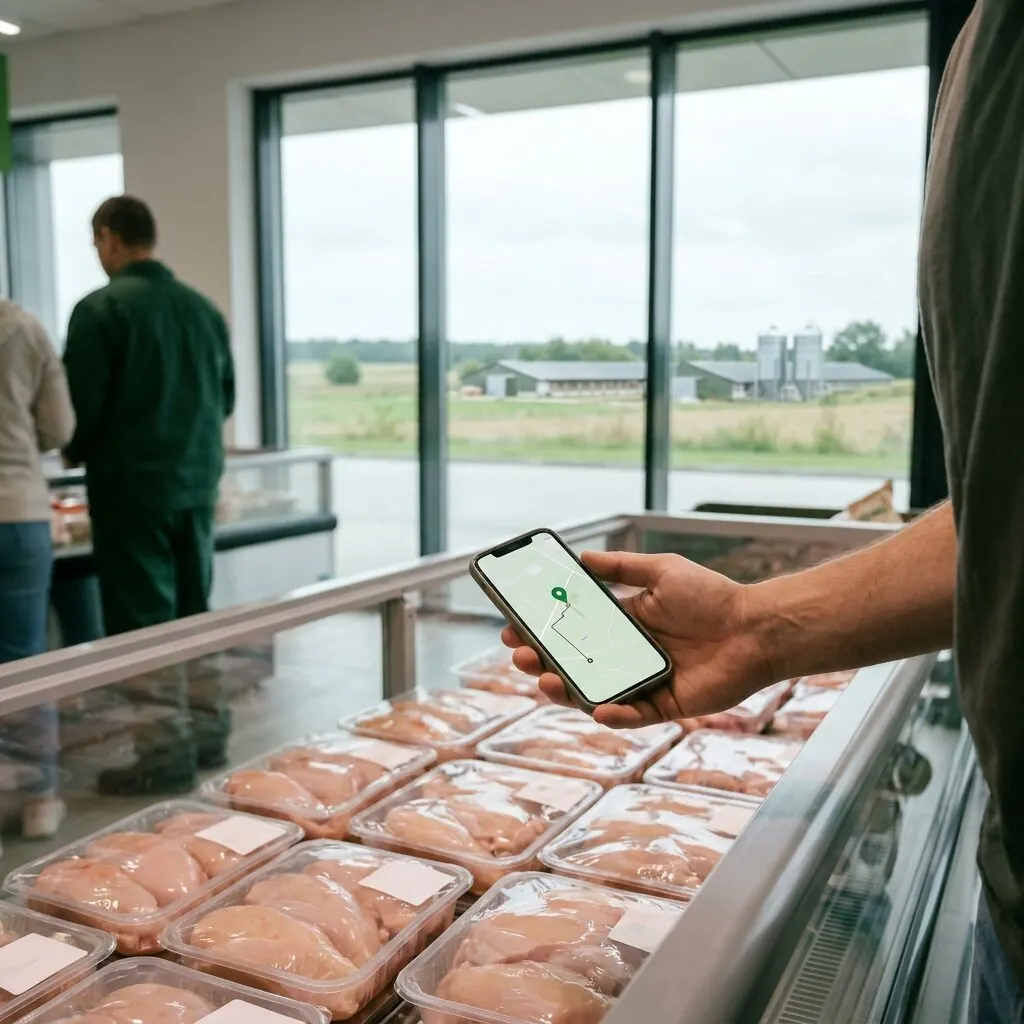
The carcass shows what happened to the flock
After slaughter, the carcass is a record of the flock's last days and hours. Footpad dermatitis points to litter, bruises and fractures point to catching, loading and transport, and burns and skin damage point to the scalder and plucker. Every condemnation means a lower payment for the batch. We cover general slaughter yield and carcass classes in our article on slaughter yield.
Totals do not point to the culprit
Today the slaughterhouse passes information to the grower in aggregate form: this many condemnations, this class, this price. It is hard to tell from that which house had a litter problem, or whether bruises came from the crew, the transport or the equipment at the plant. Judging carcasses on the line is still largely done by people, and lines keep getting faster.
How we solve it
1. The slaughterhouse sees the flock card before pickup
The farm notifies the slaughterhouse of a ready flock with the date and number of birds. Before pickup, the plant sees the flock card: weight, bird count and withdrawal periods. This works today. Read more about the plant module on the page for slaughterhouses (program dla ubojni).
2. Every batch has an origin and a crew
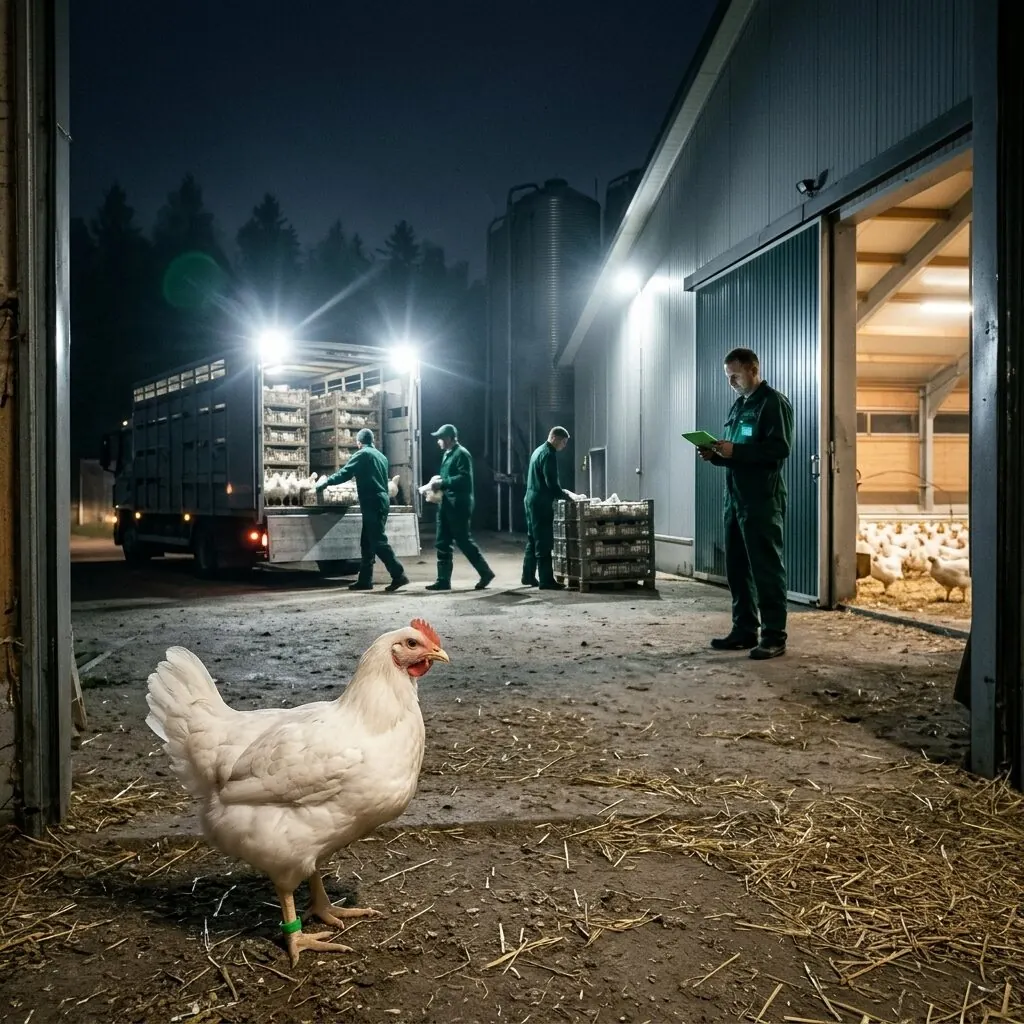
Every batch has its origin on record: the farm, the flock and the vehicle that delivered it. Catching and loading are recorded as a job order for the crew, so you know who worked on a given flock. This also works today.
3. The slaughter summary returns to the grower
After slaughter, the plant sends the grower a summary with the number of birds received, slaughtered and rejected, the average carcass weight and the veterinary decision. The result goes into the flock history next to the data from the whole grow-out.
4. Camera-detected carcass defects linked to the flock
We are researching camera-based assessment of carcass defects on the line and linking the results to the flock, house and catching crew, and we are rolling it out together with slaughterhouses. Post-mortem inspection is the job of the veterinarian, and we do not replace it.
What the research says
A camera at the line detects and tells apart carcass defects
A team from the University of Arkansas (Tran et al., 2024) built a system that finds the carcass in a single image, outlines it and classifies its defects. The dataset had 7321 images from a camera at the shackle line in the university's pilot plant, and three experts labeled the defects. Compared with a popular reference model, the new system improved carcass detection accuracy by 8.7 percentage points, defect classification by 14.8 points and outlining by 16.9 points in AP. This is the basis for getting a description of every carcass from the line, not just a condemnation count.
Different defects lead to different places in the chain
The authors of the same study state plainly that the defects result from welfare problems in production and transport, and from equipment failures at the plant, such as the stunner, scalder or plucker. The system tells these sources apart at the design level. For the grower this matters most: a reliable assessment from the line can separate mistakes made on the farm from those the farm is not responsible for. Footpad dermatitis leads back to litter and ventilation (more in our article on footpad dermatitis), while fresh bruises and fractures point more to catching and loading.
Detailed assessment makes sense only with batch origin
A description of every carcass from the camera, without origin data, remains a plant statistic. The value for the grower appears when a defect can be assigned to a flock, a house, the catching day and the crew. When bruises per 1000 birds can be counted separately for each crew, differences stop being a matter of opinion. That is why we started with recording batch origin and crew job orders.
A camera can even grade woody breast
Pallerla and colleagues (2024) studied woody breast, a defect of the breast muscle in fast-growing broilers. The authors estimate losses to the US industry at around 200 million dollars a year. They examined 250 raw fillets from 125 broilers, photographed in a laboratory with a hyperspectral camera. The model recognized three grades of the defect (none, mild, severe) with 95% accuracy, while classical methods reached 80% and 72.8%. It was weakest at recognizing the mild grade. This is a laboratory measurement, but it shows that an image can replace assessment by touch.
What the farm gains
You know which house and which crew
The slaughterhouse result is linked to the flock, and the flock to the house and the crew's job order. You compare houses, cycles and crews instead of looking at one number for the whole batch.
An argument in talks with the plant and the crew
When defects point to catching or to equipment at the plant, you have data for the conversation. We write about calm catching practice in our article on welfare during catching and loading.
Fewer phone calls at delivery
The slaughterhouse sees weight, bird count and withdrawal periods before pickup, and the slaughter summary arrives in the system. You do not retype documents or call for the result.
Let's talk about your deliveries
Do you run a slaughterhouse, or send flocks to one, and want line results to come back to the farm? Write to us through the contact form at the bottom of the page.
Frequently asked questions
How do slaughterhouse results get back to the grower?add
After slaughter, the plant sends a batch summary in DlaFerm: the number of birds received, slaughtered and rejected, the average carcass weight and the veterinary decision. The grower sees it in the flock history.
Does the slaughterhouse need special equipment?add
Not for the data flow. A DlaFerm slaughterhouse account is enough. Assessing defects with a camera on the line needs a camera at the shackle line and is the subject of our research.
How much work does this take on the farm side?add
The grower notifies the ready flock with the date and number of birds. You order catching from the crew in the same system. The rest, meaning batch origin and the slaughter summary, is recorded with the flock.
What if there is no signal in the poultry house?add
The grower's app works offline. Entries are sent automatically when the phone gets a signal.
Will a camera replace the veterinarian at the slaughterhouse?add
No. Post-mortem inspection and the decision on fitness of the meat belong to the veterinarian. A camera can describe defects but does not make official decisions.
Which carcass defects depend on the farm?add
Mainly footpad dermatitis and hock burns, linked to litter and ventilation. Bruises and fractures more often arise during catching, loading and transport, and some skin damage comes from equipment at the plant.
How do you know a camera can assess carcasses?add
In the University of Arkansas study, the system tested on 7321 images from a pilot plant detected, outlined and classified carcass defects clearly better than the reference model, and defect classification improved by 14.8 percentage points. In a second study, a hyperspectral camera recognized three grades of woody breast with 95% accuracy on 250 fillets. Both studies were done at experimental plants and in a laboratory, so moving this to a fast line in an ordinary slaughterhouse needs further work.
Sources & resources
- linkTran M., Truong S., Fernandes A.F.A., Kidd M.T., Le N. (2024). CarcassFormer: An End-to-end Transformer-based Framework for Simultaneous Localization, Segmentation and Classification of Poultry Carcass Defect. arXiv:2404.11429
- linkPallerla C., Feng Y., Owens C.M., Bist R.B., Mahmoudi S., Sohrabipour P., Davar A., Wang D. (2024). Neural Network Architecture Search Enabled Wide-Deep Learning (NAS-WD) for Spatially Heterogenous Property Awared Chicken Woody Breast Classification and Hardness Regression. arXiv:2409.17210 (also doi:10.1016/j.aiia.2024.11.003)
Prepared by: DlaFerm Team based on data from the sources listed · Publisher: INSTA-TECH sp. z o.o.
Let's talk about slaughterhouse results coming back to the farm
Want to know which house and which crew are behind carcass defects? Get in touch. We will show you flock notification, crew job orders and the slaughter summary in DlaFerm, and you can also create a free farm account.
Phone
+48 796 258 151