How much manure per hectare: nitrogen limits
There is no single number of tons of manure per hectare for every farm. The dose is set by the limit on nitrogen from livestock manure, not by volume. Below we show how to turn that limit into a dose for your own manure, and when to spread it.
verifiedFrom the team that has organised work on poultry farms for years.
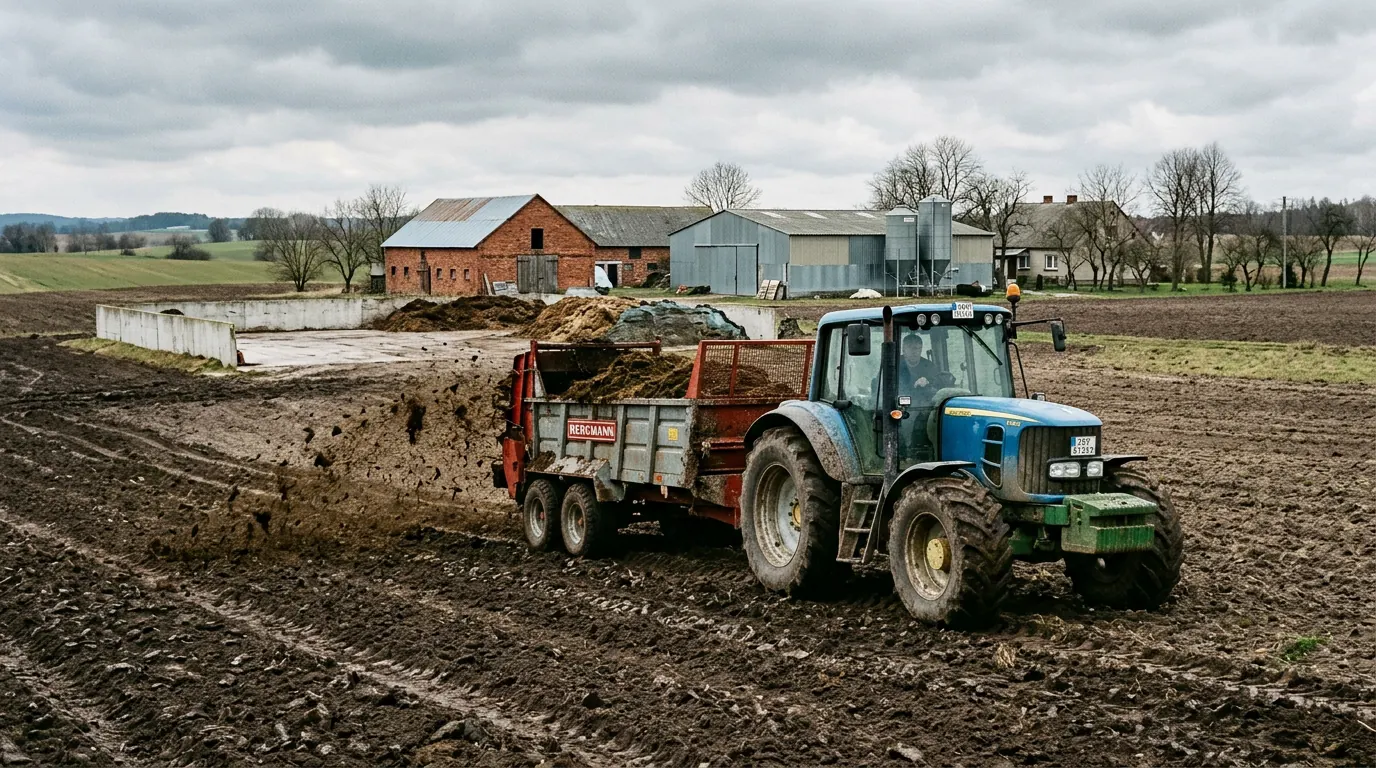
Nitrogen caps the manure dose per hectare, not weight. Under the EU Nitrates Directive, as applied in Polish law, farmland is subject to a limit of 170 kg of nitrogen from livestock manure per hectare per year. So the amount of manure you may spread depends on how many kilograms of nitrogen are in a ton of your manure. You can check the current wording of the rules in ISAP, Poland's online database of legal acts (isap.sejm.gov.pl). We describe the legal status as of 22.11.2026, but compare it with the current text before you spread, because rules change. Details on contracts and dates are in our guide Manure and slurry: contracts, fertilization plan, spreading dates.
How to convert tons into kilograms of nitrogen
The nitrogen content of cattle manure depends on the bedding, the age of the animals, feed quality and how long the manure sat in the heap before spreading. Do not take a value from memory or from a neighbor. The safest way is a laboratory analysis of a sample. For fertilization questions you can also turn to ODR advisers (Poland's agricultural advisory centers) and the Institute of Animal Science (Instytut Zootechniki PIB). The math is simple: tons of manure spread times kilograms of nitrogen per ton gives kilograms of nitrogen. Divide that by the area of the field and compare it with the 170 kg N/ha limit. If the result is higher, reduce the dose or pass part of the manure to other land under a contract.
Nitrogen from manure, counted per hectare
Where the 170 kg N/ha limit comes from
The limit of 170 kg of nitrogen from livestock manure per hectare comes from the Nitrates Directive (Council Directive 91/676/EEC). It covers manure, slurry and other fertilizers of animal origin. You count it per year, usually for the whole farm or for specific plots, as the law requires. If you spread manure on only part of your fields, do not divide it over your whole acreage, or you will understate the result. What counts is the area that actually receives the manure.
Mineral nitrogen is counted separately
The 170 kg limit applies only to nitrogen from livestock manure. You plan mineral fertilizers separately, based on crop needs and soil test results, and you always record their total together with manure in your fertilization plan. For each field, write down how much manure and how much nitrogen from it went on, and when. Then, if you are inspected, you have the summary ready and do not have to rebuild the data from memory.
How much nitrogen beef cattle produce
Teagasc data for finishing systems
The Irish Teagasc Beef Manual (section 3, beef systems) gives organic nitrogen per hectare for different finishing systems in its table "Key stocking rate targets". Values range from 151 to 214 kg of organic nitrogen per hectare, with stocking rates from 3.0 to 7.5 finished animals per hectare. This is data from Irish farms with pasture, not Polish norms. It does show the order of magnitude: at high stocking rates, nitrogen per hectare quickly approaches the limit. For your own calculation, use values from an analysis or from national tables.
Stocking rate and manure from the barn
The stocking rate in the table is a reference point, not a target. The number of animals on the farm is only half of the calculation. The other half is the amount of manure collected with the bedding and how you store it, because part of the nitrogen is lost during storage. Before the season, calculate the manure you actually have in the barn and in the heap, not the theoretical stocking rate. Then your result matches what you really spread on the field.
Until when can you spread manure
Closed periods
The rules set periods when hauling and spreading manure on fields is banned. They usually cover part of the winter, when plants take up no nitrogen and the soil is frozen or under snow. Exact dates and exceptions are in the current regulation, so we do not quote them from memory. Check them in ISAP and ask an ODR adviser, because some regions have extra restrictions.
Field conditions
Even outside the closed period, do not spread manure on frozen, waterlogged or soaked fields. The risk of nitrogen running off into water grows when the soil cannot absorb water and the manure lies on the surface. Before spreading, check the forecast for the next few days, plan spreading for dry days and leave a buffer from streams and ditches. Record every load with the date and plot number. How to organize spreading is covered in our guide on contracts and spreading dates.
Solid manure and slurry: different conversions
Differences in composition
Manure is a solid fertilizer with bedding, after storage in a heap. Slurry is a liquid fertilizer diluted with water, and it releases nitrogen at a different rate. Do not apply one analysis to the other fertilizer. Each has its own value, given by an analysis or a table, and you add up the doses together against the 170 kg N/ha limit. When you use both, keep separate records, because only then can the result be checked.
What to put in the records
In your summary, separate manure and slurry: mass, nitrogen content, field and date, each on its own. When you pass fertilizer to another farm, write the amount and date in the contract. You will find summary templates and the fertilization plan in our guide on manure and slurry documents. Good records save time at every inspection and when you settle up with neighbors.
Bedding and rearing affect the amount of manure
Dry floor and manure removal
The KPODR Minikowo guide on rearing beef calves (KPODR is a regional agricultural advisory center) lists among housing requirements a dry floor, a suitable manure removal system, regular disinfection and an environment without drafts. This matters for your fertilization plan, because wet, compacted bedding and manure left in the pen for a long time change its moisture and nitrogen content, and so the result of your calculation. Write down when and how much manure you removed from the pen instead of guessing by eye.
Feeding and nitrogen in manure
Feed composition affects how much nitrogen animals excrete. When feeding calves and cows in winter, build the ration on feeds of known composition, for example dry TMR for calves or haylage. A nutritionist or adviser sets the ration, and you take nitrogen values from an analysis, not from an online calculator.
Frequently asked questions
How much manure per hectare can you spread?add
There is no single number of tons per hectare. The limit is 170 kg of nitrogen from livestock manure per hectare per year, so the amount of manure depends on how much nitrogen your manure contains. First get the value from an analysis, then divide the nitrogen amount by the area.
How much beef cattle manure per hectare?add
The result depends on stocking rate, bedding and storage, not just on the number of animals. Teagasc data for finishing systems give 151 to 214 kg of organic nitrogen per hectare, but those are Irish systems and do not replace a calculation for your own farm. Work out your own manure and compare the result with the limit.
When can you spread manure?add
The rules set closed periods for spreading, usually covering part of the winter. Exact dates are in the current regulation, which you can check in ISAP. Some regions have extra restrictions, so ask an ODR adviser.
Do you have to keep records of manure spreading?add
Recording how much manure went on which field and when makes it easier to check the limit and prepare for an inspection. Check the detailed requirements in the current rules. We cover the summary and the fertilization plan in our guide on manure documents.
Can you spread manure on frozen ground?add
No. It is poor practice and often banned. Frozen or waterlogged soil does not absorb nitrogen, and runoff reaches water. Choose dry days and leave a buffer from streams.
Where can you check the nitrogen content of manure?add
The best way is a laboratory analysis of a sample, which you can order through an adviser or a research body such as the Institute of Animal Science (Instytut Zootechniki PIB). A result from your own manure is more reliable than a value from a general table.
Sources & resources
- linkInternetowy System Aktów Prawnych (Poland's online database of legal acts) — isap.sejm.gov.pl
- linkTeagasc — Teagasc Beef Manual — Section 3: Beef Systems
- linkKPODR Minikowo — Rearing beef calves (guide, authors from SGGW)
- linkInstitute of Animal Science PIB (Instytut Zootechniki PIB) — izoo.krakow.pl
Prepared by: DlaFerm Team based on data from the sources listed · Publisher: INSTA-TECH sp. z o.o.
Do you run a cattle herd and want your data in one place?
The <a href="/program-do-zarzadzania-ferma-drobiu">farm management program</a> keeps your herd data and farm records in one place. Create a free farm account or get in touch, and we will show you how it works in practice.
Phone
+48 796 258 151