An AI assistant on your farm data: answers from the flock record, with a link to the source
When something goes wrong in a flock, the farmer pulls together mortality, water, temperature and treatments alone, often at night. We offer farm data in one place, AI that already fills in forms from photos and voice recordings, and an assistant that answers from your farm data and shows its source. We build on studies that measured where language models are right and where they get it wrong.
verifiedFrom the team that has organised work on poultry farms for years.
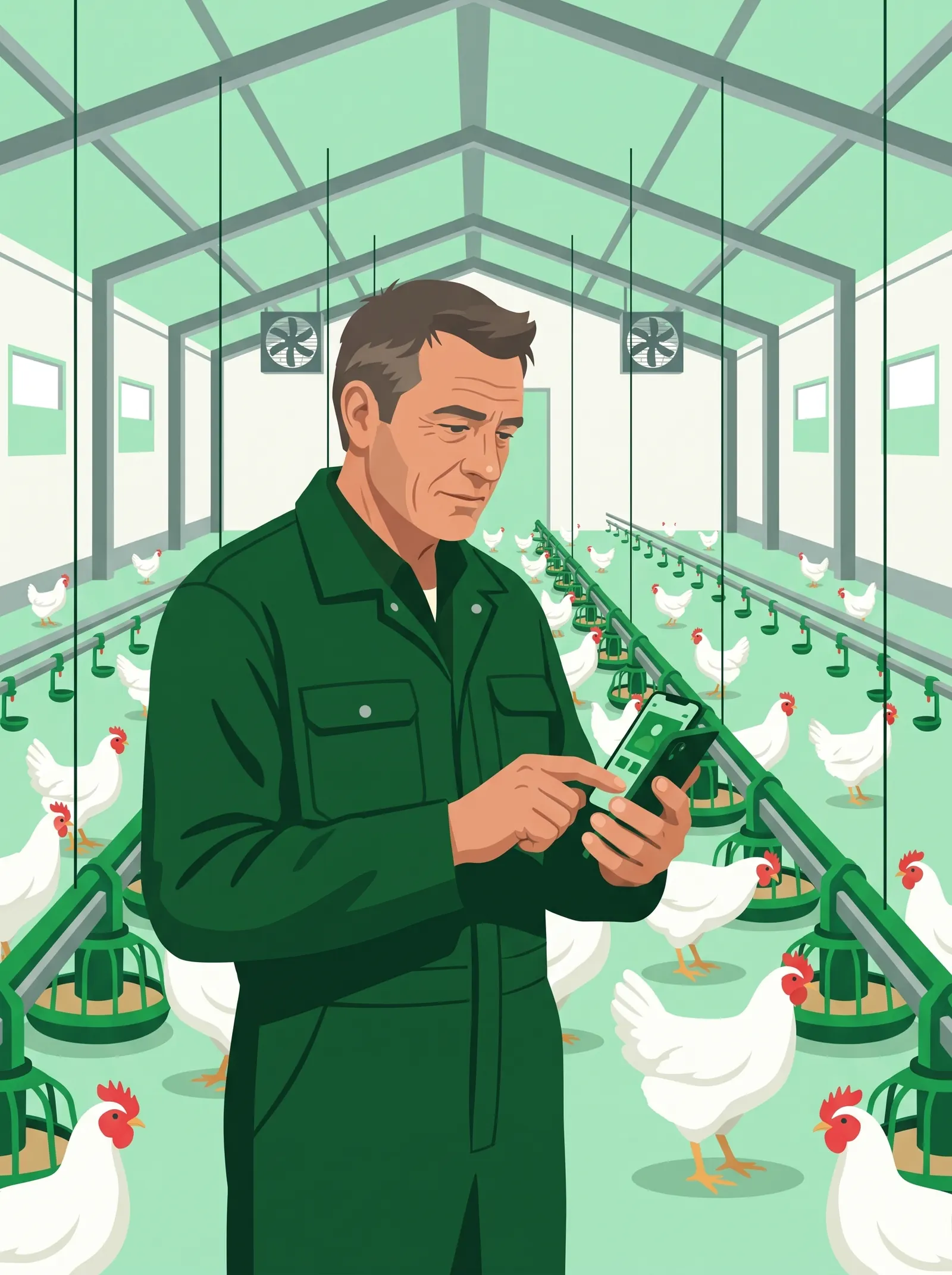
The data exists, but in five places
On a farm, data is scattered: the flock record, sensor readings, alerts, treatment records, the vet's notes. When something goes wrong, the farmer has to put it all together alone, often at night and under time pressure. Large language models, programs like ChatGPT, tempt you with a promise: just ask a question in plain words.
A fluent answer is not the same as a good one
A language model always answers fluently and in a confident tone, even when it is wrong. On a farm, a mistake can cost you the flock. A general chatbot also does not know the data of your farm, so it answers in generalities. For a general introduction, read our article on artificial intelligence on a poultry farm.
How we solve it
1. All farm data in one place
DlaFerm keeps a digital flock record with mortality, weighings, feed, water and treatments, plus climate and silo sensor readings and alarms with thresholds. The vet enters visits straight into the flock record. This works today, and it is the base an assistant can work on.
2. AI that already saves you retyping
You can enter a flock from a photo of a delivery document, a PDF, a spreadsheet or a voice recording: the AI fills in the form, and you check it and save. A service order from a pasted message works the same way. The app reads the water meter from a photo, and the farmer checks the number before saving.
3. An assistant that answers from your farm data
We are researching and building an assistant that answers the farmer's questions from the data of their own farm and shows the source with every answer: an entry in the flock record or a sensor reading.
4. Treatment stays with the vet
The assistant is meant to collect facts and put them in order before you talk to the vet. Treatment recommendations and diagnosis belong to the vet.
What the research says
A knowledge base lifts the result from about ten percent to over eighty
Han, Liu and Norton (2025) built a goat health knowledge assistant on a small local model with a base of 125 articles. Before answering, the model searched the base for passages and answered from them. Accuracy, measured automatically as similarity to a reference answer, was 87.9% on 1324 questions drawn from the articles and 84.2% on 86 questions from experts. Without the base, the same model was right in 9–11% of cases. On questions from outside the base, the result fell to about 60%, even with a web search, and the only made-up answers came from web results. That is why our assistant is meant to answer from farm data, not from the internet.
A poultry assistant gets nine answers in ten right
Khanal and colleagues (2025) described an assistant with a poultry knowledge base that takes text questions and photos. On 200 questions checked by experts, answers matched the reference in 84.0% of cases, with an average response time of 3.6 s. In a test with 34 users who asked 267 questions, 89.9% of answers were rated accurate and about 9.1% wrong. That is a good result, but one wrong answer in ten rules out treatment advice on its own. Hence the source with every answer.
Finding information in records works best
Wulcan and colleagues (2024) compared GPT-4o with five people at finding six symptoms in 250 cat records. The model reached 96.9% sensitivity and 97.6% specificity, but only 80.7% of the symptoms it flagged were actually present. It was more repeatable than people: agreement between repeat runs was 0.98 versus 0.80 between pairs of people. Most errors, 35 of 43, came from unclear records where people also disagreed. Boguslav and colleagues (2024) fine-tuned models on notes from 246,473 visits to assign diagnoses, and the best reached a weighted F1 of 76.9. Putting records in order is exactly the work that eats a farmer's time.
Video description by a language model is still unreliable
Wu and colleagues (2024) tested four vision-capable models on recordings of piglets in one pen. On a 0–5 scale, the best scored 4.31 for time perception in close-ups, but only 1.94 for how well its description matched the actual behavior. The authors name made-up content as the main problem. That is why the assistant relies on numbers from the flock record and sensors, not on descriptions of video.
What the farm gets
Less retyping today
A delivery document, a water meter or a message with an order turns into a filled-in form. You only check it and save.
The full picture of the flock before you call the vet
Mortality, water, temperature and recent treatments are in one place. The talk with the vet starts from facts, not from trying to remember.
An answer you can check
Every answer from the assistant is meant to point to the entry or reading it came from. You do not have to take it on trust.
We will show it on your farm's data
Want to see how AI fills in forms from photos and what work on the assistant looks like? Write to us through the contact form at the bottom of the page.
Frequently asked questions
What AI features work in DlaFerm today?add
Filling in the flock form from a photo of a document, a PDF, a spreadsheet or a voice recording, a service order form from a pasted message, and reading the water meter from a photo. We are researching and building the assistant that answers from farm data.
Do I need special equipment?add
No. A phone or a computer is enough. Data from sensors and controllers goes into the system if they are connected, but the forms from photos work without them.
How much work is setup?add
You create an account in a few minutes, and a wizard guides you through describing the farm. You can enter your first flock from a photo of the delivery document. We describe the steps on the page how we implement.
What if there is no signal in the poultry house?add
The farmer app works offline. Entries are sent automatically when the phone gets a signal.
Can an AI assistant replace the vet?add
No. In the study on cat records, GPT-4o found almost all symptoms, but only 80.7% of the symptoms it flagged were actually present. An assistant can collect facts, but the vet decides diagnosis and treatment.
What happens to the photo of a document?add
The file is not stored. Only the result counts: the filled-in form, which you check before saving.
How do you know an assistant built on farm data makes sense?add
In the study on an assistant for goat farmers, the same model was right in 9–11% of cases without a knowledge base and in 84–88% with it. On questions from outside the base, the result fell to about 60%. In the test of a poultry assistant with 34 users, 89.9% of answers were rated accurate. The conclusion: the model must answer from specific data and show its source. Language models did poorly at describing video (1.94 out of 5 points for match with behavior), so we do not rely on that.
Sources & resources
- linkKhanal K., Khatiwada B., Afrifa S., Sapkota R., Shah S., Bai F., Bist R.B. (2025). PoultryTalk: A Multi-modal Retrieval-Augmented Generation (RAG) System for Intelligent Poultry Management and Decision Support. arXiv:2512.08995
- linkHan N., Liu D., Norton T. (2025). Towards an AI-based knowledge assistant for goat farmers based on Retrieval-Augmented Generation. arXiv:2509.09848
- linkWulcan J.M., Jacques K.L., Lee M.A., Kovacs S.L., Dausend N., Prince L.E., Wulcan J., Marsilio S., Keller S.M. (2024). Classification performance and reproducibility of GPT-4 omni for information extraction from veterinary electronic health records. arXiv:2409.13727 (also Frontiers in Veterinary Science 11, 2025)
- linkBoguslav M.R., Kiehl A., Kott D., Strecker G.J., Webb T., Saklou N., Ward T., Kirby M. (2024). Fine-tuning foundational models to code diagnoses from veterinary health records. arXiv:2410.15186
- linkWu Y., Hu X., Fu Z., Zhou S., Li J. (2024). GPT-4o: Visual perception performance of multimodal large language models in piglet activity understanding. arXiv:2406.09781
Prepared by: DlaFerm Team based on data from the sources listed · Publisher: INSTA-TECH sp. z o.o.
Let's talk about AI on your farm's data
Want your flock data in one place and less retyping? Get in touch, or create a free farm account in the DlaFerm farm management program. We will show you forms filled in from photos and our work on an assistant that answers from farm data.
Phone
+48 796 258 151