Medication in Water and Drinking Rhythm: Water Use and Treatment in One View
A drug dosed evenly across the day does not reach every animal evenly, because animals do not drink evenly. We propose recording water use and treatment for the same flock, so you and your vet can see how the flock drinks during a course. We build on research showing that the same dose, given in a different rhythm, reached more of the herd.
verifiedFrom the team that has organised work on poultry farms for years.
Even dose, uneven drinking
Giving a drug through water is the simplest way to treat a whole flock at once. The vet calculates the dose per kilogram of body weight, you dissolve the product in the amount of water the flock will drink in a set time, and you usually deliver it evenly across 24 hours. We describe how to work out the dose in our drug dilution calculator. But animals do not drink evenly. Some drink in the morning, others in the afternoon, and some drink little throughout the treatment.
Too little drug means a second course
An animal that gets too little drug may not recover, and bacteria that survive a low dose acquire resistance more easily. An animal that gets too much also favors resistance in gut bacteria. Raising the dose increases antibiotic use, which all of us are trying to cut. A repeat course means extra drug cost, a longer withdrawal period and worse flock results.
How we solve it
1. Water counted from the water meter
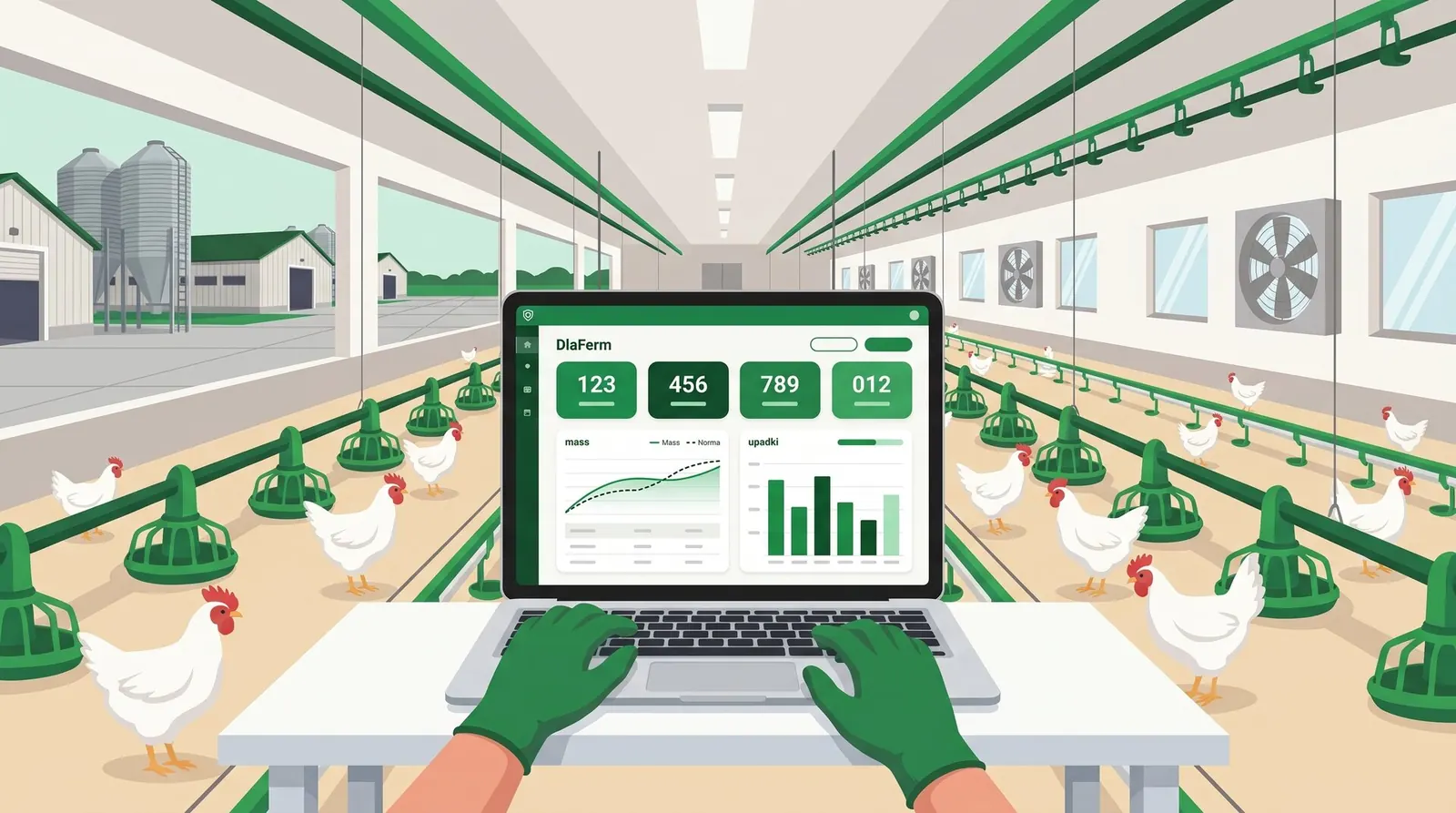
DlaFerm calculates daily water use from water meter readings: from the house controller or from a photo of the meter that AI reads. For each sensor you see a chart of the last few days. This works today.
2. An alert when the flock drinks less
A drop in drinking sends an alert to the farmer. During treatment this matters twice over: less water drunk means less drug taken in. You see it right away and can contact your vet.
3. Treatment recorded with the flock
Treatment records store the drug, dose, date and number of birds, and calculate the end of the withdrawal period for you. The vet enters recommendations straight into the flock card. Water and treatment are recorded for the same flock. This also works today.
4. Hourly drinking profile and dosing window
We are researching an hourly drinking profile of the flock and a suggested drug dosing window, and are building them into the app. The suggestion is meant as material for a conversation with your vet. The vet decides on treatment and the dosing schedule.
What the research says
The differences come from drinking, not from the body
A team from a French agricultural research institute (Hernández et al., 2024) points to three sources of differences between animals: different drug concentration at the end of the pipe, different behavior at the drinker, and different rates of drug absorption and elimination. Their earlier work shows the first two matter most. They also showed that with three days of amoxicillin or doxycycline in water, only a small share of animals reach sufficient exposure. That is why we start by measuring water, not by changing the drug.
Drinking rhythm can be measured and described
The work was based on measurements of 918 piglets aged 28–70 days. Each had a chip in its ear tag, so at the drinker the system recorded who drank, when and how much. The authors built a water use model that separates the growth trend, the repeating daily rhythm and outliers, such as water spilled during play. With lights on from 9:00 to 17:00, drinking peaked around midday and around 17:00, and drinking was more even by day than at night. This shows that you can pull the flock's rhythm out of water readings.
The same dose in a different rhythm reaches more of the herd
The authors combined drinking profiles with models of how amoxicillin and doxycycline act, and for each piglet simulated 300 runs of drug concentration in the blood, without changing the total dose. Dosing matched to the drinking rhythm raised the share of piglets with sufficient amoxicillin exposure from 30% to at least 60% for Pasteurella multocida and from 20% to over 70% for Actinobacillus pleuropneumoniae. Even dosing across the day was one of the weakest strategies. In these conditions the best window fell between 15:00 and 18:00, not at midday when the most animals drink.
The schedule has to be set for your own farm
The authors stress that drinking rhythm depends on light, feed, temperature, stocking density and stress. In poultry it also depends on the lighting program and the age of the birds, and drugs act differently in poultry than in pigs. So the dosing window must come from your own flock's data, not from a table. That is the basis of our work on the hourly profile.
What your farm gains
You know whether the flock is drinking during treatment
A drop in drinking during treatment shows up the same day. You can react before the course ends, not after the fact.
Treatment records without the counting
Drug, dose, date, number of birds and the end of the withdrawal period are recorded with the flock. At an inspection and before shipment to the slaughterhouse, the data is ready.
Hard data for your vet
Instead of "I think they drank less", you show your vet the water chart for the whole course. That is a better basis for deciding on further treatment. Read more about cutting drug use in our article on raising poultry without antibiotics.
We will show water and treatment on your flock
Want to see how your flock drinks during a course? Book a call through the contact form at the bottom of the page.
Frequently asked questions
Where does the system get its water data?add
From water meter readings: automatically from the house controller, or from a photo of the meter that AI turns into a number. The readings give you daily water use and a chart.
What equipment do I need?add
A water meter on the drinker line. If it is not connected to the controller, a phone to photograph the meter is enough. For the hourly profile you need a meter with a pulse output, installed before the medicator, so that it counts the water the birds actually drink. More in our guide to medicators and water treatment.
How much work does setup take?add
You assign the water meter to a house once. After that, readings come from the controller or you photograph the meter. The vet or the farmer enters the treatment, and the withdrawal period is calculated for you.
What if there is no signal in the poultry house?add
The farmer's app works offline. Meter photos and entries send themselves once the phone picks up a signal.
Can I change the antibiotic dosing hours myself?add
No. How the drug is given is part of the vet's prescription. You can show the vet your flock's drinking data and agree on a schedule together.
Does this apply to poultry?add
The study covers piglets. The mechanism of uneven drinking is shared, but drugs act differently in poultry, so the results cannot be carried over directly. You need to measure the drinking rhythm in your own flock.
How do you know the dosing rhythm matters?add
In a simulation using drinking data from 918 piglets, with the same total amoxicillin dose, matching dosing to the drinking rhythm raised the share of animals with sufficient exposure from 30% to at least 60% for Pasteurella multocida and from 20% to over 70% for Actinobacillus pleuropneumoniae. The area under the curve of the share of animals reaching the target rose 1.7–2.6 times, depending on the day treatment started. A variant that changed the distribution from day to day usually gave even higher exposure.
Sources & resources
Prepared by: DlaFerm Team based on data from the sources listed · Publisher: INSTA-TECH sp. z o.o.
Let's talk about water and treatment on your farm
Want to see how much your flock drinks during a course, with treatment and withdrawal period recorded against the flock? Try <a href="/ewidencja-leczenia-i-karencja-lekow">treatment and withdrawal records</a> in DlaFerm. Create a free farm account or get in touch, and we will show you water use, alerts and treatment records.
Phone
+48 796 258 151