Vaccination against HPAI and other listed diseases: Delegated Regulation (EU) 2023/361
Delegated Regulation (EU) 2023/361 sets out when and on what conditions vaccines against listed diseases may be used, including highly pathogenic avian influenza (HPAI). It is in force as of 23.11.2026. In Poland, vaccination against category A diseases takes place only under the supervision of the Veterinary Inspection (Inspekcja Weterynaryjna). We explain the requirements of Annexes XIII and XIV and the steps for your farm.
verifiedFrom the team that has organised work on poultry farms for years.
Updated:
Legal status as of 23 November 2026. Commission Delegated Regulation (EU) 2023/361 of 28 November 2022 supplements Regulation (EU) 2016/429 on the use of certain veterinary medicinal products to prevent and control listed diseases. It applies to establishments keeping poultry and captive birds, and under other annexes also to pigs and other species. The act is in force and has applied since 12.03.2023.
Farmers do not vaccinate against HPAI themselves
In Poland, vaccination against category A diseases, including HPAI, is possible only under the supervision of the Veterinary Inspection within an official vaccination plan (regulation of Poland's Ministry of Agriculture and Rural Development, MRiRW, of 27.07.2026, Dz.U. 2026 poz. 1030, Poland's Journal of Laws). For a general overview, see our article on poultry vaccination against bird flu. The whole section on EU rules is on the page EU rules for farmers.
Who it applies to
Annex XIII covers emergency vaccination against HPAI. Target animals are poultry or captive birds kept in establishments included in the official vaccination plan (Annex XIII, part 1, point 5). Annex XIV covers vaccination against infection with Newcastle disease virus; its target species are poultry and captive birds. Annex XII covers pigs: it sets a period of 3 months from the slaughter or killing of all vaccinated pigs. Other annexes set rules for other species. If you keep poultry, start by checking whether your establishment lies in a vaccination zone designated by the inspection.
What it requires
Annex XIII part 1 points 1–2: vaccination zone
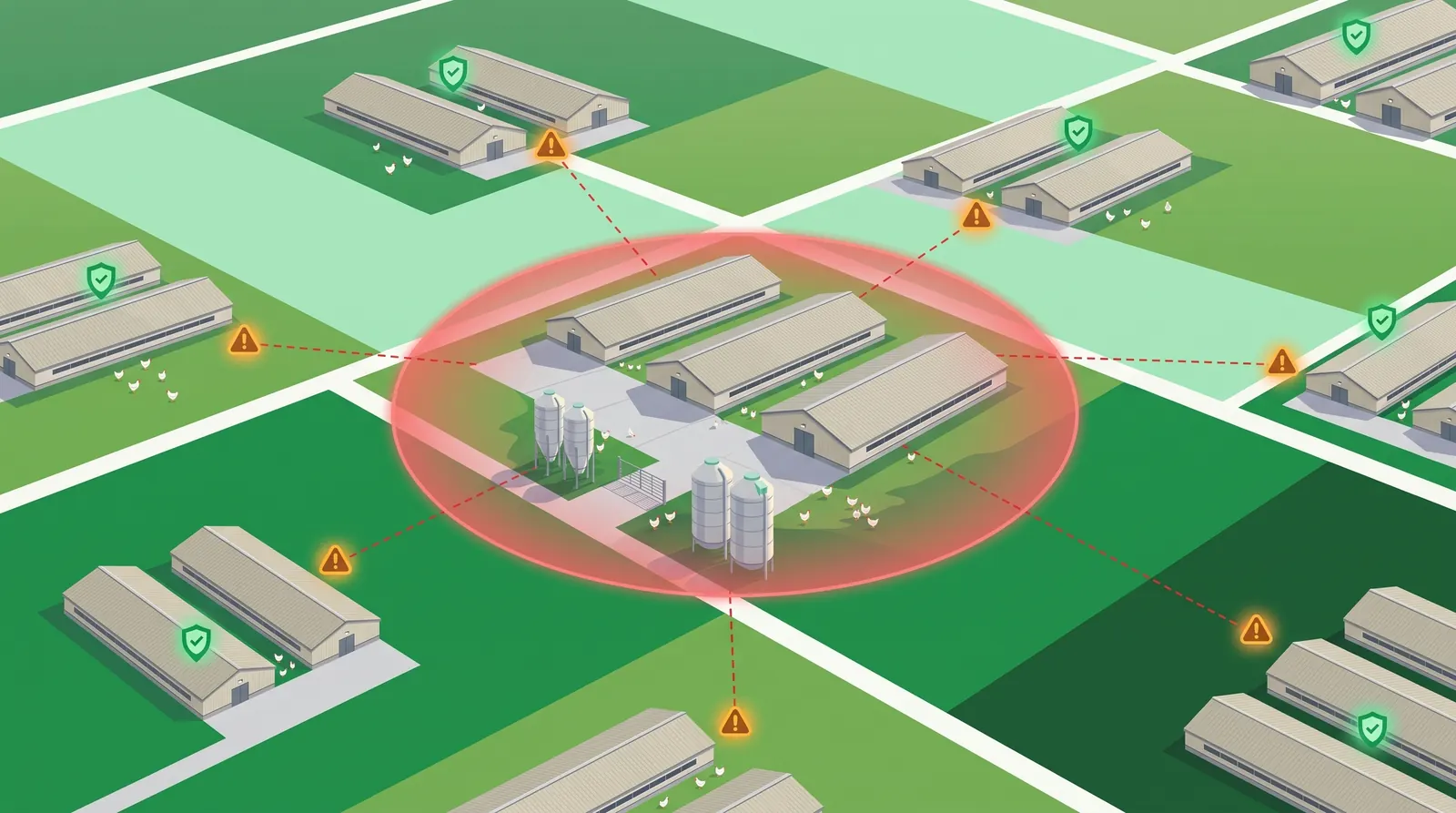
The vaccination zone is a belt with a radius of at least 3 km around affected establishments. The surrounding zone is a belt at least 7 km wide beyond the borders of the vaccination zone. Laboratory surveillance covers both areas. A farm in such a belt faces tighter checks.
Annex XIII: type of vaccine
Only vaccines that contain no live avian influenza virus may be used. The ban covers vaccines with attenuated and non-attenuated virus. The part on reinforced surveillance repeats the same rule. You can read more about products on the page about bird flu (HPAI) vaccines.
Annex XIII part 2 point 2.2: passive surveillance
All establishments with poultry or captive birds in the vaccination zone must introduce passive surveillance. It is triggered by any clinical sign or post-mortem lesion pointing to HPAI, and by a change in normal production and health parameters such as mortality and feed and water intake. For you, this means daily records of these indicators. We describe the signs in Bird flu: symptoms in poultry.
Annex XIII part 2 point 2.3: active surveillance every 30 days
Once vaccination starts, the official veterinarian or a person acting on their behalf must carry out active surveillance at least once every 30 days in establishments with vaccinated poultry. It includes a clinical examination with a check of the production records and medical records of each flock, and sampling of dead birds, from a maximum of 15 birds per flock, collected within 48 hours before sampling. Outside the period of high risk of infection, checks can be done on a representative sample of establishments. Surveillance lasts as long as the establishment keeps vaccinated animals (point 2.5).
Annex XIII: reinforced laboratory surveillance
In establishments where vaccination took place, samples from dead birds are taken at least once every three weeks, from a maximum of 15 birds per flock, collected within 48 hours before sampling. The number of samples and their frequency must be enough to detect infection in a vaccinated flock with a probability of at least 99% and a confidence level of at least 95%. In establishments without vaccination, passive surveillance applies to species of the order Galliformes, and samples from dead birds of the order Anseriformes are taken every week, from a maximum of 15 birds per flock.
Annex XIII part 3 point 3 and part 4 point 4.1: movements
Movements are banned for vaccinated poultry or captive birds, and for their hatching eggs and products of animal origin, both inside and outside the vaccination zone. Derogations apply to birds with a negative surveillance result. Poultry may go to a slaughterhouse for immediate slaughter, or to an establishment holding only vaccinated birds or with vaccinated and unvaccinated birds fully separated. It may not be moved to another Member State.
When it applies
The regulation entered into force and has applied since 12.03.2023. As of 23.11.2026 it is in force. The current consolidated text in the Polish language version dates from 02.06.2026 (CELEX 02023R0361-20260602). Annex XIII was amended in 2026; check the consolidated text for details.
Changes and deadlines
The authority, not the farmer, counts the waiting periods after emergency vaccination. For HPAI it is 28 days, and for Newcastle disease 3 months, in both cases from the end of vaccination or from the lifting of the restricted zones (Article 55 of Regulation 2020/687), whichever came later. We cover the zone rules in the article on Regulation 2020/687.
| Date | What happens | Basis |
|---|---|---|
| 28.11.2022 | Date of the act | Delegated Regulation (EU) 2023/361 |
| 12.03.2023 | Entry into force and application | Delegated Regulation (EU) 2023/361 |
| 06.03.2026 | Amendment and correction of the regulation | Delegated Regulation (EU) 2026/1073 |
| 02.06.2026 | Date of the consolidated text | CELEX 02023R0361-20260602 |
| 01.08.2026 | Entry into force of the Polish MRiRW regulation | Dz.U. 2026 poz. 1030 |
| 28 days | Waiting period after vaccination against HPAI | Annex XIII |
| 3 months | Waiting period after vaccination against Newcastle disease | Annex XIV |
How it works in Poland
The delegated regulation applies directly. In Poland, the MRiRW regulation of 27.07.2026 on measures concerning the use of veterinary medicinal products for certain listed diseases (Dz.U. 2026 poz. 1030) applies from 01.08.2026. Vaccination against category A diseases, such as HPAI, is possible only under the supervision of the Veterinary Inspection within an official vaccination plan. Using medicines in breach of this regulation risks a fine of 0.1–8 times the average salary (Animal Health Act, Art. 98 sec. 1 point 16). You can vaccinate poultry against HPAI only within the official vaccination plan under the supervision of the Veterinary Inspection. The list of national acts is on the page Acts and regulations for poultry farmers.
This text summarizes the act and is not legal advice. In a specific case, the text published in the Official Journal of the EU and Polish law decide, and explanations come from the county veterinary officer (powiatowy lekarz weterynarii) or another competent authority.
What to do on your farm
The steps follow directly from the requirements above. First, do not vaccinate your flock against HPAI on your own. Vaccination is possible only in the official vaccination plan under the supervision of the inspection. Second, ask the county veterinary officer whether your establishment lies in the vaccination zone or the surrounding belt. Third, keep daily records of mortality and of feed and water intake, because a change in them triggers passive surveillance (Annex XIII, part 2 point 2.2). Fourth, have the production records and medical records of each flock ready for checks every 30 days. Fifth, collect dead birds separately and note the date, because samples are taken from birds collected within 48 hours. Sixth, do not move vaccinated poultry or hatching eggs without the authority's permission. The biosecurity plan generator helps you organize your biosecurity rules. We describe early recognition of problems in the article on early disease detection.
Frequently asked questions
When did Regulation 2023/361 start to apply?add
Delegated Regulation (EU) 2023/361 entered into force and has applied since 12.03.2023. As of 23.11.2026 it is in force. It was amended by Delegated Regulation (EU) 2026/1073 of 06.03.2026.
Can I vaccinate my poultry against bird flu myself?add
No. Under the MRiRW regulation of 27.07.2026 (Dz.U. 2026 poz. 1030), vaccination against category A diseases, including HPAI, is possible only under the supervision of the Veterinary Inspection within an official vaccination plan.
Which vaccine may be used against HPAI?add
According to Annex XIII (part 1 point 1 and part 3 point 3), only a vaccine that contains no live avian influenza virus. The ban also covers attenuated virus.
How large is the vaccination zone?add
According to Annex XIII (part 1 points 1–2), it is a belt with a radius of at least 3 km around affected establishments. A belt at least 7 km wide is set around it.
How often are vaccinated flocks checked?add
According to Annex XIII (part 2 point 2.3), the official veterinarian or a person acting on their behalf does it at least once every 30 days. Samples are taken from dead birds, from a maximum of 15 per flock.
Can vaccinated poultry be sold to another EU country?add
No. Annex XIII (part 4 point 4.1) rules out moving vaccinated poultry, day-old chicks and hatching eggs to another Member State under the derogations.
What is the penalty for using medicines in breach of the rules?add
Using medicines in breach of the MRiRW regulation (Dz.U. 2026 poz. 1030) carries a fine of 0.1–8 times the average salary (Animal Health Act, Art. 98 sec. 1 point 16).
Sources & resources
- linkEU Publications Office (EUR-Lex): Commission Delegated Regulation (EU) 2023/361 of 28 November 2022 supplementing Regulation (EU) 2016/429 of the European Parliament and of the Council as regards rules for the use of certain veterinary medicinal products for the purpose of prevention and control of certain listed diseases
- linkMRiRW regulation of 27.07.2026 on measures concerning the use of veterinary medicinal products for certain listed diseases (vaccination against category A diseases, including HPAI) (Dz.U. 2026 poz. 1030)
- linkChief Veterinary Inspectorate (Główny Inspektorat Weterynarii): gov.pl/web/wetgiw
- linkInternet System of Legal Acts (ISAP): isap.sejm.gov.pl
Prepared by: DlaFerm Team based on data from the sources listed · Publisher: INSTA-TECH sp. z o.o.
Keep the flock records required for surveillance in the Digital flock card module
The Digital flock card in DlaFerm lets you record mortality, feed and water intake and treatments in one place, so your records are ready for an inspection. Create a free farm account in DlaFerm or get in touch.
Phone
+48 796 258 151