Selling from the farm in Poland: RHD, direct sale, registration and limits
To sell poultry and eggs from your own farm in Poland, you choose between agricultural retail (RHD, rolniczy handel detaliczny) and direct sale. The choice decides who keeps your registration, which limits apply and which papers you need before the first sale. We describe the rules as of 22.11.2026.
verifiedFrom the team that has organised work on poultry farms for years.
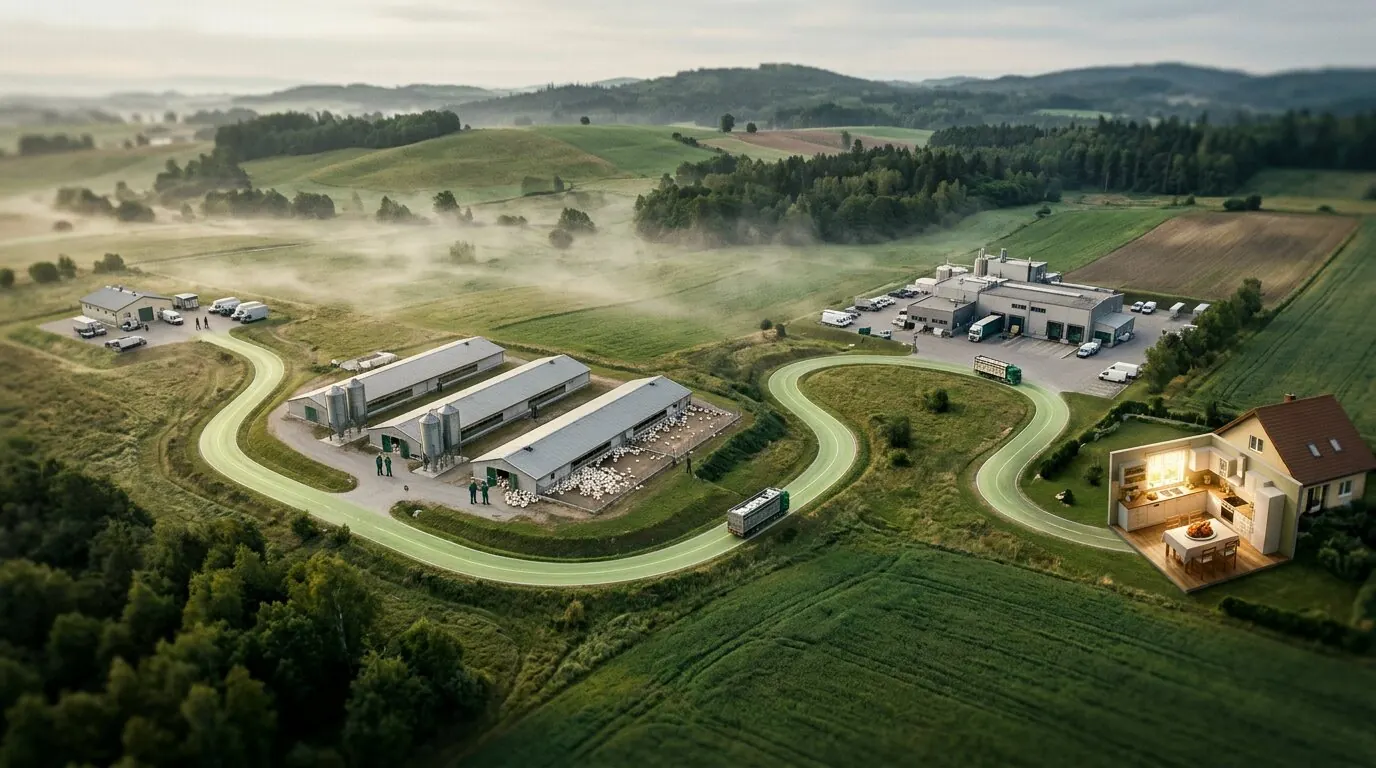
RHD is the sale of food from your own production to consumers and, in limited amounts, to shops and restaurants. Direct sale means selling animal products, such as poultry meat and eggs, straight from the producer to the final customer. For animal products, the register is kept by the county veterinary officer (powiatowy lekarz weterynarii, PLW), not by the sanitary inspection (sanepid), which handles plant products. The act on food and nutrition safety (Dz.U. 2026 poz. 1399, Poland's Journal of Laws) describes RHD. The act on products of animal origin (Dz.U. 2026 poz. 981) sets the requirements for direct sale of poultry meat and eggs.
Why the choice matters before you start
The two modes have different limits and different record rules. Selling above the limit of your mode breaks the terms of your registration. First work out whether most of your sales go to individual customers or to shops and restaurants. In the first case the weekly limit matters. In the second, the yearly RHD limits matter. If you are still planning your sales, see the guide Raising poultry for sale: where to start.
What you need before the first sale
Before you sell meat, eggs or processed products from the farm, you must be entered in the register kept by the PLW. Registration is the basis of legal sales, and only then does the quantity sold count. Prepare your farm details, a description of production and a sales plan with estimated quantities per week and per year.
RHD and direct sale: which to choose
Who buys from you
In direct sale, the buyer is a consumer who comes to the farm or collects goods from an agreed delivery. With RHD you can also supply retail businesses and restaurants, but only within the yearly limits. The rule is simple: the more you sell through intermediaries, the more closely you must watch the yearly limit. Direct sale has weekly thresholds, which you count every week, not once a year.
What the PLW checks
The veterinary requirements for producing animal products for direct sale are set by the Agriculture Minister's regulation of 30.09.2015 (Dz.U. 2015 poz. 1703), in force since 01.01.2016. The inspector assesses production conditions, storage and your sales records. For the rules on registration and the application, see the guide Selling poultry from the farm (RHD).
Weekly limits for carcasses and eggs
Values from the regulation
The regulation of 30.09.2015 (Dz.U. 2015 poz. 1703) sets these weekly limits for direct sale: 200 poultry carcasses, excluding turkeys and geese, 50 turkey carcasses, 500 goose carcasses and 2450 eggs. Each group has its own threshold, so you do not add them into one limit. Plan slaughter and egg sales ahead, because the week closes on one date and any surplus does not roll over to the next week. Mark eggs as described in the guide Marking chicken eggs.
Exceeding the limit with PLW consent
The rules allow you to exceed the weekly limit, but only with PLW consent and while keeping to the yearly limit. As an example, the regulation gives 10 000 poultry carcasses and 2500 turkeys per year. Do not assume consent in advance. Ask the PLW first, and only then raise your sales, because selling above the threshold without consent breaks the terms of your registration.
Yearly RHD limits for shops and restaurants
What the 2022 regulation says
The Agriculture Minister's regulation of 12.09.2022 (Dz.U. 2022 poz. 1971), in force since 05.10.2022, sets the maximum yearly amounts of food sold under RHD to retail businesses. For poultry it gives 148 200 eggs and 2100 kg of fresh poultry meat. Before you start your sales plan, ask the PLW how this limit is counted and over what period. In the materials we used, the table items were not fully matched with their units, so check the text of the act in ISAP, Poland's online legal database (Internetowy System Aktów Prawnych).
How to keep records in practice
Record each sale with the date, quantity, product type and buyer. This makes it easier to check the yearly limit and to prepare for an inspection. The summary shows how much of the limit is left in a given year. With more buyers, a farm management program that keeps sales next to the flock and treatment records helps, for example the DlaFerm farm management program.
Registration with the PLW step by step
What to prepare for the application
You send the application to the PLW responsible for your farm. Attach your farm details, a description of production (number of birds, type of product, way of selling) and a sales plan with weekly and yearly quantities. The deadline for filing before you start RHD could not be confirmed in our materials, so check the exact deadline directly with the PLW before you sign the first contract with a buyer. We give no number of days because we have not confirmed one.
Producer number from ARiMR
To meet your duties in the IRZ system (Poland's animal identification and registration system), you need a producer number. You get it by entering the producers' register at ARiMR (Agency for Restructuring and Modernisation of Agriculture). The application goes to the ARiMR county office for the producer's place of residence, in person, by post or through e-PUAP, Poland's government online portal. Forms are available at county offices, regional branches and on the Agency's website.
Reporting a poultry establishment in IRZ
Changes in the number of birds and eggs
The act on the animal identification and registration system (Dz.U. 2026 poz. 591) requires the keeper of a poultry establishment to report any increase or decrease in the number of birds and hatching eggs to the computer database within 7 days of the event. Deaths are reported weekly in one batch. Reports concern the state of the establishment, not the size of sales, but good records let you handle both duties together. If you are unsure whether your farm is a poultry establishment under the act, ask the PLW or ARiMR. See also Integrations with IRZplus and sensors.
Frequently asked questions
What is the difference between RHD and direct sale?add
RHD lets you sell food from your own production to consumers and, in limited amounts, to shops and restaurants. Direct sale covers final customers and has weekly limits for carcasses and eggs. For animal products, the PLW keeps the register in both modes.
Who registers egg and poultry meat sales?add
The county veterinary officer (PLW) keeps the register for animal products, including poultry meat and eggs. Sanepid handles plant products. File your application before you start selling.
How many eggs can I sell per week without consent?add
In direct sale the weekly limit is 2450 eggs under the 2015 regulation. Going above it needs PLW consent and keeping to the yearly limit. Get consent before you raise sales.
Are the poultry carcass limits the same for all species?add
No. The weekly limit is 200 poultry carcasses, excluding turkeys and geese, 50 turkey carcasses and 500 goose carcasses. Each group has its own threshold. Check the details with the PLW, because its decision for your farm matters.
How long does RHD registration take?add
The processing time was not confirmed in our materials, so we give no number of days. Ask the PLW for the current processing time and the required attachments. Do not start selling before you are registered.
Do I have to report birds to IRZ if I only sell eggs?add
It depends on whether your farm is a poultry establishment under the IRZ act. If it is, you report changes in the number of birds and hatching eggs within 7 days. If in doubt, ask the county veterinary officer or ARiMR.
Sources & resources
- linkSejm RP / Journal of Laws — Act of 4.11.2022 on the animal identification and registration system, consolidated text (Dz.U. 2026 poz. 591)
- linkARiMR — Information brochure on the new IRZ act (updated 06.03.2025)
- linkInternetowy System Aktów Prawnych (ISAP) — isap.sejm.gov.pl
- linkChief Veterinary Inspectorate — gov.pl/web/wetgiw
- linkMinistry of Agriculture and Rural Development — gov.pl/web/rolnictwo
Prepared by: DlaFerm Team based on data from the sources listed · Publisher: INSTA-TECH sp. z o.o.
Selling from your farm and want all your records in one place?
The DlaFerm farm management program keeps flock, treatment and poultry sales records together. Create a free farm account and see how it works in practice, or get in touch with us.
Phone
+48 796 258 151