Water Speaks First: Water Meter, Flock Norm and Alarm
Sick birds usually drink and eat less first, and die later. But water use also changes with age, heat and the condition of the drinker lines. We collect water, feed and mortality in a digital flock record with a chart and an alarm. We are also researching and rolling out a water-use norm that accounts for temperature, based on farm studies.
verifiedFrom the team that has organised work on poultry farms for years.
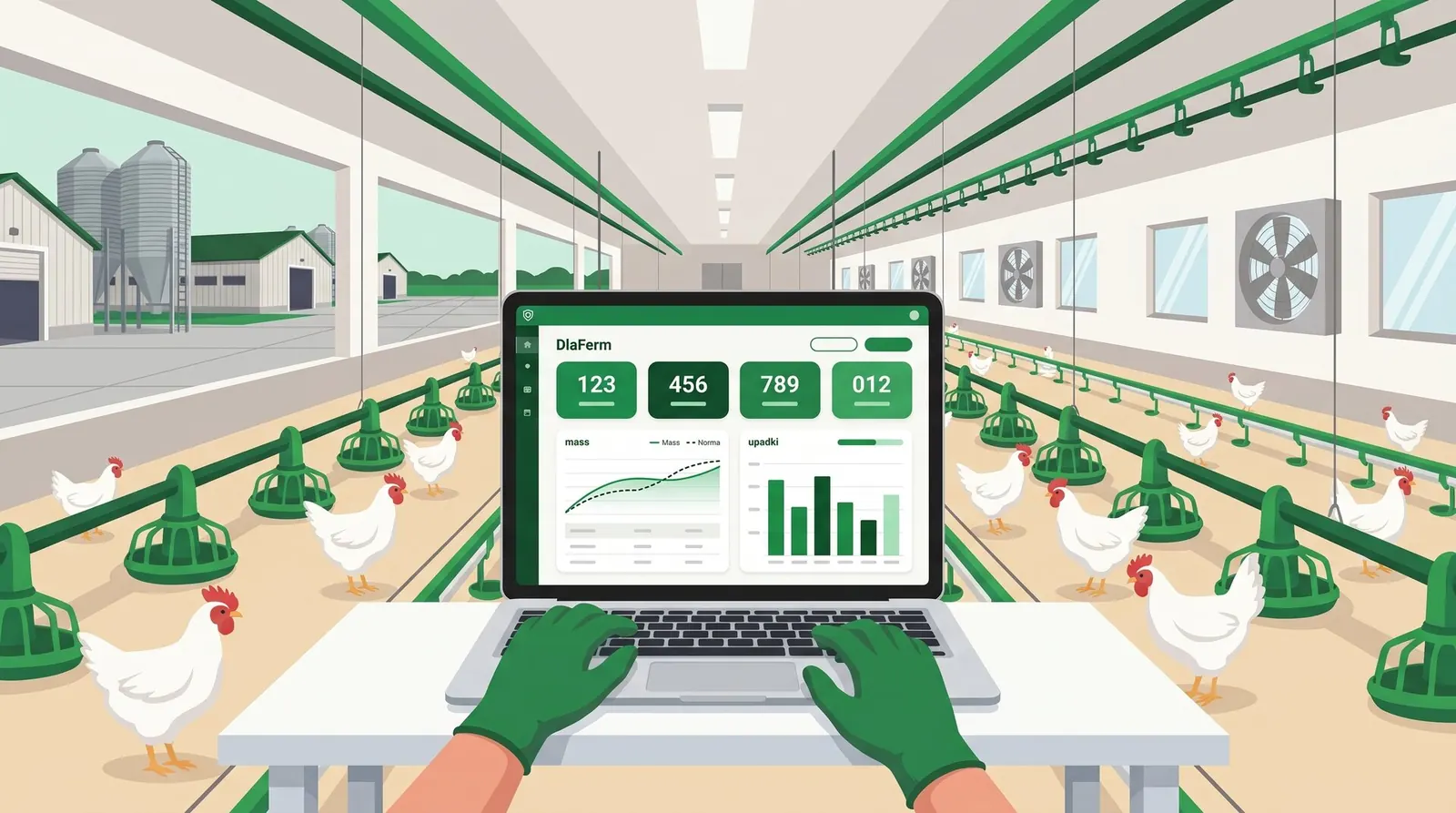
A 10% drop sometimes means disease and sometimes a cooler day
Many farms read the water meter every day and compare it with the day before. The problem is that water use also changes with flock age, house temperature, lighting program and the condition of the drinker lines. The same drop can be the first sign of disease or just the weather.
Old tables no longer fit
Modern broilers grow faster and drink more, so old consumption tables can mislead. Avian influenza seasons demand fast detection: every day of delay in reporting gives the virus more time to spread. We describe practical measuring rules in our guide to water consumption in broilers.
How we solve it
1. Water, feed and mortality in the flock record (available)
In the digital flock record you enter mortality and water use every day, even with no signal in the house. The app sends the entries when the phone finds a network.
2. Water meter, chart and alarm (available)
DlaFerm integrates with a water meter, shows a consumption chart for every day of the grow-out and sends an alarm when use departs from the norm. A meter on each drinker line also shows whether the problem affects the whole house or one line. In that case it is more often blocked drinkers or pressure.
3. Feed compared with the norm (available)
We compare feed intake with the norm for the breed and age of the flock and send an alert when birds clearly eat less.
4. Water norm with temperature (we are researching and rolling it out)
We are researching and rolling out a water-use norm that accounts for flock age and house temperature. A deviation from that curve says more than the difference from yesterday, especially in hot weather and after a lighting program change.
5. The decision stays with you and your vet
An alarm is a signal to walk into the house and check the lines. When a drop in drinking comes with mortality, you call the vet. We cover line cleaning in the article on drinker line hygiene.
What the research says
The norm must be current
Edge and colleagues (2025) measured daily water use in commercial houses in two broiler flocks raised from day 8 to day 63. The flocks used 14,629 liters per 1000 birds on average, and in week 8 birds drank 27–46% more than data from 20–30 years ago suggested. The authors recommend reporting water use in milliliters per kilogram of body weight. That is why we calculate the norm for the breed and age of the flock, not from a single table.
Temperature and age explain changes in water use
Marroco and colleagues (2026) analyzed 30 hourly series of water use in fattening pigs from five batches over three years. Ambient temperature affected it most, and use followed a clear daily rhythm. A model with temperature, ammonia and day of fattening predicted hourly use well and caught deviations from the norm. The same method fits a water meter on a drinker line in a poultry house.
Mortality rises several days before avian influenza is reported
Wolters and colleagues (2024) analyzed 92 HPAI H5 outbreaks on Dutch commercial farms. Deaths rose exponentially in the four days before reporting. The drop in feed and water intake was clear mainly in ducks, while in chickens mortality was the dominant signal. That is why water, feed and mortality go to one place.
Water is among the warning signs
In the Netherlands, the duty to report suspected avian influenza includes a drop in feed or water intake of 5% for two days in a row, as the authors of the same study note. Recording water daily is therefore not only a line check but part of early warning. We cover duties when HPAI is suspected in our guide to avian influenza.
What your farm gains
Faster response
The water meter alarm arrives before the change shows in the mortality notebook.
Fewer false alarms
A norm built on flock age and temperature is meant to tell a hot day from disease.
Full flock history
Water, feed and mortality for every day are recorded. Your vet can see when the change began.
See the norm on your own flock
If you want to see the water-use norm on a chart from your own flock, write to us using the contact form at the bottom of the page.
Frequently asked questions
How does water monitoring work in DlaFerm?add
We integrate with a water meter, show a consumption chart for every day of the grow-out and send an alarm when use departs from the norm. You can also enter water by hand in the flock record.
What equipment do I need?add
A water meter with a pulse output, ideally on each drinker line. Without it, you enter the reading by hand in the flock record.
How much work is the setup?add
You can complete the account and farm wizard in one afternoon. We connect the water meter together with the farm.
What if there is no signal in the poultry house?add
You make flock record entries offline, and the app sends them when the phone finds a signal.
Is a water alarm a diagnosis?add
No. A drop in drinking can mean disease, a line fault, poor water quality or heat. You check the house, and if birds show signs of disease, you call your vet.
Why is comparing with yesterday not enough?add
Because it misleads in hot weather and when the lighting program changes. A norm based on flock age and temperature separates weather from a real problem better.
What data do you collect?add
Water use from the meter or manual entry, feed use, mortality and flock record data. For the temperature-based norm, also house temperature readings.
How do you know water gives an early warning?add
In 92 HPAI outbreaks in the Netherlands, deaths rose exponentially for four days before reporting, and the drop in water and feed was clear especially in ducks (Wolters team, 2024). Edge's team (2025) showed that modern broilers drink 27–46% more than old tables suggest, and Marroco's team (2026) showed that temperature changes water use most.
Sources & resources
- linkEdge C.M. et al. (2025). Water consumption trends for commercial broilers grown to nine weeks. Journal of Applied Poultry Research 34, 100511
- linkWolters W.J. et al. (2024). Comparison of the Clinical Manifestation of HPAI H5Nx in Different Poultry Types in the Netherlands, 2014–2022. Pathogens 13(4), 280
- linkMarroco M. et al. (2026). Modeling and predicting water consumption in fattening pigs using autoregressive moving average with external parameters. Scientific Reports 16, 10027
Prepared by: DlaFerm Team based on data from the sources listed · Publisher: INSTA-TECH sp. z o.o.
Let water warn you earlier
We will show you how the water meter, flock record and alarms work in the app, and how we roll out the water-use norm with temperature. Create a free farm account or get in touch.
Phone
+48 796 258 151