How many birds are really in the house: bird balance and camera counting
Bird numbers drift at placement, through unrecorded mortality and at pick-up. We keep the bird balance in the flock record, and we research and roll out bird counting and detection from a camera. We build on studies that tested when a camera counts reliably.
verifiedFrom the team that has organised work on poultry farms for years.
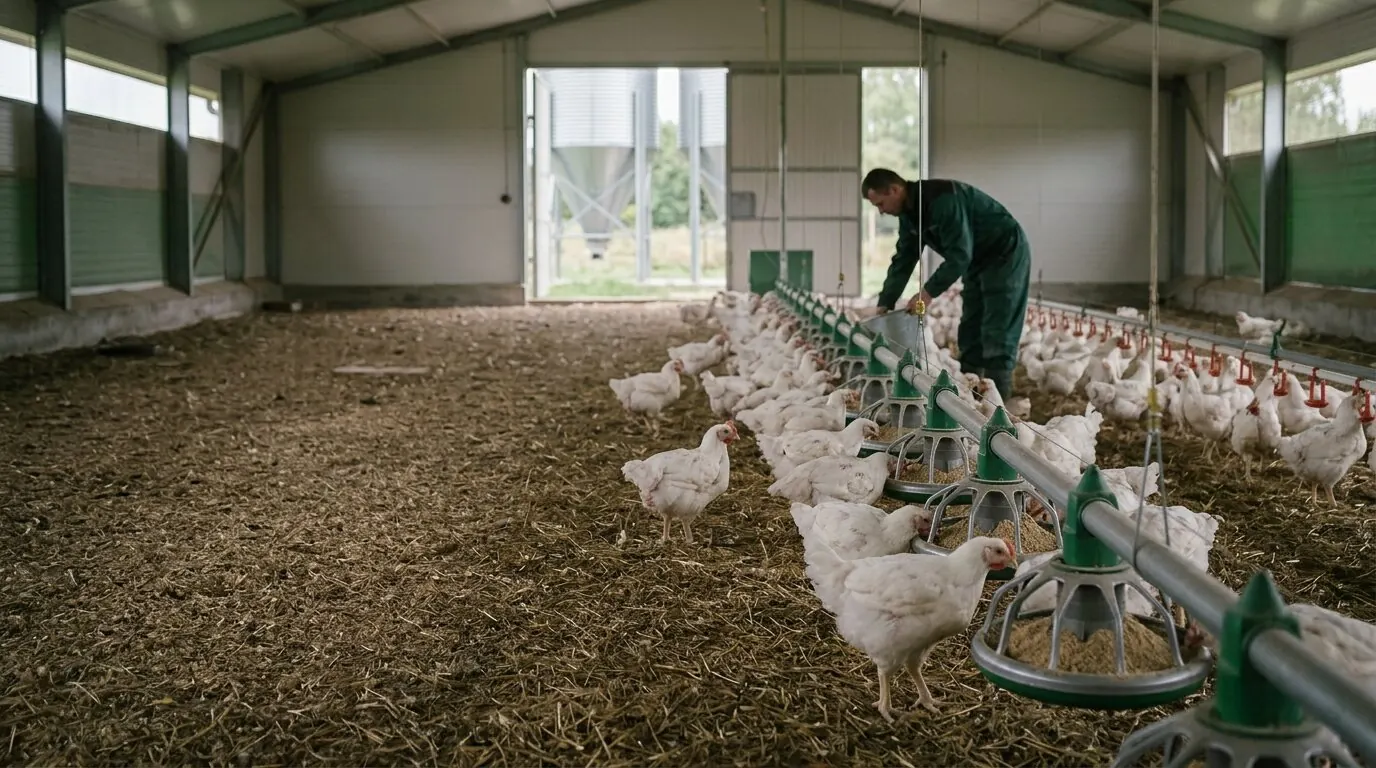
Placed, minus mortality. In theory
The number of birds in a house looks simple: the number placed, minus mortality and culls. In practice the balance drifts at placement, because chicks are counted in boxes. Then mortality does not always reach the notebook on the day. At the end the catching crew counts, and the figure differs from the paperwork.
Every missing bird is a question without an answer
You have to settle the gap with the hatchery, the catching crew or the slaughterhouse. Without numbers recorded at each stage, it is one person's word against another's. The bird count also underlies other measures: feed use per bird, flock weight and stocking density. If the count is wrong, every per-bird indicator is wrong too.
How we solve it
1. Bird balance in the flock record (works today)
In the digital broiler flock record you enter the number of chicks placed, daily mortality and culls, and at pick-up the number of birds delivered. You make entries from your phone in the house, even without signal. The app sends them when the phone finds a network.
2. The gap shows up in the numbers (works today)
You settle with catching crews in the same system, described in our article on the program for poultry catching crews. The difference between placement, mortality and pick-up is visible before anyone starts explaining it.
3. Bird counting and detection from a camera (we research and roll it out)
We research counting and detecting birds from images and roll it out on farms. We fine-tune the model on photos from the given farm and compare the result with the bird balance from the flock record. For a general overview of AI uses, see our article on artificial intelligence on a poultry farm.
4. Detecting birds is the base for further measurements
A camera that sees birds reliably also gives you a map of where the flock sits, activity and weight from the image. We write about robots finding dead birds in the article on automatic detection of dead birds.
5. A person makes the decision
The system shows numbers and differences. Explaining a gap and deciding what to do with the flock stay with the farmer.
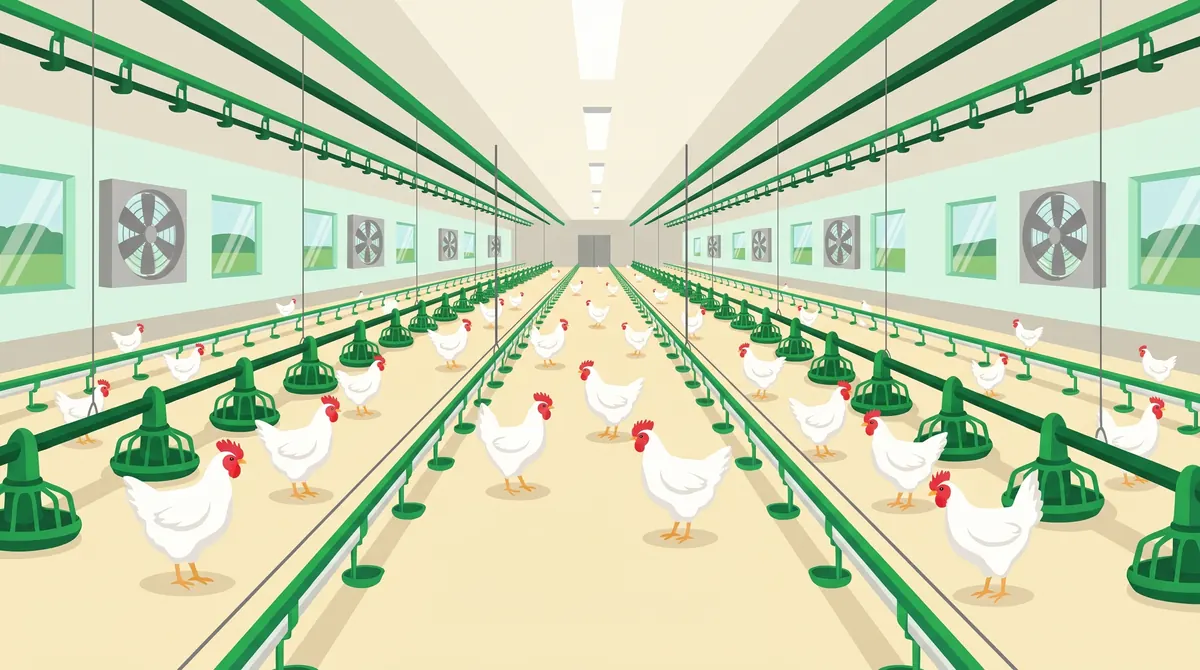
What the research says
The model has to be fine-tuned on farm data
Hwang's team (2026) trained a broiler detector on camera images from a commercial house. After fine-tuning on data from that farm, in-frame bird counting reached 97.6% accuracy, while a model trained only on public photos did 26% worse. On free-range areas, Chen J.'s team (2025) collected 6600 images from 14 scenes: on scenes outside the training set the result fell from 80.7% to 73.2%. That is why we assume the camera learns one specific house.
Fine-tuning takes days of work, not months
Bist's team (2025) from the universities of Arkansas and Georgia tested semi-automatic labeling of broiler and laying hen photos. When the model suggested and a person corrected, 3000 images were labeled in about 24 hours instead of 118. The ArgusTrack tool from Vo's team (2026) annotated a scene from 11 cameras in a broiler house in 102 seconds instead of 1872.
A small computer in the house is enough for counting
Boniche's team (2026) compared detectors on recordings of a dense broiler flock. YOLOv10s reached mAP 0.95 and on a single-board computer processed a frame in 392 ms, about 2.5 frames per second. That is enough to count the flock and map where birds sit every few minutes.
Several cameras count better than one
Chen S.'s team (2025) counted hens from three synchronized cameras. Accuracy was 95.1% with an average error of 2.9 birds, while the same detector from one camera gave 84.2%. Birds hiding each other is the main difficulty, and extra views reduce it.
Data from your own farm is the most valuable
Bhujel's team (2024) reviewed 58 public image datasets of farm animals. Only 5 cover poultry, and only 4 of all of them come from animals that were actually sick. That is why we build the model on images from the farms where it runs.
What the farm gains
Gaps settled with numbers
Placement, mortality, culls and pick-up are recorded with a date. Talks with the hatchery, the catching crew or the slaughterhouse rest on records, not memory.
Indicators based on the right number of birds
Feed per bird, stocking density and flock weight are calculated from the current bird count in the flock record.
Less manual counting
As the camera is rolled out, counting and watching how the flock is spread no longer depend on when someone last walked the house.
Let's check counting on your farm
Want to tidy up your bird balance or test camera counting in your house? Leave a message in the form at the bottom of the page.
Frequently asked questions
How do you keep track of the number of birds in a broiler house?add
In the flock record you enter placement, daily mortality, culls and the number of birds delivered. The system calculates the balance and shows differences. We research and roll out counting from a camera.
What equipment do I need?add
For the bird balance, a phone or a browser is enough. Counting from images needs a camera in the house and a small computer that processes the image on site. We set this up together with the farm.
How much work does setting up a camera take?add
After installation, photos from your house have to be collected and labeled to fine-tune the model. The model suggests and a person corrects, which cut labeling by about 80% in the studies.
What if there is no signal in the house?add
You make app entries offline, and the app sends them when the phone gets a signal. The computer in the house processes the camera image.
Will a camera trained elsewhere work in my house?add
According to the studies, less well. A model trained only on public photos did 26% worse than one fine-tuned on farm data. Houses differ in light, litter and camera position.
What data do you collect?add
Numbers from the flock record (placement, mortality, culls, pick-up) and crew settlements. With a camera, also the image from the house that the birds are counted from.
How do you know a camera counts reliably?add
After fine-tuning on farm data, Hwang's team (2026) reached 97.6% counting accuracy and mAP@0.5 of 0.988. Three cameras at once in Chen S.'s work gave 95.1% instead of 84.2% from one. Boniche's team showed that a lightweight model runs on a small computer in a dense flock. We measure accuracy in your house at rollout.
Sources & resources
- linkHwang et al. (2026). Combining Public and On-Farm Datasets for Deep Learning-Based Broiler Detection and Counting in a Commercial Broiler House. Agriculture 16(21), 2321
- linkBoniche et al. (2026). A Lightweight Deep Learning Model for Broiler Population Monitoring on an Edge AI Platform. Poultry 5(3), 36
- linkChen S., Feng Y., Wang Y., Liao J., Zhang Q. (2025). TP-MVCC: Tri-plane Multi-view Fusion Model for Silkie Chicken Counting. arXiv:2509.24329
- linkChen J., Feng Y., Dai T. et al. (2025). SFN-YOLO: Towards Free-Range Poultry Detection via Scale-aware Fusion Networks. arXiv:2509.17086
- linkBist R.B., Chai L., Weimer S. et al. (2025). Efficient auto-labeling of large-scale poultry datasets (ALPD) using an ensemble model with self- and active-learning approaches. arXiv:2501.10809
- linkVo H., Nguyen D., Le N. (2026). ARGUSTRACK: A Multi-View Annotation System for Multi-Object Tracking. arXiv:2606.20687
- linkBhujel A., Wang Y., Lu Y., Morris D., Dangol M. (2024). Public Computer Vision Datasets for Precision Livestock Farming: A Systematic Survey. arXiv:2406.10628
Prepared by: DlaFerm Team based on data from the sources listed · Publisher: INSTA-TECH sp. z o.o.
Let's tidy up the bird balance on your farm
We'll show how placement, mortality and pick-up connect in the flock record, and talk about counting birds from a camera on your farm. Create a free farm account or get in touch.
Phone
+48 796 258 151