What is Mercosur? Member countries and the EU trade deal
Mercosur is a South American trade bloc: Argentina, Brazil, Paraguay and Uruguay. The EU–Mercosur agreement has applied provisionally since 1 May 2026. For a farmer, the key points are the duty-free quotas for poultry, beef and sugar, and the rules imported meat must meet.
verifiedFrom the team that has organised work on poultry farms for years.
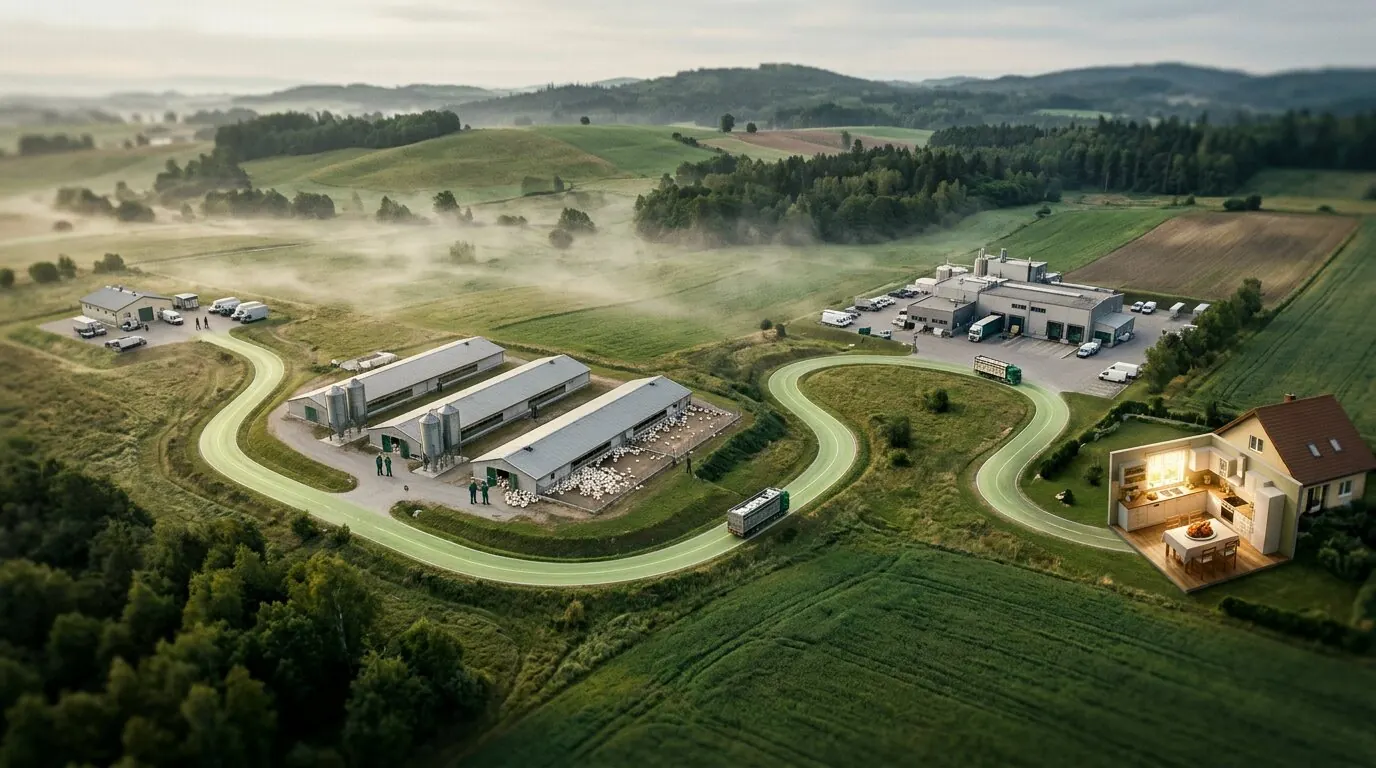
Mercosur is a trade bloc of South American countries. According to the European Commission, it has four founding countries: Argentina, Brazil, Paraguay and Uruguay. A trade agreement links them with the European Union and has applied provisionally since 1 May 2026. Together they form a trade area of 700 million people.
What is Mercosur: the short version for farmers
A farmer wants to know one thing: will more cheap meat enter the EU? The agreement cuts tariffs, but it sets volume limits (quotas) on sensitive products such as poultry, beef, sugar, ethanol and honey. For a detailed look at the effects on farming, read the EU–Mercosur agreement and farming: poultry, beef, quotas and safeguard clauses. Below we explain the basics: who belongs to the bloc, what was agreed and how it relates to your farm.
Status as of 23.11.2026
We describe the situation as of 23.11.2026, based on European Commission pages. The Commission says that after provisional application starts, it will work toward fully completing the procedure in line with the EU treaties. Poland challenged Council Decision (EU) 2026/183 on provisional application of the agreement before the CJEU (Court of Justice of the EU), case C-460/26, filed 10.05.2026. By an order of 29.09.2026, the Vice-President of the Court rejected Poland's request to suspend the decision. The agreement therefore still applies, and the case on the merits continues. We collect EU acts that matter to farmers in the EU rules section. Check details and deadlines on the European Commission pages and on the site of Poland's Ministry of Agriculture and Rural Development.
Mercosur: which countries belong
Mercosur countries and members
The European Commission lists four founding countries: Argentina, Brazil, Paraguay and Uruguay. They are the parties to the agreement with the EU. The market of these countries has 295 million people. When someone searches for a "Mercosur map", they usually mean these four countries in South America that share a common trade policy. We do not cover other associated states here, because the EU agreement concerns the four founding countries.
Scale of production in Mercosur countries
According to DG Trade (the European Commission's trade department), total beef production in Mercosur in 2023 was 15.5 million tonnes. Of this, Brazil produced 11.2 million tonnes, Argentina 3.3 million tonnes, Uruguay 0.6 million tonnes and Paraguay 0.5 million tonnes. These figures show they are large meat producers. The Commission notes, however, that exports to the EU are a small fraction of their output. For comparison, look at the domestic market: bull prices, for beef and dairy breeds depend on many factors, not only on imports.
The EU–Mercosur agreement: since when and what it contains
Timeline
According to the European Commission, negotiations began in 2000. The EU and the four Mercosur founding countries reached a political agreement on 6 December 2024. EU member states formally backed the agreement on 9 January 2026. The agreement has applied provisionally since 1 May 2026. The Commission's page describing the agreement was last updated on 30 April 2026.
What the agreement changes in trade
The Commission says the agreement removes trade barriers and cuts tariffs on many products. It estimates that EU companies will save over EUR 4 billion a year. By 2040 the Commission expects EU GDP to grow by more than EUR 77.6 billion and annual EU exports to rise by about 39%. These are the Commission's forecasts, not a guarantee. For farmers, the provisions on import limits and safeguard clauses matter more.
Fund and safeguard clauses
According to the European Commission, the agreement protects EU farmers through agreed limits (quotas) and legally binding safeguard clauses. The EU will also set up a fund worth EUR 6.3 billion in case of harmful effects on farmers and agricultural markets. The Commission calls such a scenario unlikely. We explain how the safeguard clauses work in a separate article on the EU–Mercosur agreement and farming.
Mercosur and poultry: the duty-free quota
The 180,000-tonne quota
According to DG Trade, the EU will allow 180,000 tonnes of poultry in duty-free. In Implementing Regulation (EU) 2026/996 these are two quotas of 90,000 tonnes each (boneless and bone-in meat) at a 0 duty, reaching full size in 2031. The volume will be phased in over five years. The Commission says this is 1.3% of total EU production. The quota is lower than current imports from Mercosur, which were 293,000 tonnes in 2024. The Commission points out that EU poultry exports to the world are 2.1 million tonnes (2024). It also forecasts that EU poultry consumption grows each year by an amount similar to the new quota.
What it means for broilers
The quota applies to meat imports, not to production in Poland. The real effect on prices depends on how the market reacts and whether processors buy more imported meat. If you grow under contract, look at your processor's contract template and check how placements and price are settled. We cover this in Broiler contracts: the agreement with the processor. Cycle planning and cost control in placement planning help you spot a drop in profitability sooner.
Beef, sugar, ethanol and honey
Beef
According to DG Trade, the lower-duty quota for beef from Mercosur is 99,000 tonnes for all four countries together. Implementing Regulation (EU) 2026/996 splits it into 54,450 tonnes of fresh or chilled meat and 44,550 tonnes of frozen meat, at a 7.5% duty, at full size from 2031. The Commission says this is about 0.6% of Mercosur production. It also says it does not expect a significant rise in beef production in the region. If you keep cattle, watch how bull prices develop and how processors react to import volumes.
Sugar, ethanol and honey
No new sugar quota was created for Brazil: 180,000 tonnes of raw cane sugar for refining will enter duty-free under an existing limit. A new quota of 10,000 tonnes was agreed for Paraguay. The agreed amounts equal 1.1% of EU sugar production (16.5 million tonnes). For ethanol, a duty-free quota of 450,000 tonnes was opened for the chemical industry, plus 200,000 tonnes at a rate equal to one third of the full duty for other uses. Both quotas will be phased in over five years. According to the Commission, the honey quota will cover less than 10% of EU consumption.
Standards imported meat must meet
Veterinary and consumer rules
The European Commission stresses that the EU has very strict sanitary and phytosanitary standards that protect human, animal and plant health. According to DG Trade, every product sold in the EU must meet consumer protection standards, and the agreement does not change them. Products from Mercosur must meet them in the same way. The Commission states that no exceptions to EU food safety rules are planned. Information on veterinary controls is published by Poland's Chief Veterinary Inspectorate (Główny Inspektorat Weterynarii).
What to do on your own farm
A trade agreement does not change your duties on the farm. Biosecurity, flock records and correct use of medicines with withdrawal periods still count. These tools help: the biosecurity plan generator, treatment and withdrawal records and the QR farm entry and exit log. Good records are your advantage: they show the buyer that you control quality from placement to loading.
How to prepare your farm for market changes
Watch your costs and production results
Under price pressure, every point of feed conversion counts. Track the results of each flock in the FCR and EPEF online module, and control feed use through silo monitoring. Compare batches with each other and look for the causes of differences: health, litter, water, feed. If you are considering expanding, see raising poultry for sale.
Where to check current information
The legal status and conditions change over time. Quotas are phased in, and the European Commission is still working toward fully completing the procedure. Information for farmers is published by Poland's Ministry of Agriculture and Rural Development and by ARiMR (Agency for Restructuring and Modernisation of Agriculture). Check market prices for poultry and eggs regularly, because they change every week. We explain this in the article on egg prices.
Frequently asked questions
What is Mercosur?add
It is a South American trade bloc. The four founding countries are Argentina, Brazil, Paraguay and Uruguay. A trade agreement links them with the EU and has applied provisionally since 1 May 2026.
Which countries are in Mercosur?add
According to the European Commission, the agreement covers four founding countries: Argentina, Brazil, Paraguay and Uruguay. Together with the EU they form a trade area of 700 million people.
When did the EU–Mercosur agreement take effect?add
The European Commission says the agreement has applied provisionally since 1 May 2026. The political agreement was reached on 6 December 2024, and EU member states formally backed it on 9 January 2026. Poland challenged the decision on provisional application before the CJEU (case C-460/26), but on 29.09.2026 the Court rejected the request to suspend it.
How much Mercosur poultry can enter the EU duty-free?add
According to DG Trade, the duty-free quota is 180,000 tonnes of poultry, phased in over five years. That is 1.3% of EU production. Imports from Mercosur in 2024 were 293,000 tonnes.
What is the Mercosur beef quota?add
The lower-duty quota is 99,000 tonnes for all four countries together: 54,450 tonnes of fresh and 44,550 tonnes of frozen beef at a 7.5% duty. The Commission says this is about 0.6% of Mercosur production.
Does meat from Mercosur have to meet EU standards?add
Yes. According to the European Commission, EU sanitary, phytosanitary and consumer protection standards do not change, and products from Mercosur must meet them in the same way.
Will farmers get any protection?add
The Commission says the agreement includes import limits and legally binding safeguard clauses. The EU will also set up a fund worth EUR 6.3 billion in case of harmful effects on farmers.
Sources & resources
- linkEUR-Lex: Council Decision (EU) 2026/183 on the signing and provisional application of the EU–Mercosur interim agreement
- linkEUR-Lex: Implementing Regulation (EU) 2026/996 (EU–Mercosur tariff quotas)
- linkEUR-Lex: Order of the Vice-President of the CJEU of 29.09.2026, case C-460/26 R, Poland v Council
- linkEuropean Commission: EU-Mercosur trade agreement
- linkEuropean Commission (DG Trade): Factsheet: EU-Mercosur partnership agreement, Opening opportunities for European farmers
- linkPoland's Ministry of Agriculture and Rural Development: gov.pl/web/rolnictwo
- linkChief Veterinary Inspectorate: gov.pl/web/wetgiw
Prepared by: DlaFerm Team based on data from the sources listed · Publisher: INSTA-TECH sp. z o.o.
Track flock results in the FCR and EPEF online module
When the market shifts, your own numbers matter: feed conversion, weight gain and mortality in every flock. The FCR and EPEF online module shows them in one place. Create a free farm account in DlaFerm or get in touch.
Phone
+48 796 258 151