Bull prices: beef and dairy bulls, and what sets them
A bull's price depends mainly on its purpose, breed, age and weight, and on documented breeding value. We give no amounts because quotes change every week. We show the factors a buyer checks before purchase and where to find current data.
verifiedFrom the team that has organised work on poultry farms for years.
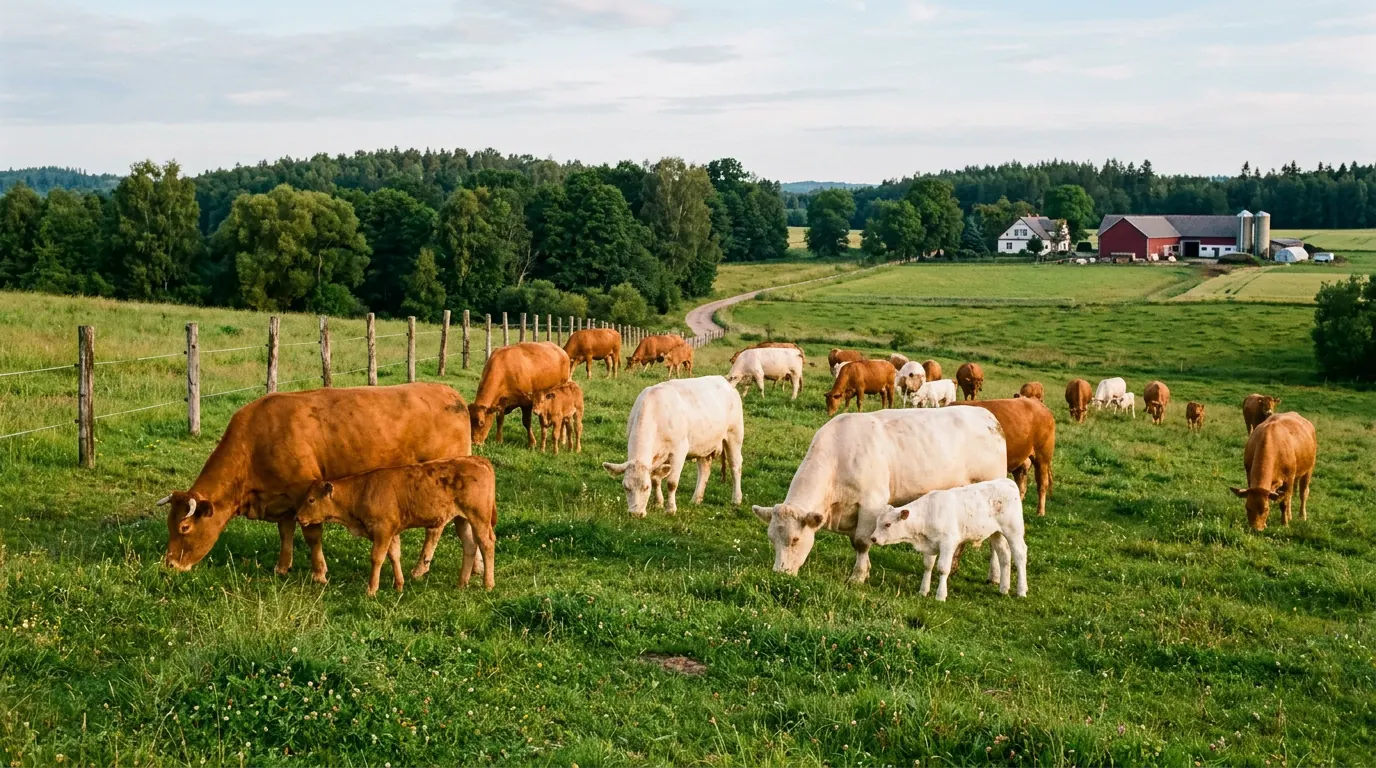
A bull's price is set first by what the animal is for: breeding in a beef herd, rearing for fattening, or producing slaughter cattle. Breed, age, body weight, origin with a breeding value assessment, health and complete documents all add to that. This text reflects the state of 22.11.2026. We give no amounts, because they change every week, but we show what drives them and where to check the market.
Why bull prices vary so much
Two bulls of the same age can have very different value. A bull with a documented assessment and good conformation is bought by herds where calf quality counts. An animal without papers usually goes to sale as slaughter cattle. The buyer pays for predictability: even calves and calm work in the herd. In your advert, give the breed, date of birth, weight and origin. You can keep your herd records in farm management software and copy the data from there into the advert.
Beef bull and dairy bull: two different markets
Beef bulls
Bulls of beef breeds are most often sold to breed suckler herds or to be reared for fattening. Their value depends on growth rate, conformation and how well they pass traits on to offspring. Breeding centers run performance and breeding value assessments, and the results are one of the main arguments in setting the price. An animal without an assessment, even in good condition, usually sells for less, because the buyer does not know which traits it will bring to the herd. See also Limousine and Hereford.
Dairy bulls
According to a publication by the Institute of Animal Science (IZ PIB) on 60 years of work on beef cattle, about 75% of the cattle population in Poland is already of the dairy type. Bull calves from such herds usually go to rearing and fattening, and their price depends on age, weight and whether they were reared in conditions that allow good meat yield. A dairy bull for breeding in a beef herd is valued less often and with more caution, because his genetics were not selected for meat. Compare breeds in our guide to dairy and dual-purpose breeds.
Age and body weight in valuation
Gain as a source of value
Rate of gain decides how many kilograms of live weight a bull delivers in a given time. The Irish Teagasc Beef Manual (section 3, beef systems) gives, for bulls fattened from 8 to 16 months of age in an outdoor system, a weight range from 350 kg to 620 kg. These data come from another country and another system, so use them as a reference point, not as a standard for a Polish farm. Compare them with your own weight measurements.
Age at sale
Selling a younger animal usually carries less risk for the buyer, who finishes the rearing, but it also means a lower weight. An older bull with an established weight is easier to value, and his breeding value is often already visible in assessment results. Before you list the animal, write down the date of birth and the latest weight measurements, because the buyer will always ask for them. Missing data lowers trust and often cuts the price talk short.
Pedigree and breeding value assessment
Assessment, not just pedigree
The Institute of Animal Science (IZ PIB) describes in Wiadomości Zootechniczne (its animal science journal) methods for assessing the performance and breeding value of beef cattle, developed in work from 2018 among others. So the buyer cares not only who the sire was, but whether the animal was assessed and what its result is. A pedigree without an assessment is a good document, but it justifies a higher price less than a pedigree together with a result.
Identification and match with the register
Every bull sold must carry identification that meets the rules. Whether ear tag numbers, date of birth and origin match the cattle database is the first thing a buyer checks. A mismatch in a single number can stall a deal. Keep records up to date and compare the data before you list the animal. Look at the options for integration with IRZplus (ARiMR's online animal register) and set up your animal data before you start looking for a buyer.
Market, export and price swings
Scale of production
According to a 2012 IZ PIB publication, Poland then ranked seventh in the European Union for beef production. The same paper stated that about 70% of Polish beef went to export. Because a large share of the meat goes abroad, a bull's price also depends on demand in importing countries, not only on the home market. The 2012 data show the market structure, not today's quotes.
What pushes prices up and down
The same publication noted that in the year before it was written, prices of breeding stock and slaughter cattle rose by about 30%. It shows how fast the market can change. We give no current quotes, because they change every week. Check them with agricultural advisory centers and in publications of the Ministry of Agriculture and Rural Development, and compare offers from at least a few buyers. For the outlook, see our cattle price forecast.
Animal health and valuation
Infectious diseases and reporting
The PODR Szepietowo leaflet (a regional agricultural advisory center) describes lumpy skin disease (LSD) as a disease whose presence affects trade in animals. A buyer asks about the herd's status and whether there were outbreaks nearby. The rule is simple: if you suspect disease, do not put the animal up for sale and report it to your vet. Decisions on testing and restrictions belong to the veterinary services, not to the farmer.
Withdrawal period and treatment records
A bull that has been treated cannot be sold before the withdrawal period of the drug has passed. The length of the withdrawal period comes from your vet or the product leaflet, not from a general rule. Record every treatment with the date and the animal's number, because without a record you cannot prove the withdrawal period has passed. Keep this in treatment and withdrawal records, so the paperwork is ready at every sale.
How to prepare a bull for sale
Condition and rearing
A bull in good condition, with steady gain and no chronic health problems, sells more easily. The KPODR Minikowo guide on rearing beef calves (a regional advisory center, with authors from SGGW, the Warsaw University of Life Sciences) points to bedding area conditions and the choice of litter, because they affect the health of young animals. Record weight and gain at regular intervals. A buyer wants to see the animal's history, not just one day's result.
Documents and invoice
At sale, prepare the full set: identification, origin data, assessment results and treatment records. The invoice for a sold animal must be issued under the current rules, and the KSeF invoicing module (KSeF is Poland's national e-invoicing system) helps with it. That way you keep your sales documents in one place, next to your herd data. For the paperwork a beef farmer needs, see rules and documents for beef cattle keepers.
Frequently asked questions
What affects the price of a beef bull?add
Most of all breed and performance assessment results, then age and body weight. The buyer also looks at origin and the animal's condition. Amounts change over time, so check current quotes with advisers.
Is a dairy bull valued the same as a beef bull?add
Usually not in the same context. A dairy bull is valued mainly as an animal for rearing and fattening, while a beef bull is also valued as a source of genetics for breeding a beef herd. The difference comes from the animal's purpose, not its looks.
Where can I check current bull prices?add
We give no quotes, because they change every week. Ask advisers at agricultural advisory centers and compare offers from several buyers. The Ministry of Agriculture and Rural Development also publishes market data.
Do documents really affect the price?add
Yes. Matching identification, pedigree and a breeding value result reduce the buyer's risk, and that shows in the price. Missing documents usually lower the offer or rule the animal out of a deal for breeding.
Can I sell a treated bull right away?add
No. After treatment the drug's withdrawal period applies, given by your vet or the product leaflet. Record every treatment in your register so you can easily show that the period has passed.
What should I do if my bull may be sick?add
Do not put the animal up for sale. Contact your vet, who will decide on tests and next steps. The farmer does not judge disease status alone.
Sources & resources
- linkIZ PIB — Wiadomości Zootechniczne — Breeding work in a beef cattle herd (Z. Choroszy et al.), WZ L(2012)1:11–20
- linkIZ PIB — WZ — 60 years of IZ work on beef cattle (J. Trela et al.), WZ XLIX(2011)4:11–56
- linkIZ PIB — WZ — New methods of assessing performance and breeding value of beef breeds (Z. Choroszy et al.), WZ LVI(2018)3:17–23
- linkTeagasc (Ireland) — Teagasc Beef Manual — Section 3: Beef Systems
- linkKPODR Minikowo — Rearing beef calves (guide, SGGW authors)
- linkPODR Szepietowo — Lumpy skin disease (LSD) — leaflet (Z. Marciniak)
Prepared by: DlaFerm Team based on data from the sources listed · Publisher: INSTA-TECH sp. z o.o.
Selling bulls and want your records in one place?
The Integrations with IRZplus and sensors module helps you sort out animal data before a sale. Create a free farm account or get in touch, and we will show you how to set it up for your herd.
Phone
+48 796 258 151