Hereford cattle: a beef breed guide
Hereford is a beef breed with a red coat and a white face. In Poland it is kept as a pure breed and for crossbreeding. According to IZ PIB (Poland's National Research Institute of Animal Production), it makes up a few percent of the pure-bred beef herd, and its gains and cow longevity are well documented. We explain what the data means for your herd.
verifiedFrom the team that has organised work on poultry farms for years.
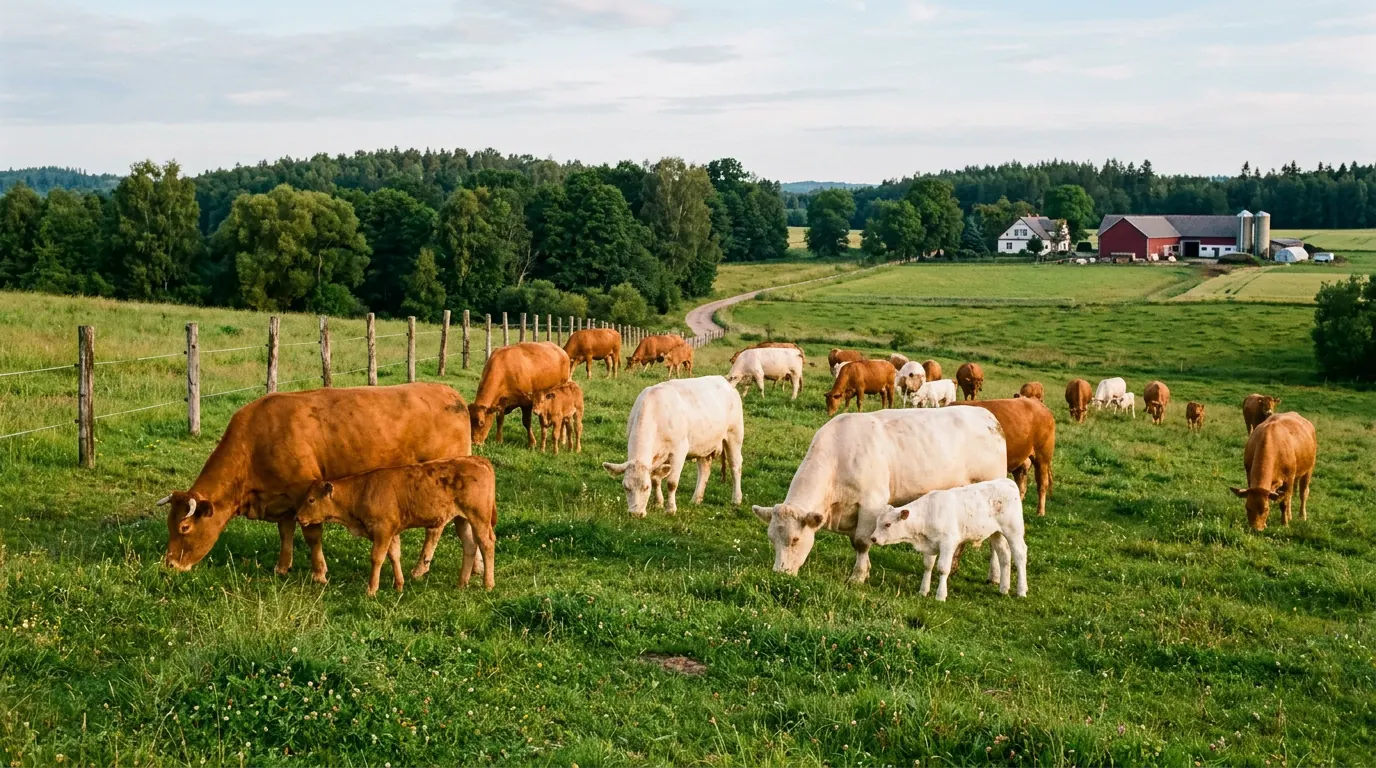
Hereford is a beef breed with a distinctive coat: a red or reddish-brown body with a white head and white markings on the dewlap, belly and legs. In Poland it is kept as a pure breed and for commercial crossbreeding. According to a 2018 IZ PIB review, Hereford makes up about 6% of the pure-bred beef population, which is dominated by Limousine and Charolaise. Breeding stock is available, but in smaller numbers than for the most popular breeds.
Who this breed suits
Hereford suits suckler herds, where cows are kept on pasture and the goal is a steady output of calves for weaning. The calm temperament makes calving and handling easier. Below we set out what Polish and foreign data say about performance, breeding, feeding and health. We also show how to record results so you can judge your own herd, not just the study averages. For suckler systems, see our guide to the suckler cow system.
Appearance and role of Hereford in the herd
Coat and build
A typical Hereford has a red or reddish-brown coat, a white head and white markings on the dewlap, belly and legs. The animals are compact and medium-sized, which gives good meat yield with a moderate frame. When buying, look at how even the group is: a herd of similar build is easier to feed and easier to sell. Breed standards and conformation scoring are handled by breeders' organizations, and you can check performance data in the performance recording results.
Hereford in crossbreeding
Farms that want to switch from a dairy herd to a beef herd use grading-up crossbreeding. You mate cows of a production breed to a beef bull, and the share of beef blood rises with each generation. According to an IZ PIB paper (Wójcik and Czubska, WZ 2014), consistent crossing steadily reduces the share of the unwanted breed, and by the fourth generation the offspring have over 90% beef blood. Hereford can serve as the bull in such a scheme or as the dam breed for further crossing. The choice depends on the cows you have and your production goal. For other breeds used this way, see Limousine and Galloway.
Weight gain of bulls and heifers
A 2015 IZ PIB review (WZ LIII) listed average body weights and daily gains after standardization to day 210 of life. Hereford bull calves averaged 254.8 kg and a daily gain of 1122 g, and heifers 224.5 kg and 950 g. For comparison, Limousine bull calves gained 1095 g, Limousine heifers 1001 g and Charolaise heifers 1057 g. So Hereford bull calves gained slightly faster than Limousine, and heifers more slowly than both breeds.
What this means in practice
These figures are averages from the studied population, not the result of your herd. Before you build a rearing plan on them, weigh your group at weaning and compare it with last year. Daily gain is calculated from weighing dates, so record them for each animal. It also helps to keep your animal data consistent with IRZplus, ARiMR's online animal register (ARiMR is Poland's Agency for Restructuring and Modernisation of Agriculture). The IRZplus and sensor integrations module shows how such a comparison can work.
How long Hereford cows stay in the herd
Distribution of calvings
In a 2015 IZ PIB summary covering 663 Hereford cows, 21.3% of calvings were first calvings and 1.5% were tenth calvings. For cows with more than ten calvings the share was 1.7%. The share falls with calving number, which shows how few cows reach late calvings. For a farmer this means that herd replacement and the selection of breeding heifers affect herd economics.
Breeding in practice
Beef cows usually calve once a year, so every extra month between calvings costs money. Agree mating dates and the calving season with an adviser from an ODR (Poland's regional agricultural advisory center) and your vet, not by your neighbor's calendar. Record mating and calving dates for every cow and plan the next cycles ahead. Cycle and stocking planning helps here, because you can see which cows are due next.
Feeding and meat quality of Hereford
Beef
In a study of beef from organic farms (Walczak et al., 2013, cited in an IZ PIB paper from 2014), Hereford cattle had the highest level of polyunsaturated fatty acids of the groups tested. The lowest level was found in crossbreds. The same breed also had the highest vitamin E content in the meat. The results come from one production system and a small group of animals, so treat them as a direction, not a guarantee of quality for every batch.
Pasture and stocking rate
On pasture, forage yield and stocking rate per hectare decide gains. An IZ PIB paper on feeding beef cattle in organic systems (Bilik et al., WZ 2014) shows that on a poor paddock you have to reduce the stocking rate of cows with calves and young fattening cattle. Rations and supplements are set with a nutrition adviser. Keep the feeding plan and feed records in your herd register, and collect gains at every weighing.
Herd health and welfare in practice
Welfare of calves and cattle
Council Directive 2008/119/EC sets minimum standards for the protection of calves. The European Food Safety Authority (EFSA) has published opinions on the welfare of beef cattle, calves and cattle in transport. For a beef herd this means constant access to water, a place to lie down and daily checks on calves. Check the exact requirements for buildings and pens in the current text of the law in ISAP (Poland's online legal database) and in Veterinary Inspection (Inspekcja Weterynaryjna) guidance. You can set out your disease protection plan in the biosecurity plan generator. For paperwork, see rules and documents for beef cattle keepers.
Disease and treatment
If you suspect disease, report it to your vet before giving any medicine. For lumpy skin disease (LSD) and other infectious diseases, reporting a suspected case is required, and animals may be subject to movement restrictions. The vet always chooses the medicine and dose. After treatment, observe the withdrawal period and record every treatment so you do not send an animal to slaughter too early. Treatment records and withdrawal periods help you keep track of these dates.
Frequently asked questions
Is Hereford a good breed for farming in Poland?add
Yes, the breed is kept in Poland both pure and for crossbreeding. According to IZ PIB, it makes up a few percent of the pure-bred beef population. Before buying, check the performance recording results with the breeders' organization.
How fast do Hereford bull calves grow?add
In a 2015 IZ PIB summary, standardized to day 210 of life, Hereford bull calves gained 1122 g a day on average. Heifers gained more slowly, at 950 g a day. These figures describe a population, so calculate gain in your own herd from your own weighings.
How many years does a Hereford cow stay productive?add
IZ PIB data show that the share of cows falls with calving number, and few remain after the tenth calving. Productive life depends on udder health, fertility and herd economics, not on breed alone. Record each cow's calving number so you can judge her at replacement time.
Does Hereford produce good quality beef?add
In studies of meat from organic farms, Hereford had the highest vitamin E content and the highest level of polyunsaturated fatty acids. Carcass quality also depends on feeding, slaughter age and how even the batch is. Results from one system do not settle the question for all farms.
How much do Hereford heifers cost?add
Prices change with the season and the market, so we do not give figures. They depend on origin, age, weight, pedigree and performance score. Current offers are available from breeders and in breeders' association listings, and ODR centers offer advice.
Can you cross Hereford with other breeds?add
Yes, commercial and grading-up crossbreeding are common in beef cattle. Set the crossing scheme before the first mating and choose the bull breed to fit your production goal. If you change the herd's breed, check how it will affect calf rearing results.
Sources & resources
- linkIZ PIB — WZ — New methods of assessing the performance and breeding value of beef cattle breeds (Z. Choroszy et al.), WZ LVI(2018)3:17–23
- linkIZ PIB — WZ — Current state and prospects of beef cattle farming and breeding in Poland (H. Grodzki et al.), WZ LIII(2015)2:77–87
- linkIZ PIB — WZ — Slaughter characteristics of beef from organic farms (P. Wójcik, J. Walczak)
- linkIZ PIB — WZ — Breed selection and breeding work in beef herds under organic conditions (P. Wójcik, A. Czubska)
- linkIZ PIB — WZ — Feeding beef cattle in organic farming (K. Bilik et al.)
Prepared by: DlaFerm Team based on data from the sources listed · Publisher: INSTA-TECH sp. z o.o.
Running a beef herd and want breeding under control?
The stocking and cycle planning module lets you record mating and calving dates in one place. Create a free farm account on DlaFerm.pl or get in touch, and we will show you how it works in practice.
Phone
+48 796 258 151