Suckler cow: how a suckler herd works in beef cattle farming
In a suckler system, beef cows (or beef crossbreds) raise their own calves on their mother's milk. We explain how such a herd runs, how many cows fit on a hectare, and what to watch in breeding, health and records.
verifiedFrom the team that has organised work on poultry farms for years.
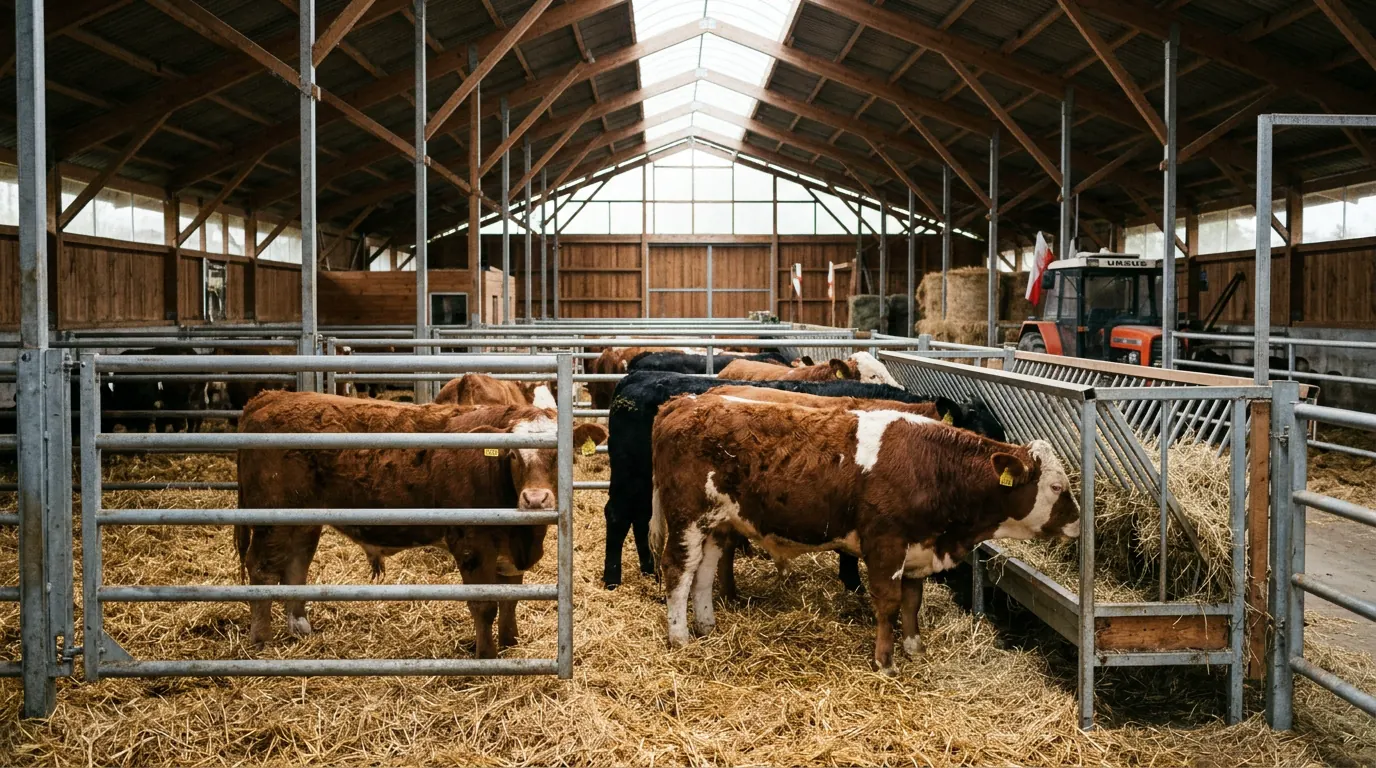
A suckler cow is a beef cow, or a cross with a beef breed, that raises her own calf. In a suckler system the calf nurses until weaning. After that you sell it as a weaner or finish it on the farm. Suckler farming needs no milking and no daily udder care, so it suits farms without the setup for milk production. The system rests on a herd of mothers, a bull for mating and a paddock where cows with calves graze for most of the season.
Why a suckler system needs a plan
A suckler cow has two jobs at once: keeping herself going and raising a calf. So what counts is not a single animal but the whole yearly cycle: calving date, feed access during lactation, calf health and weaning date. If calves are born in different months, you handle a different group of animals every day. In a herd of a few dozen head, a mistake in an ear tag number or a calving date comes back later in settlements and paperwork.
How many suckler cows per hectare
Paddock quality sets the stocking rate
Stocking rate depends mainly on paddock quality. According to a table from IZ PIB (Poland's National Research Institute of Animal Production; a paper on organic farms, WZ 2014), take a medium-frame beef cow of about 500 kg body weight, calving in February and rearing a calf up to 250 kg, with 80% forage utilization. Her stocking rate with calf is 3.2 head/ha on a very good paddock, 2.4 head/ha on an average one and 1.3 head/ha on a poor one. This is a starting point for a talk with your adviser, not a ready norm for your farm. On light soil or after a drought, cut the stocking rate.
Pasture and rotational grazing
Cows with calves need constant access to fresh grass and water. You usually divide the pasture into paddocks and move the animals through them in turn, so the grass has time to regrow. The Teagasc Beef Manual links the profitability of suckler systems to pasture quality and to matching stocking rate to grass growth. Near the paddock, provide shelter from wind and rain and shade in hot weather. The app for farm workers makes it easier to manage pasture work and coordinate the team.
Suckler cows in breeding and breed choice
Grading up with beef sires
A suckler herd often starts from crossbreeding. According to an IZ PIB paper on breed choice in organic beef herds, consistently crossing the base breed with a beef breed gradually raises the share of beef blood. Heifers from successive generations carry up to 50%, 75%, 87.5% and 93.7% beef blood. In the fourth year of crossing, the offspring have over 90% beef breed blood. The example uses Limousine as the sire, but breed choice depends on calving conditions and what your buyer wants. See breed profiles such as Limousine, Hereford or Galloway.
Calving and calf rearing
Calves are born next to their mothers, so the calving date shapes the whole herd. AHDB materials on feeding suckler cows and calves, and the KPODR Minikowo guide on rearing beef calves, indicate that a cow's condition before calving and her milk yield in lactation decide calf gains. Plan calving pens, check calves in the first hours after birth and record every birth with the dam's number. You can compare cycle dates in the batch and cycle planning module.
Herd health and withdrawal periods
Diseases that need a vet
Lumpy skin disease (LSD) needs quick contact with a veterinarian. A leaflet from PODR Szepietowo (a regional agricultural advisory center) describes its symptoms and the rules to follow. If you suspect it, isolate the animal and do not move it without the vet's decision. Do not diagnose it yourself. Write down every observation with the date and the animal's number, since this helps in talking to the vet and in later inspections.
Medicines and withdrawal periods
The vet chooses the medicine and dose for a cow or calf. The farmer is responsible for making sure that, after a treatment, the animal does not go to slaughter or sale before the withdrawal period ends. Record the medicine name, the date given, the ear tag number and the end of the withdrawal period. The treatment and withdrawal period module in DlaFerm collects these entries in one place, so you can check them before a sale without paging through a notebook.
Welfare of calves and cows on pasture
Minimum standards for calves
Minimum protection standards for calves are set by Council Directive 2008/119/EC. Check current national rules in Poland's Internet System of Legal Acts (ISAP), and veterinary guidance on the website of the Chief Veterinary Inspectorate (Główny Inspektorat Weterynarii). In its opinions on calf welfare, EFSA describes housing conditions that affect the health of young animals. In practice this means dry bedding, access to fresh water and a check on the animals at every round.
Shelter and shade
The EFSA review on beef cattle welfare covers studies of animals on pasture and in outdoor yards, with attention to shelter and shade. For you it is a simple checklist: is there shelter from wind near the paddock, is shade available in hot weather, and are the animals standing in mud by the drinker? Also record events on pasture, such as escapes through the fence or injuries, because they show weak spots in the fencing and in how you organize grazing.
Profitability and settlements
What income depends on
Income from beef cattle depends on feed costs, calf gains, weaning date and the buying price. ODR Lubań (a regional agricultural advisory center) prepared a sample income calculation for beef production at different levels of intensity. Prices change often, so we give no amounts. Check current quotes with your buyer and in buying-point listings, and work out costs from your own data from the past year. You gain most when you calculate the cost per kilogram of gain for each weaner.
Data for the register and support
You report herd data to IRZplus, ARiMR's online animal register, and you file support applications with ARiMR (Poland's Agency for Restructuring and Modernisation of Agriculture). The IRZplus and sensor integrations module cuts down on retyping the same data. Keep records of mothers and calves in one place, because the register and inspections ask for the same information: the animal's number, date of birth and dam. For the paperwork a beef farmer needs, see rules and documents for beef cattle farmers.
Frequently asked questions
What is the difference between a suckler cow and a dairy cow?add
A suckler cow raises her own calf on her milk, while a dairy cow gives milk for milking. A suckler system has no milking, and you sell calves as weaners or finish them on the farm. A suckler herd needs less daily work with the animals but more pasture planning.
How many suckler cows per hectare?add
According to the 2014 IZ PIB table, the stocking rate of cows with calves is 3.2 head/ha on a very good paddock and 1.3 head/ha on a poor one. The data is for a medium-frame cow with 80% forage utilization. Set the number for your farm with an adviser, taking soil and rainfall into account.
Do you have to wean calves in a suckler system?add
Weaning depends on your farm's plan: selling the weaner or rearing it further. Decide the date and method in advance, and check the cows' condition after weaning before the next calving. Records of calf gains from each season help you decide well.
How do you record treatment of suckler cows?add
Record the medicine name, date given, ear tag number and end of the withdrawal period. The vet chooses the medicine and dose. After treatment, do not sell the animal before the withdrawal period ends, and check the record before every sale trip.
Can you run a suckler system without pasture?add
You can, but the herd then needs roughage and silage for more of the year, which raises costs. IZ PIB guides on feeding beef cattle in organic farming and the Teagasc Nutrition manual describe feed needs and feeding. Compare feed cost with the cost of renting paddocks before you change the system.
Where can you check current cattle rules in Poland?add
You find current rules in Poland's Internet System of Legal Acts (isap.sejm.gov.pl), and veterinary guidance on the website of the Chief Veterinary Inspectorate (Główny Inspektorat Weterynarii). This article reflects the legal position as of 22.11.2026. Before you decide to change your system, check whether the rules have changed.
Sources & resources
- linkIZ PIB — WZ — Current state and prospects of beef cattle farming and breeding in Poland (H. Grodzki et al.), WZ LIII(2015)2:77–87
- linkIZ PIB — WZ — Breed choice and breeding work in beef cattle herds under organic conditions (P. Wójcik, A. Czubska)
- linkIZ PIB — WZ — Feeding beef cattle in organic farming (K. Bilik et al.)
- linkTeagasc (Ireland) — Teagasc Beef Manual — Section 3: Beef Systems
- linkAHDB Beef & Lamb (UK) — Beef BRP Manual 5: Feeding suckler cows and calves for Better Returns
- linkEU Publications Office — Council Directive 2008/119/EC laying down minimum standards for the protection of calves
Prepared by: DlaFerm Team based on data from the sources listed · Publisher: INSTA-TECH sp. z o.o.
Running a suckler herd and want your records in one place?
The treatment and withdrawal period module and the IRZplus integrations help you keep herd records without a notebook. Create a free farm account and see how cow and calf records work in practice.
Phone
+48 796 258 151