ASF in the pig barn: records for every room, ready on day one of a suspected case
Early in an ASF infection very few pigs die, and the signs are easy to confuse with PRRS. We offer daily records for every room from your phone, water use per room, and a log of people and vehicles that your vet gets right away. We base this on simulations of ASF surveillance on almost two thousand pig farms.
verifiedFrom the team that has organised work on poultry farms for years.
One outbreak halts a whole area
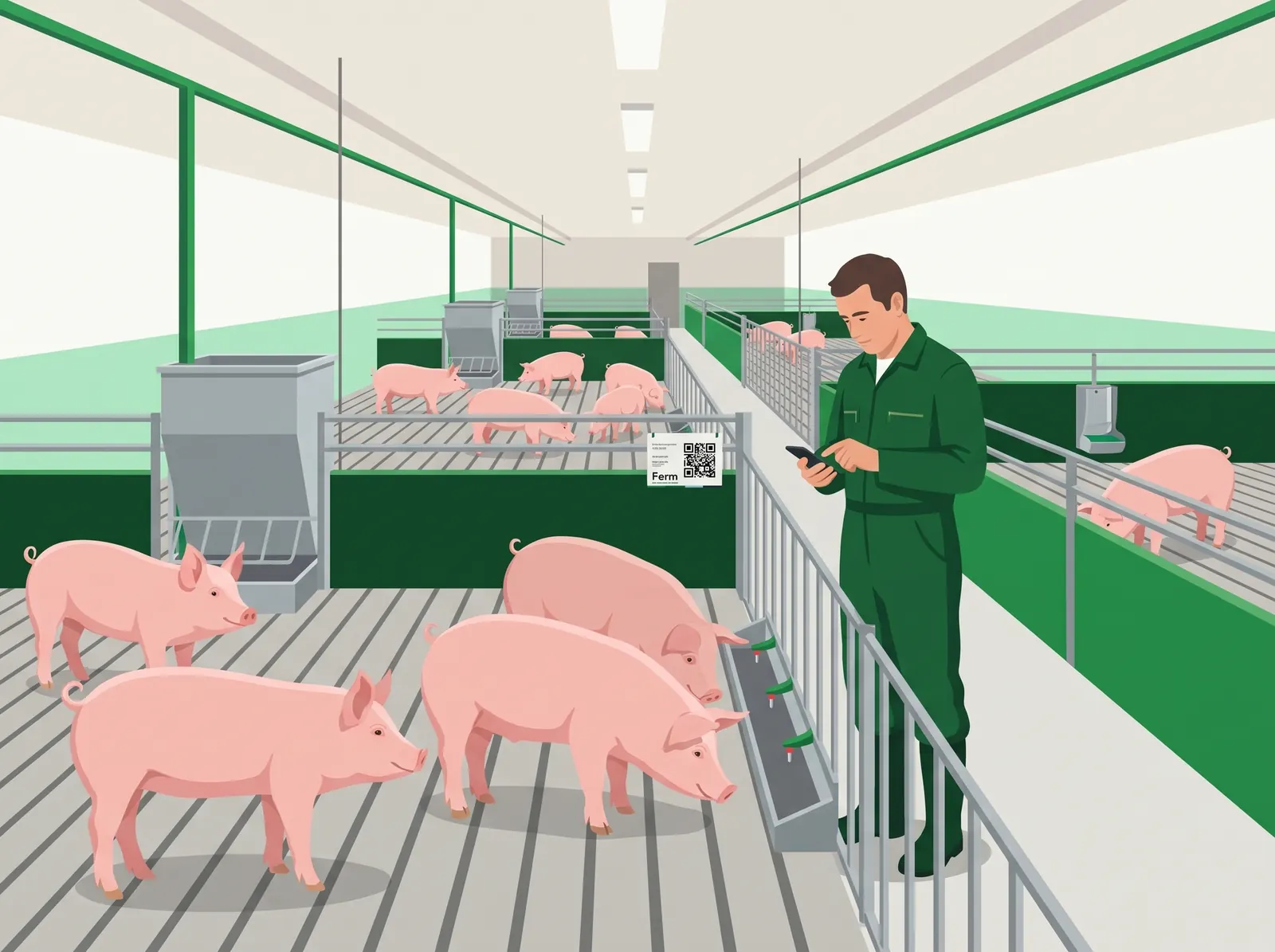
African swine fever (ASF) has no vaccine and no treatment. When the virus reaches a pig barn, the herd is culled and zones with movement restrictions are set up around it. Farms in a zone cannot place or sell pigs without testing, so animals that cannot be moved keep growing in their pens beyond the plan. In Poland the virus circulates constantly in wild boar and from time to time reaches pig farms.
The first days look like an ordinary day
At the start of an infection the signs are not specific. One dull pig in a room, slightly poorer appetite, a single death. It is easy to blame PRRS or another disease already in the herd. By the time the picture is clear, the virus may have been in the building for two weeks. Then what counts is whether you have a record of what happened in each room, and whether you know who came onto the farm in that time.
How we solve it
1. Every room has its own record
In the app for pig farmers you divide the barn into rooms. Each has its own group of pigs, daily entries and a water meter. A card with a QR code hangs above the pen, and you log deaths, culls and transfers from your phone, even in a barn with no signal. This works today.
2. An alert when a room differs from the rest
Each room has its own alerts, and water meter readings give a baseline: a drop in drinking often comes before other signs. You see which room differs from the others. This works today. You decide whether to call a vet, and if ASF is suspected, you must report it to the Veterinary Inspection (Inspekcja Weterynaryjna).
3. A list of people and vehicles from recent weeks
The entry log with QR codes and entry control with plate recognition give you a ready list of people and vehicles, which the authorities ask for in an epidemiological investigation. This also works today.
4. A suggestion of which pens to sample
We are researching, and building into the app, a sampling plan suggestion based on room records: where the pigs with signs are, and which pens to pick at random. The vet and the Inspection set the sampling plan. The app is meant to shorten their work, not make the decision.
What the research says
Many pens, one pig each, detects fastest
Galvis, Deka and Machado (2025) rebuilt in a model 1865 finishing farms from 33 US states, run by 48 companies, with their barns, rooms and pens. They compared 48 sampling strategies in the first 14 days after the virus was introduced. The best result came from combining pens with pigs showing signs and random pens, one pig from each of 30 pens in every unit. This took a median of 120 pigs per farm, the fewest of all variants. The chance of detecting at least one infected pig was 29% on days 1–4 and 93% on days 5–8. Sampling from only 5 pens did worst. That is why records must reach down to a single room and pen.
Observation alone misses a milder virus
In the same model, observation without sample testing, meaning reporting signs and reacting to deaths, detected the highly virulent strain in 97% of runs within 14 days, with a median of 9 days. It detected the moderately virulent strain in only 36% of runs. By day 7 only 0.2% of pigs had died. With numbers this small, a general impression from your walk-round is not enough. You need a daily record that shows a small deviation in one room.
A second disease in the herd muddies the trail
Pigs with PRRS can also be dull and bluish. In the model, when sampling from 5 pens, sensitivity fell by 29–55 percentage points when PRRS affected 30% of pigs. With 30 pens, this effect was about seven times smaller. So your vet should know from your records what is circulating in the herd before choosing animals to test.
The zone mostly costs the neighbors
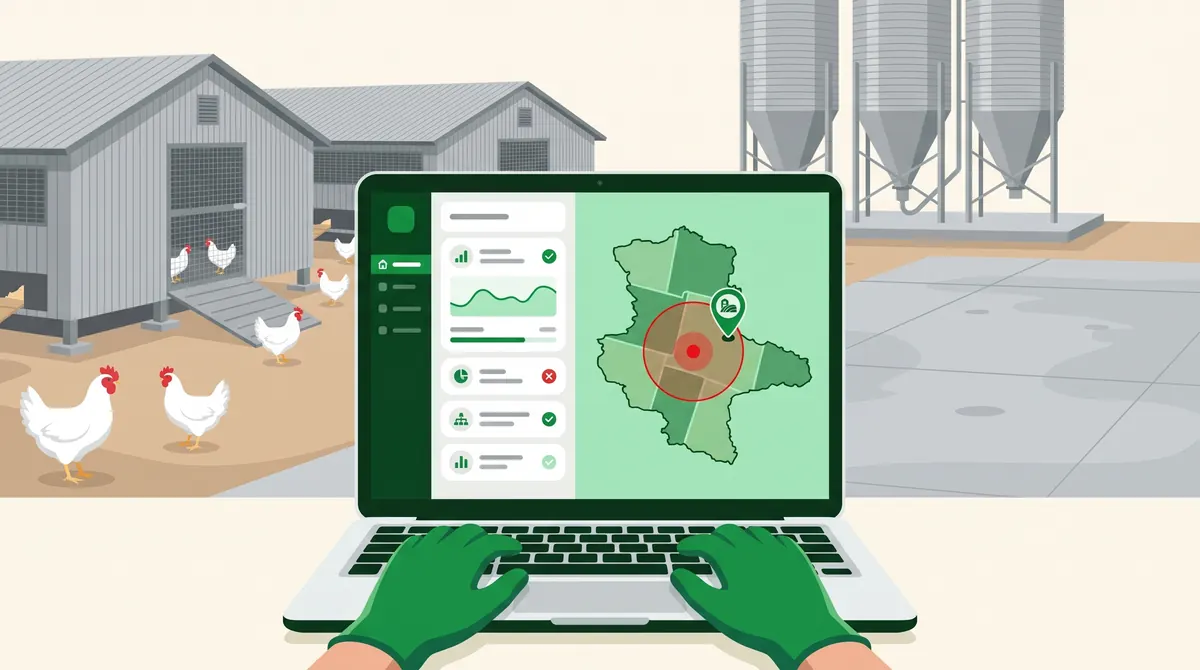
Yi, Galvis and Machado (2025) modeled 1981 farms of three companies with real pig movements and vehicle trips. With a 3 km zone and restrictions lifted after 30 days, the median number of pigs that could not be placed in the first year was 153,020. Shortening the zone period to 20–25 days cut this number by 16.7–33.5% with no rise in the median number of outbreaks. A wider zone, up to 15 km, raised the number of held pigs by as much as 282%, but cut the number of culled pigs by 28.8–73.9%. In the worst runs, losses exceeded 800 million dollars. The lesson for your farm: fast detection and good biosecurity protect the whole area, and an entry log shortens the investigation.
What your farm gains
An earlier signal from one room
A drop in drinking or a few deaths in one room show on the dashboard the same day. You can call your vet earlier, before the disease spreads through the whole barn.
Data ready for an official visit
The barn plan with room numbers, the history of deaths, water and movements, and the list of people and vehicles are in one place. Nobody reconstructs them from memory on the worst day.
Less work on daily records
An entry from your phone at the pen, via QR code, takes less time than a notebook you then have to copy up. Staff log the same things as today, just straight into the system.
See it in your own barn
Want to see how rooms, water meters and the entry log would look on your farm? Write to us through the contact form at the bottom of the page.
Frequently asked questions
How do room records work in the app?add
You divide the barn into rooms, and each has its own group of pigs. QR cards hang above the pens. A worker scans the code and logs deaths, culls or transfers. Water use is counted for each room separately.
What equipment do I need?add
For entries, a phone with the app and printed QR cards are enough. To measure water in each room you need one water meter per room. For the vehicle log you need a camera with plate recognition at the gate.
How much work is setup?add
The farm wizard guides you through describing buildings, rooms and partners. You enter the first group of pigs from a photo of the document or from a spreadsheet. After that, workers make daily entries from their phones. We describe the steps on the how we roll out page.
What if there is no signal in the barn?add
The farmer app and the worker app work offline. Entries send themselves when the phone picks up a signal.
Will the app recognize ASF?add
No. The app shows deviations in room data. Suspected ASF must be reported, and the diagnosis is made by a vet based on laboratory tests.
How many pigs must be tested to detect ASF early?add
In a simulation on 1865 finishing farms, the best approach was sampling one pig from each of 30 pens in every unit, including pens with pigs showing signs. That is a median of 120 pigs per farm. In Poland the Veterinary Inspection sets the sampling plan.
How do you know daily records make sense?add
In the US model, about 0.2% of pigs had died by day 7 after infection, and observation alone detected the moderately virulent strain within two weeks in only 36% of runs. So the early signal is weak and shows only in precise room-level numbers. The data come from the USA, where zone rules differ, but this finding applies to any pig barn.
Sources & resources
- linkGalvis J.A., Deka A., Machado G. (2025). Evaluating sampling strategies for effective detection of African swine fever in the growing pig population in the U.S. arXiv:2510.01026
- linkYi C., Galvis J.A., Machado G. (2025). Modeling the impact of control zone restrictions on pig placement in simulated African swine fever in the United States. arXiv:2505.14191
Prepared by: DlaFerm Team based on data from the sources listed · Publisher: INSTA-TECH sp. z o.o.
Let's talk about room records and an entry log for your pig barn
Want to see which room differs from the rest, and have a list of people and vehicles ready for an official visit? Try the <a href="/hodowca-trzody-chlewnej">app for pig farmers</a>: create a free farm account or get in touch, and we will show it on your own buildings.
Phone
+48 796 258 151