Poultry house ventilation: keep ammonia in range without overpaying for heat
In winter you have to heat every cubic meter of fresh air, so it is tempting to ventilate less, and then ammonia rises. We collect data from climate controllers with alarms, and we research and roll out ventilation setting suggestions from a house model in an advisory mode. We build on research into control that predicts instead of reacting.
verifiedFrom the team that has organised work on poultry farms for years.
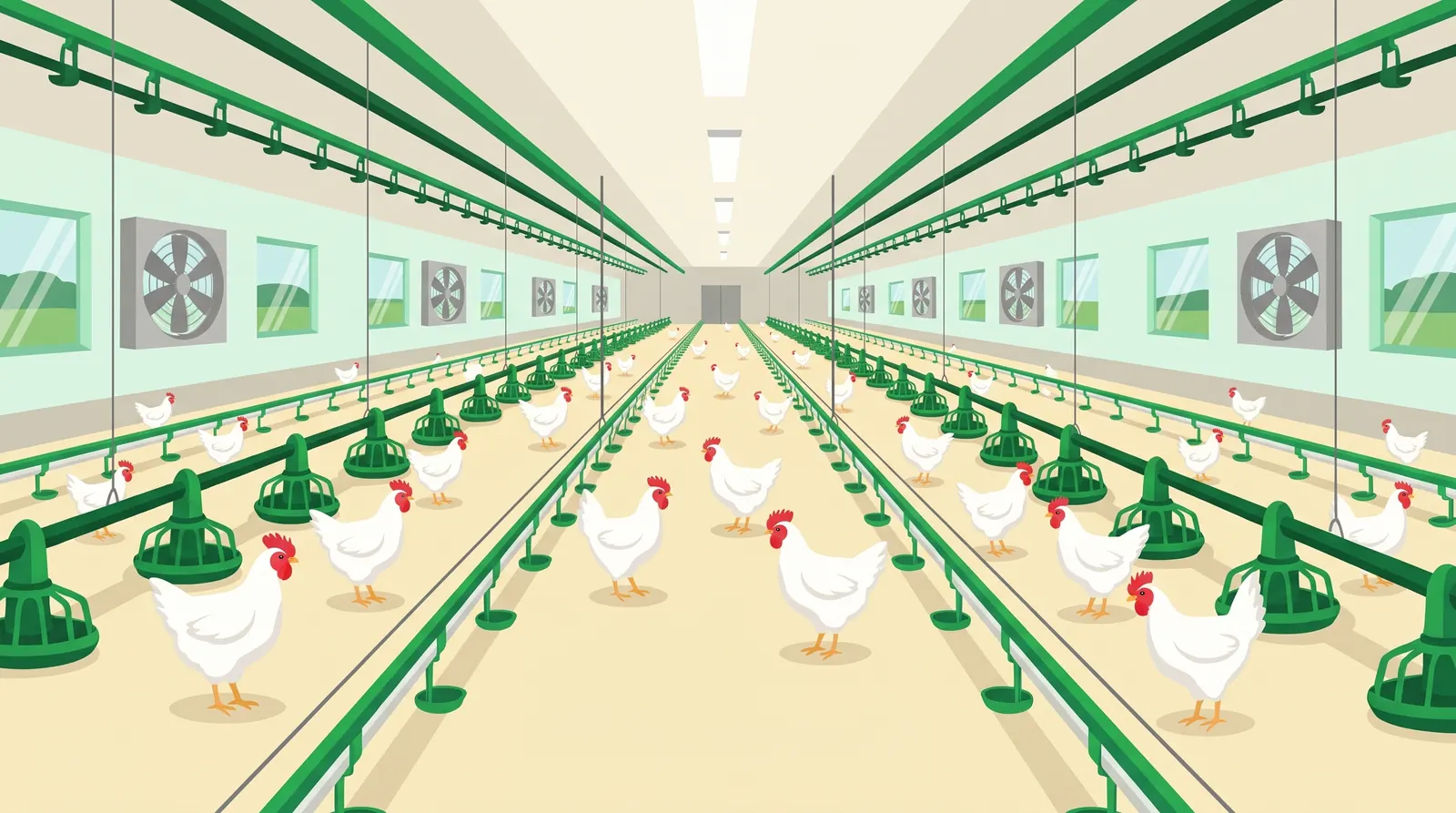
Ventilation has conflicting goals
In winter you have to heat every cubic meter of fresh air, so it is tempting to ventilate less. Then humidity, CO₂ and ammonia rise. In summer the controller fights the temperature, and power bills climb. A classic controller follows simple rules and reacts to what has already happened.
The ammonia limit and the bills at once
Poland's broiler welfare rules for higher stocking density require ammonia at bird head height not to exceed 20 ppm, while energy costs are not falling. Less ammonia means more heated air. Good control does not remove that trade-off, but it lets you make it knowingly and ahead of time.
How we solve it
1. Readings from climate controllers (working)
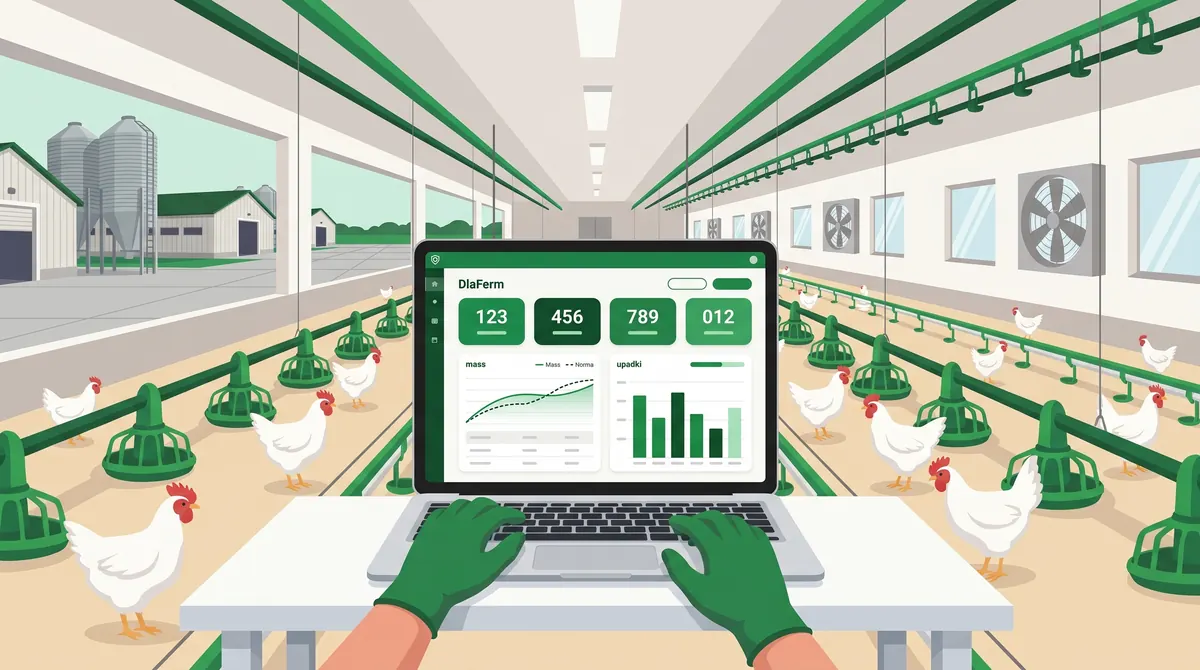
DlaFerm connects to climate controllers and sensors, and the farmer sees readings and alarms from the houses on a phone, next to the flock record. We research and roll out temperature, humidity and ammonia sensors in the same app. Details on the page about NH₃ and CO₂ sensors.
2. History of every cycle
To predict, a model has to know the building: how fast the temperature rises at a given stocking density and weather, and how humidity responds. That is why we store controller data from every cycle next to the flock record.
3. Ventilation setting suggestions (we research and roll out)
We research setting suggestions from a predictive model and roll them out in an advisory mode. At regular intervals the model calculates several ventilation scenarios for the near future and proposes the one that keeps conditions within limits, including the ammonia limit, at the lowest cost.
4. The system suggests, the farmer decides
The farmer approves or rejects a suggestion and changes the settings on the controller. Responsibility for the climate stays with the person, and data from later cycles will show whether the model really understands the building.
5. The effect, measured on the farm
We count hours with NH₃ above 20 ppm, foot pad condition at slaughter, feed conversion (FCR) and energy use per kilogram of live weight. We compare houses on the same farm or successive cycles. We cover litter and ammonia in our guides on poultry house litter and reducing ammonia emissions.
What the research says
A model combining physics and data predicts temperature more accurately
Neethirajan (2026) combined a physical model of a poultry house (heat and mass balance) with a neural network that learns, among other things, the heat given off by active birds. In calculations for a house of 25,000 broilers over 42 weeks, the temperature forecast error fell from 1.8 °C to 0.4 °C.
Control with an ammonia limit reduces exceedances
In the same work, predictive control with an ammonia constraint cut the number of NH₃ limit exceedances by 90% compared with rule-based control. Calculating on a computer in the house reduced the amount of data sent by about 30 times. We treat this figure as a direction, not a result we promise.
A model tested on real building data
Wei's team (2025) built a heat and ventilation model of a pig house in Guangdong province that calculates temperature and humidity together. On data from the building, the average temperature error was 1.23 °C in winter, 0.81 °C in spring and 0.60 °C in summer.
Comfort versus energy is a conscious choice
In Wei's team comparison, predictive control in spring kept comfort for 100% of the time (rules 91%) with lower energy use: 62.1 versus 64.6 kWh. In summer it gave comfort for 83% of the time (rules 43%), but used more: 91.2 versus 80.8 kWh. That is why a suggestion shows the farmer both effects. We cover the energy side in our guide on poultry house energy efficiency.
What the farm gains
Fewer hours with high ammonia
A suggestion made ahead of time is meant to help keep ammonia within limits before the controller reacts to an exceedance.
A conscious decision about costs
You see what more air costs and what leaving ammonia at the limit costs, and you choose for yourself.
Data for inspections and settlements
The climate history of every cycle sits with the flock, next to mortality and slaughterhouse results.
See suggestions for your house
If you want to see setting suggestions set against your own controller's performance, write to us through the form at the bottom of the page.
Frequently asked questions
How do ventilation setting suggestions work?add
We collect data from the climate controller and sensors. A predictive model, which we research and roll out, calculates several ventilation scenarios and suggests settings. The farmer approves or rejects them.
Does DlaFerm change controller settings by itself?add
No. We only read data from controllers, and suggestions work in an advisory mode. You change the settings on the controller as you do now.
What equipment do I need?add
A climate controller that shares its data, and preferably an ammonia sensor. A phone with the app for viewing data and alarms.
How much work is the setup?add
We connect the controller together with the farm. The model needs a few cycles of data from the building before its suggestions become accurate.
What if the internet goes down?add
The climate controller works locally and does not need the internet to run ventilation. You make entries in the app offline, and they send when the phone gets signal.
Will this replace my adviser or vet?add
No. A suggestion covers ventilation only. A veterinarian decides on flock health, and the farmer decides on settings.
What ventilation setting keeps ammonia under 20 ppm?add
There is no single setting, because it depends on the building, stocking density and weather. That is why the model learns from your house and compares scenarios.
How do you know this makes sense?add
A model combining physics and data gave a temperature forecast error of 0.4 °C instead of 1.8 °C and 90% fewer ammonia exceedances in calculations for a house of 25,000 broilers (Neethirajan, 2026). A pig house model tested on building data had an error of 0.60–1.23 °C depending on the season (Wei's team, 2025). We will measure results on your farm in the advisory mode.
Sources & resources
- linkNeethirajan S. (2026). A Hybrid Edge Cloud Digital Twin for Welfare-Constrained Control in Poultry Production. arXiv:2608.20367
- linkWei M., Zhang J., Groot Koerkamp P., Aarnink A., Sun C. (2025). Modeling and Optimal Control of Thermal Environment in Pig Houses. arXiv:2506.00502
Prepared by: DlaFerm Team based on data from the sources listed · Publisher: INSTA-TECH sp. z o.o.
Predictive ventilation in your poultry house
We will show you how controller data reaches the app and how we roll out setting suggestions in an advisory mode. Create a free farm account or get in touch.
Phone
+48 796 258 151