Official controls on your farm: Regulation (EU) 2017/625
Regulation (EU) 2017/625 sets out how authorities check compliance with food and feed law and with animal health and welfare rules. You must give inspectors access to the farm, the animals and the documents (Art. 15(1)). We explain your duties, the dates, the Polish rules and the steps to take.
verifiedFrom the team that has organised work on poultry farms for years.
Updated:
Legal status as of 23 November 2026. Regulation (EU) 2017/625 of the European Parliament and of the Council of 15 March 2017 on official controls and other official activities (CELEX 32017R0625) applies to operators subject to control, including livestock keepers. The act is in force: on 23.11.2026 the consolidated text of 05.01.2025 applies. In Poland it has applied directly since 14.12.2019.
What this act means for your farm
The regulation does not describe how to keep animals. It says how the authorities check that you follow the rules and what they do when they find non-compliance. Your duty: give the Veterinary Inspection (Inspekcja Weterynaryjna) and other authorities access to the farm and the documents for inspection. For an overview of other EU acts, see EU rules for livestock keepers.
Who it applies to
The title of the regulation covers checks on compliance with food and feed law and with animal health and welfare rules. The act amends, among others, Directives 98/58/EC, 1999/74/EC, 2007/43/EC, 2008/119/EC and 2008/120/EC, so it applies to keeping farm animals. That means poultry, pigs, cattle, goats, sheep and rabbits, to the extent the act covers them. The duties are addressed to you as the "operator" subject to official control.
The regulation also governs controls in areas that do not concern farms, such as plant health (Art. 22) and border control posts (Art. 64). We describe species and production types on the page Farm animals.
What it requires
Art. 15(1): access to the farm, animals and documents
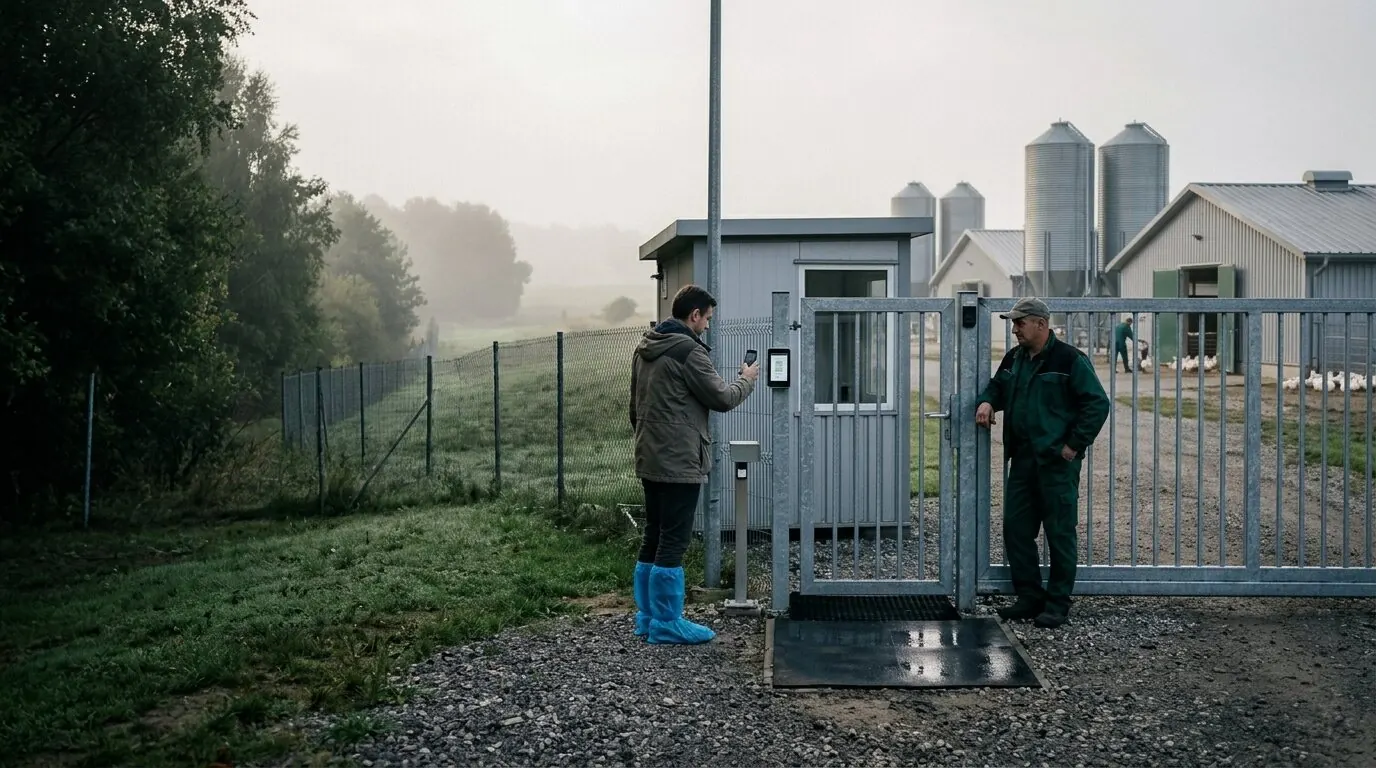
If it is necessary for the control and the competent authorities require it, you give them access to equipment, means of transport, premises and other places under your control, and their surroundings. This also covers your computerized information management systems, the animals and goods under your control, and documents and other relevant information. It is better to keep documents together in one place. You will find the list in the article Veterinary inspection of the farm: list of documents.
Art. 15(2): help and cooperation
During a control you give the staff of the competent authorities and of the organic production control bodies help in carrying out their tasks, and you cooperate with them. The rule does not list specific actions. In practice it means someone from the farm should be available, know the layout of the buildings and know where the records are kept. You can organize who does what on the farm with the page Permissions and roles.
Art. 14: what the authorities may examine during a control
Control methods include examining documents, traceability records and other records relevant to assessing compliance, including documents accompanying feed and materials entering and leaving the establishment. The authorities also verify measurements and test results made by the operator, take samples, carry out analyses, diagnostics and tests, and take other actions needed to detect non-compliance. We describe feed records under Regulation (EC) 183/2005.
Art. 13(2): copy of the documentation and written notice of non-compliance
The authorities draw up written documentation of every control, on paper or in electronic form (Art. 13(1)). On your request you receive a copy of it, unless the purposes of a judicial investigation or the protection of court proceedings require otherwise, or an official certificate or official attestation has been issued. The authorities notify you in writing without delay of all non-compliances found during the control. The documentation may also include actions the authorities require you to take.
Art. 137–138: action after non-compliance is found
If non-compliance is suspected, the authorities carry out an investigation (Art. 137(2)). Once non-compliance is confirmed, they establish its origin and extent and your obligations, and they take measures to ensure corrective action and prevent further cases (Art. 138). When choosing measures they consider the nature of the non-compliance and your past record of compliance. The list of measures is not closed. It includes an order to treat animals, quarantine, postponement of slaughter, restriction or a ban on moving animals, an order to increase the frequency of your own checks, and more frequent official controls of selected parts of your activity.
Art. 83(1): fee for a control triggered by a complaint
For an official control and other activities carried out following a complaint, the operator is charged a fee only if the control confirms non-compliance. Fees collected under Articles 79 and 80 are in principle not refunded, unless they were collected unduly (Art. 83(2)). On request you receive confirmation that the fee was paid, if you have no other access to it (Art. 84(1)). Member States must make fees transparent: the method of setting them, the amounts for each category of operator and the authorities collecting them (Art. 85).
When it applies
The regulation entered into force on 27.04.2017. EUR-Lex lists further dates of entry into force and application: 27.04.2017, 28.04.2017, 29.04.2018, 14.12.2019 and 29.04.2022. In Poland, as across the EU, the act has applied directly since 14.12.2019. On 23.11.2026 the regulation is in force.
Amendments and dates
The key dates according to EUR-Lex: the amendment dates are the dates of the amending acts. As of 23.11.2026 there are no European Commission proposals pending. The 2017 regulation has been amended several times, and the 2026 acts mostly concern topics other than farms.
| Date | What happens | Basis |
|---|---|---|
| 27.04.2017 | Regulation enters into force | EUR-Lex |
| 28.04.2017, 29.04.2018, 29.04.2022 | Further dates of entry into force and application of some provisions | EUR-Lex |
| 14.01.2019 | Delegated Regulation (EU) 2019/478 amends the act | CELEX 32019R0478 |
| 10.10.2019 | Delegated Regulation (EU) 2019/2127 amends the act | CELEX 32019R2127 |
| 14.12.2019 | Direct application in Poland | Implementation in Poland |
| 06.10.2021 | Regulation (EU) 2021/1756 amends the act | CELEX 32021R1756 |
| 27.11.2024 | Regulation (EU) 2024/3115 amends the act | CELEX 32024R3115 |
| 05.01.2025 | Date of the consolidated text (Polish version) | CELEX 02017R0625-20250105 |
| 20.05.2026 | Regulation (EU) 2026/1392 amends the act | CELEX 32026R1392 |
| 17.06.2026 | Regulation (EU) 2026/1388 amends the act | CELEX 32026R1388 |
How it works in Poland
An EU regulation applies directly, so there is no Polish act implementing it. Farm controls are carried out by the Veterinary Inspection (Inspekcja Weterynaryjna) under the Veterinary Inspection Act (Dz.U. 2024 poz. 12, Poland's Journal of Laws). The act sets out who in the inspection is responsible for what and what the fees are for the work of veterinarians. Keepers pay for some tests and official activities. We describe inspections in detail in the article Veterinary Inspection: what it checks on the farm.
Since 18.03.2026 the Animal Health Act of 21 November 2025 (Dz.U. 2025 poz. 1795) has applied. You report a suspected infectious disease to the county veterinary officer (powiatowy lekarz weterynarii) without delay (Art. 10). You report changes in a registered establishment without delay and no later than within 7 days (Art. 68(1)). Fines range from 0.1 to 8 times the average salary (Art. 98). The county veterinary officer imposes them, and the fine is payable within 14 days of the decision becoming final (Art. 100(3)). If the same offense is repeated within 2 years of the previous fine, the fine rises by 25% (Art. 100(2)).
This description summarizes the text of the act and is not legal advice. In a specific case, the text published in the Official Journal of the EU and the Polish rules decide, and the county veterinary officer or another competent authority gives explanations.
What to do on your farm
Name a person who will open up the buildings, the animals and the documents during a control and help the inspectors (Art. 15). Keep records in one place: documents accompanying goods entering and leaving, traceability records, and the results of your own measurements and tests (Art. 14). If you keep records in a computer system, inspectors may ask for access to it (Art. 15(1)). The QR entry and exit log helps you record who enters the farm.
After a control, ask for a copy of the documentation (Art. 13(2)) and check whether actions for you to take are listed. If non-compliance is found, carry out the corrective actions, because the authorities take your compliance record into account (Art. 138). If a complaint turns out to be justified as to non-compliance, you may be charged a fee (Art. 83(1)). Report suspected disease and changes in your establishment within the deadlines in the Animal Health Act. You can prepare a biosecurity plan in the biosecurity plan generator.
Frequently asked questions
When did Regulation 2017/625 start to apply?add
It entered into force on 27.04.2017. In Poland the act has applied directly since 14.12.2019. On 23.11.2026 it is in force.
Do I have to let an inspector onto my farm?add
Yes, if the competent authorities require it and it is necessary for the control. The operator gives access to premises, animals, documents and computerized information management systems (Art. 15(1)).
Will I get a copy of the inspection report?add
On request, yes, unless the purposes of a judicial investigation or the protection of court proceedings require otherwise, or an official certificate or attestation has been issued (Art. 13(2)). The authorities also notify you in writing without delay of any non-compliance.
What can an inspector do after finding non-compliance?add
The inspector establishes the origin and extent of the non-compliance and your obligations, then introduces corrective measures (Art. 138). These can include an order to treat animals, quarantine, restriction or a ban on moving animals, or more frequent controls.
When do I pay for a control triggered by a complaint?add
The fee for a control carried out following a complaint is charged only if the control confirms non-compliance (Art. 83(1)).
Who inspects farms in Poland?add
The Veterinary Inspection (Inspekcja Weterynaryjna), under the Veterinary Inspection Act (Dz.U. 2024 poz. 12). The regulation applies directly in Poland.
What is the penalty for not reporting a disease?add
The Animal Health Act (Dz.U. 2025 poz. 1795) sets a fine of 0.3 to 6 times the average salary for failing to report a disease (Art. 98). The county veterinary officer imposes it.
Sources & resources
- linkPublications Office of the EU (EUR-Lex): Regulation (EU) 2017/625 on official controls
- linkAct of 29 January 2004 on the Veterinary Inspection (consolidated text) (Dz.U. 2024 poz. 12)
- linkAct of 21 November 2025 on animal health (Dz.U. 2025 poz. 1795)
- linkChief Veterinary Inspectorate (Główny Inspektorat Weterynarii): gov.pl/web/wetgiw
Prepared by: DlaFerm Team based on data from the sources listed · Publisher: INSTA-TECH sp. z o.o.
Get your documents ready for inspection with the poultry house records module
The <a href="/program-do-ewidencji-kurnika">poultry house records</a> module in DlaFerm keeps your farm records in one place, so you can find them fast when an inspector asks. Create a free farm account in DlaFerm or get in touch.
Phone
+48 796 258 151