Farm animals: species and production types
The most common farm animals are poultry, pigs and beef cattle. Each species has its own production cycle, its own needs and its own way of earning money, so the choice starts with your production goal. Below we describe the species, the production types and the data worth relying on.
verifiedFrom the team that has organised work on poultry farms for years.
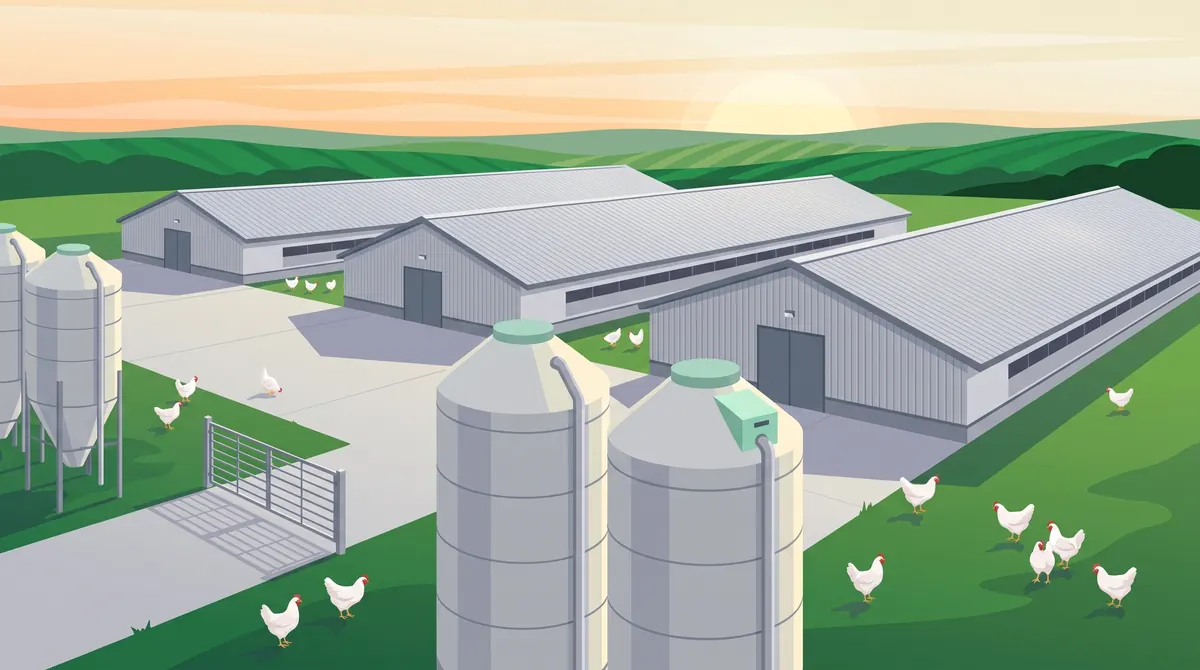
Farm animals are animals kept on a farm for meat, eggs or milk, and for breeding. The most common species are poultry, pigs and beef cattle. Each has a different production cycle, different housing needs and a different way of earning money. So start by choosing a goal: what do you want to sell, how soon, and with how much work? This overview shows the main differences and where to check the details. We compare the profitability of poultry species in the poultry species profitability ranking.
Poultry, pigs and cattle at a glance
Poultry has the shortest cycle from placement to sale. According to the Ross 308 performance objectives table, a broiler reaches about 3222 g at day 42, so the cycle is counted in weeks. Pigs and beef cattle need a longer period and more capital per animal, but each animal is a bigger unit of sale. When you plan, compare more than the price per kilogram: look at the number of cycles per year, the feed cost and the work needed per cycle. Before you pick a species, check that you have a buyer and space in the building for the group of animals you want.
Poultry species on the farm
Laying hens and broilers
A laying hen and a broiler are two different production types. A hen is kept for a long time and her product is the egg, so laying rate, feed use and steady sales matter. A broiler is raised for a short time and you sell the meat when the cycle ends, so weight gain and the empty time of the house between placements matter. We cover both types separately: keeping laying hens on the farm and raising broilers on the farm.
Ducks, geese and turkeys
Ducks, geese and turkeys differ from broilers in growth rate and in their needs for water and bedding, so do not plan them the same way as chickens. Each species has different feed needs and a different risk of disease, so ask your vet for advice on the species before you buy birds. Smaller birds such as quail need a separate plan, because their cycle and sales look different.
Meat, eggs or ornamental: choosing a type
Meat production
Meat production relies on fast weight gain and good feed conversion. For broilers, the reference point is the Ross 308 performance objectives. According to Aviagen data, body weight is about 1046 g at day 21 and about 2441 g at day 35. At day 42 the objective is 3222 g with an FCR (feed conversion ratio) of 1.517. The slower a bird grows and the worse it converts feed, the longer it stays in the house and the higher the cost of a kilogram of meat. The breeder of the line publishes these target figures, so treat them as a reference for your own results, not as a guarantee.
Egg production
Egg production relies on the laying rate of the flock and on how long the birds are kept. A laying hen works to a different rhythm than a broiler: you count laying days, egg sales and flock replacement. In this type, daily egg collection, accurate records of losses and a steady flock register matter, because every change in bird numbers affects the production plan.
How to read performance data
Body weight and daily gain
The Ross 308 table shows weight from 44 g on day 0 to 3222 g on day 42. Daily gain rises in the first weeks and, at the end of the cycle, stays at about 110–112 g a day. When you compare your own weighings with these values, you can see in the first week whether the flock is growing as planned. Weigh a sample of birds in the same place in the house and at the same time of day, because only then are the results comparable with the table and with the previous cycle.
Feed and FCR
According to the same table, daily feed intake rises from 11 g on day 1 to over 200 g at the end of the cycle. FCR is 1.000 on day 14 and 1.517 on day 42, which is the kilograms of feed needed per kilogram of gain. A rising FCR over time means feed turns into weight less and less efficiently, so track it every week. To calculate these ratios as you go, use the FCR and EPEF online module.
Water in the flock: quality indicators
TDS and pH limits
According to the Ross Broiler Management Handbook 2025, total dissolved solids (TDS) below 1000 ppm is good. Values of 3000–5000 ppm mean poor quality: wet droppings, lower water intake, weaker growth and higher mortality. Above 5000 ppm the water is unsuitable. A pH of 6.5–8.5 is recommended for poultry, and below 6 points to performance problems and corrosion of the system. Test the water before you place a flock and again whenever you change the source.
Sulfates, chlorides and hardness
According to the same handbook, sulfates below 200 ppm are fine, and 200–250 ppm is the maximum desirable level. Above 1000 ppm the water is unfit, because it raises water intake, causes wet droppings and endangers young birds. Chlorides below 250 ppm are satisfactory, 250–500 ppm are acceptable with caution, and above 500 ppm are unsatisfactory. Hard water, above 100, does not harm birds, but it limits the action of soaps, many disinfectants and medicines given in water. Factor this into your biosecurity plan.
Medicines given in water
If the water is to carry a medicine, your vet always chooses the product and the dose. Hardness and pH affect how well some products work, so plan this together with your vet. Keep the withdrawal period and the records of medicines given in the treatment and withdrawal period module, so that before you sell meat or eggs you know the withdrawal period has passed.
Slaughter, fallen stock and paperwork
Slaughter for your own use
Slaughtering poultry for your own needs is different from selling meat, and the rules depend on whether the product reaches the market. Before slaughter, check the current requirements in ISAP (Internetowy System Aktów Prawnych, Poland's online legal database) and on the website of the Chief Veterinary Inspectorate (Główny Inspektorat Weterynarii). We describe the legal state as of 22.11.2026 and give no act numbers, because they may change. The rules for this topic are collected in the article on slaughter of farm animals for your own use.
Fallen stock
You must have dead birds collected and disposed of according to the rules. The rules depend on the species and on the way of collection, and in practice inspections can be stricter than the text of the rules. Before you choose a company to collect fallen stock, ask your county veterinary officer (powiatowy lekarz weterynarii). Do not bury carcasses or dump them in places not meant for it, because that puts your flock and your neighbors at risk of disease.
What profitability depends on
Prices and market quotes
Buying prices for poultry, feed and chicks change often, so we give no specific amounts here. Check quotes with your buyer, in feed company offers and in market reports. In your calculation include the feed cost per kilogram of gain, the time birds stay in the house and losses. The same building can give a different result with a different production type.
Records as the basis for decisions
Without records you cannot work out the cost of a kilogram of meat or the laying rate of a flock. A poultry farm management program keeps flock data in one place, so it is easier to line up the results of successive cycles and compare them with earlier ones. Record placements, losses and sales from day one, because missing data is hard to fix after the fact.
Frequently asked questions
Which farm animals should I start with?add
Poultry is easier to judge at the start, because the cycle is short and you see the result quickly. Before you buy birds, check your buyer, the space in the building and whether you have time for daily care. Pigs and cattle need more capital and a longer plan.
How many days does it take to raise broilers?add
According to the Ross 308 performance objectives, a bird reaches about 3222 g at day 42, so that is a rough reference point for the cycle. The exact timing depends on the line, the target weight and conditions in the house. Set your cycle plan from your own weighings.
What is good water quality for poultry?add
According to the Ross Broiler Management Handbook 2025, good water has TDS below 1000 ppm, pH of 6.5–8.5 and chlorides below 250 ppm. Hard water does not harm birds, but it weakens soaps and disinfectants. Have the water tested in a laboratory before you place a flock.
Can I give medicines in the water myself?add
Your vet always chooses the medicine and the dose. Record every dose and keep to the withdrawal period before you sell meat or eggs. Skipping the withdrawal period can make the product unfit for sale.
Where can I check current rules on slaughter and fallen stock?add
You will find current rules in ISAP, Poland's online legal database, and guidance on the website of the Chief Veterinary Inspectorate. We describe the legal state as of 22.11.2026, so check that nothing has changed before you decide. If in doubt, ask your county veterinary officer.
How do I check which species is profitable?add
Compare the feed cost per kilogram of gain, the number of cycles per year and the work needed per cycle. Check price quotes with your buyer and in market reports, because they change quickly. The same number of birds can give a different result depending on the production type.
Sources & resources
- linkRoss Broiler Management Handbook 2025
- linkRoss 308 / 308 FF Broiler Performance Objectives 2022
- linkChief Veterinary Inspectorate (Główny Inspektorat Weterynarii): gov.pl/web/wetgiw
- linkISAP, Poland's online legal database: isap.sejm.gov.pl
Prepared by: DlaFerm Team based on data from the sources listed · Publisher: INSTA-TECH sp. z o.o.
Do you keep more than one species on your farm?
The DlaFerm poultry farm management program keeps your flock data in one place. Create a free farm account and see how records work for your species, or get in touch with us.
Phone
+48 796 258 151