Directive 2008/119/EC on calf welfare: pens, groups, feeding
Directive 2008/119/EC sets minimum standards for protecting calves, meaning cattle up to six months old. It sets the size of individual pens, the space per calf in groups, and the rules on lighting, checks and feeding. We describe these requirements with article and annex numbers.
verifiedFrom the team that has organised work on poultry farms for years.
Updated:
Legal status as of 23 November 2026. Council Directive 2008/119/EC of 18 December 2008 laying down minimum standards for the protection of calves (codified version), CELEX 32008L0119, applies to farmers who rear calves for breeding or fattening. The act is in force as of 23.11.2026 and has applied since 4.02.2009. Below we describe its requirements based on the Polish consolidated text of 14.12.2019.
The key numbers at a glance
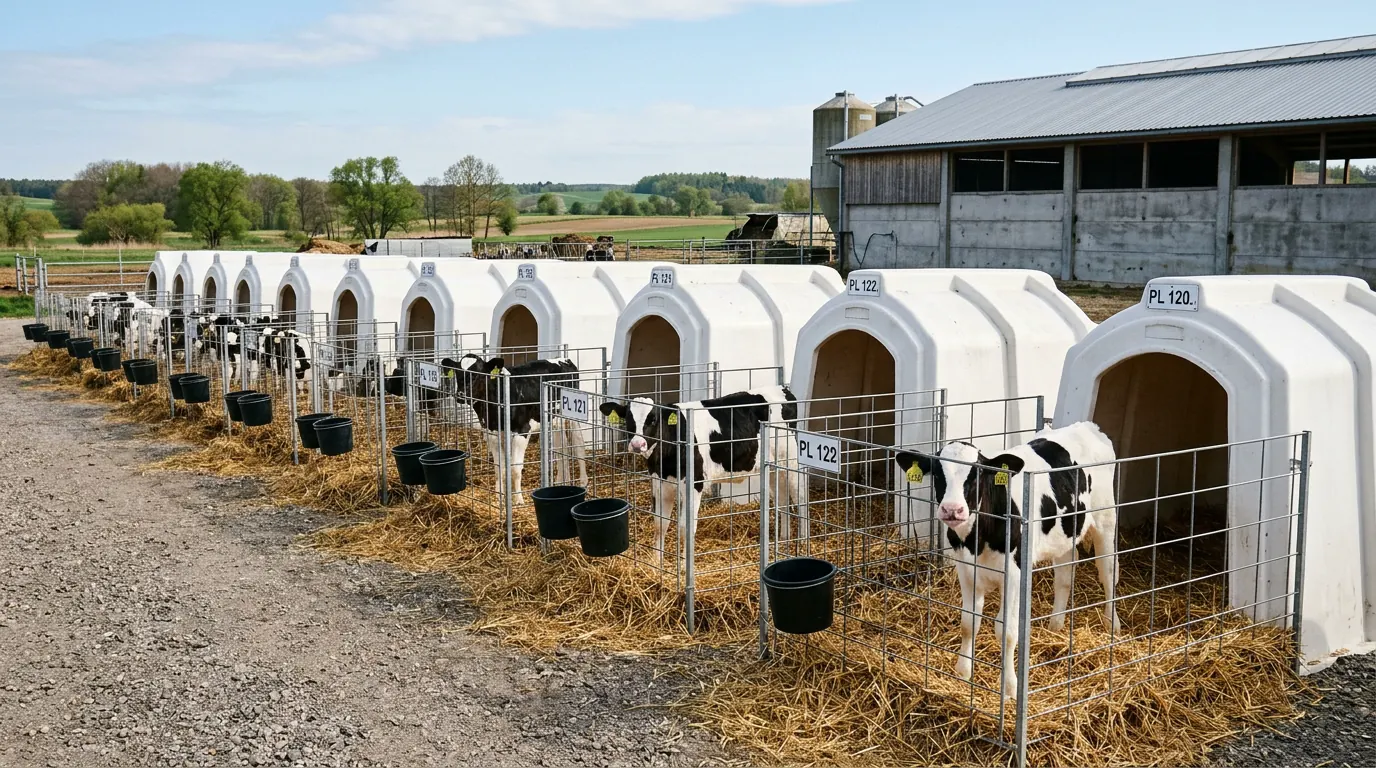
A calf older than eight weeks is not kept in an individual pen, unless a veterinarian advises isolation (Art. 3(1)(a)). In a group, each calf gets at least 1.5 m², 1.7 m² or 1.8 m², depending on live weight (Art. 3(1)(b)). The other requirements, from light to iron in the diet, are in Annex I. For an overview of EU acts for farmers, see EU regulations for farmers. For practical calf-rearing set-ups, read calf igloos, pens and calf barns.
Who it applies to
A calf under the directive (Art. 1 and Art. 2(1))
The directive sets minimum standards for protecting calves kept for breeding and fattening (Art. 1). Under Art. 2(1), a "calf" is a bovine animal up to six months old. So it covers farms that rear replacement heifers and farms that fatten calves. Member states must make sure rearing conditions follow the general provisions of Annex I (Art. 4). The directive is addressed to member states (Art. 14), so as a farmer you follow it through Polish implementing rules.
Exceptions in Art. 3(1)
The Art. 3(1) rules on pens and space do not apply in two cases: holdings with fewer than six calves, and calves kept with their mothers for suckling. Art. 3(2) says that from 31.12.2006 the rules of paragraph 1 apply to all holdings. Art. 4 refers to Annex I, which has no such exceptions. How to apply these provisions to a given herd is decided by the district veterinarian (powiatowy lekarz weterynarii).
What it requires
Art. 3(1)(a): individual pens
No calf older than eight weeks is kept in an individual pen. The exception is when a veterinarian certifies that, because of its health or behavior, the calf must be isolated for treatment. The width of an individual pen is at least the calf's height at the withers, measured standing. The length is at least the body length, from the tip of the nose to the rear edge of the pin bone, multiplied by 1.1. Pens must not have solid walls, because calves need visual and physical contact. The rule does not apply to isolation pens for sick animals.
Art. 3(1)(b): calves in groups
For calves kept in groups, the unobstructed space available to each calf is at least 1.5 m² at a live weight under 150 kg. At 150 kg to under 220 kg it is at least 1.7 m², and at 220 kg or more at least 1.8 m². The space is counted per calf, so for a group calculate it by the heaviest animals. The rule applied to newly built or rebuilt holdings from 1.01.1998, and to all holdings from 31.12.2006 (Art. 3(2)).
Annex I points 1–3: materials, installations and climate
Materials used to build housing, especially pens, and equipment the calves touch must not harm them. They must also allow thorough cleaning and disinfection (point 1). Electrical wiring and equipment must be installed to national standards to avoid electric shocks (point 2). Insulation, heating and ventilation must keep air circulation, dust, temperature, humidity and gas concentrations within limits that do not harm the calves (point 3). The directive gives no numerical values here.
Annex I points 4 and 5: equipment, ventilation and light
Automatic or mechanical equipment essential for calf health must be checked at least once a day, and faults fixed immediately (point 4). With artificial ventilation you need a backup system in case of failure and an alarm that warns the owner, tested regularly. Calves must not be kept in permanent darkness (point 5). Artificial light must run at least as long as the natural daylight available between 9.00 and 17.00. You also need lighting, fixed or portable, strong enough to inspect the calves at any time.
Annex I points 6–8: inspection, sick calves, tethering
The owner or the person responsible inspects the calves at least twice a day, and calves in outdoor systems at least once a day (point 6). A sick or injured calf gets suitable treatment without delay, and if the farmer's care does not help, you call a veterinarian as soon as possible. You isolate sick animals in housing with dry, comfortable bedding. The housing must let the calf lie down, rest, stand up and groom itself without difficulty (point 7). Tethering is banned, except for group-housed calves tied for no more than one hour when fed milk or milk replacer (point 8).
Annex I points 9–11: cleanliness, flooring, feeding
You clean and disinfect buildings, pens, fittings and utensils to prevent cross-infection. You remove feces, urine and uneaten feed often enough to limit odor, flies and rodents (point 9). Flooring must be smooth but not slippery, rigid, even and stable. The lying area must be comfortable, clean and well drained, and calves under two weeks old get suitable bedding (point 10). The diet matches age and weight, and the feed contains enough iron for an average hemoglobin level of at least 4.5 mmol/liter (point 11). A calf older than two weeks gets a daily ration of feed with easily digestible fiber.
When it applies
The directive entered into force on the twentieth day after publication in the Official Journal of the EU (Art. 13). EUR-Lex data give 4.02.2009 as the date of entry into force and application. It is a codified version that repeals Directive 91/629/EEC with its amendments (Art. 12). References to the repealed directive are read as references to Directive 2008/119/EC. As of 23.11.2026 the act is in force. The transposition deadline in EUR-Lex is 1.01.1994.
Phased application of Art. 3
Art. 3(1) applies from 1.01.1998 to newly built or rebuilt holdings and those brought into use after that date. From 31.12.2006 the same rules apply to all holdings (Art. 3(2)). As of 23.11.2026 both dates have passed, so the Art. 3 standards apply on every holding, with the exceptions described above.
Amendments and deadlines
The directive was amended by Regulation (EU) 2017/625 on official controls, which replaced the definition of competent authorities (Art. 2(2)). As of 23.11.2026 there are no Commission proposals pending on this directive.
| Date | What happens | Basis |
|---|---|---|
| 1.01.1994 | Transposition deadline given in EUR-Lex | EUR-Lex |
| 31.12.1997 | Deadline for transposing Directive 97/2/EC into national law | Annex II part B |
| 1.01.1998 | Art. 3(1) for newly built and rebuilt holdings | Art. 3(1) |
| 31.12.2006 | Art. 3(1) rules for all holdings | Art. 3(2) |
| 4.02.2009 | Entry into force and application of the directive | Art. 13; EUR-Lex |
| 15.03.2017 | Date of Regulation (EU) 2017/625, which amends the directive | EUR-Lex |
| 14.12.2019 | Date of the consolidated text | Polish consolidated text |
How it works in Poland
The implementing act
The directive does not bind the farmer directly, because national law implements it. In Poland it is implemented by the Regulation of the Minister of Agriculture and Rural Development (MRiRW) of 15.02.2010 on the requirements and procedures for keeping farm animal species covered by EU protection standards (Dz.U. 2010 nr 56 poz. 344, Poland's Journal of Laws), and by the Animal Protection Act. The regulation entered into force on 30.06.2010. It sets minimum space, lighting, ventilation, feeding and watering for calves, pigs, laying hens and broilers. An amendment, Dz.U. 2024 poz. 1919, in force from 1.01.2026, extends the requirements to other hens.
Consequences of non-compliance
A breach can bring detention or a fine under Art. 37 of the Animal Protection Act. Non-compliance is also a breach of cross-compliance for farm payments, which we describe in Payments and farmer obligations. Art. 11 of the directive lets member states apply stricter rules than the EU ones. General rules for all farmed species are in our article on Directive 98/58/EC, and the equivalent for pigs is in our article on Directive 2008/120/EC.
This text summarizes the act and is not legal advice. In a specific case, the text published in the Official Journal of the EU and Polish law decide, and the district veterinarian or another competent authority gives explanations.
What to do on the farm
Check pens and groups
Measure calves in individual pens at the withers and from nose to pin bone, and compare with the Art. 3(1)(a) dimensions (length times 1.1). Move calves older than eight weeks into a group, unless a veterinarian advises isolation. Work out the space per head by weight: 1.5 m², 1.7 m² or 1.8 m². Check that pen walls have gaps. For ideas on setting up calf rearing, see our article on igloos, pens and calf barns.
Set up an inspection routine
Fix the times of two daily rounds (one for outdoor systems) and use them to check equipment, ventilation, light and the condition of the calves (Annex I points 4–6). Test the alarm on artificial ventilation and keep a backup system. Remove feces and uneaten feed, and clean and disinfect pens (point 9). Check flooring and bedding for calves under two weeks (point 10). Watch the diet: iron, and feed with fiber after the second week of life (point 11).
Record treatments
Treat a sick calf without delay, and call a veterinarian if your own care does not help (Annex I point 6). Only the vet chooses the medicine and dose, and you keep to withdrawal periods and records. Note dates, animal numbers and isolations, because you will need them at an inspection. You can keep records in the Treatment and withdrawal module. For buying horned calves and disbudding, see Do cows have horns?.
Frequently asked questions
When did Directive 2008/119/EC come into force?add
The directive entered into force and has applied since 4.02.2009 (Art. 13). The Art. 3(1) rules apply to all holdings from 31.12.2006 (Art. 3(2)).
How much space does a calf need in a group?add
Under Art. 3(1)(b), at least 1.5 m² at a weight up to 150 kg, 1.7 m² from 150 to 220 kg, and 1.8 m² at 220 kg or more. The space is unobstructed, meaning it excludes anything that narrows it.
How long can a calf be kept in an individual pen?add
A calf older than eight weeks is not kept in an individual pen (Art. 3(1)(a)). The exception is when a veterinarian certifies that, because of health or behavior, the calf must be isolated and treated.
Do the rules apply to a small farm with a few calves?add
The Art. 3(1) rules do not apply to holdings with fewer than six calves or to calves suckling their mothers. Art. 4 refers to Annex I, which has no such exception.
How often should you inspect calves?add
At least twice a day, and calves in outdoor systems at least once a day (Annex I point 6). Equipment essential for calf health is checked at least once a day (point 4).
Can calves be tethered?add
No. The exception is group-housed calves, which may be tied for no more than one hour when fed milk or milk replacer. A tether must not injure or choke the animal (Annex I point 8).
What are the penalties for breaking the rules?add
Detention or a fine under Art. 37 of Poland's Animal Protection Act. Non-compliance is also a breach of cross-compliance for farm payments. The competent authority decides the details.
Sources & resources
- linkEU Publications Office (EUR-Lex): Council Directive 2008/119/EC of 18 December 2008 laying down minimum standards for the protection of calves (codified version)
- linkMRiRW Regulation of 15.02.2010 on the requirements and procedures for keeping farm animal species covered by EU protection standards (calves, pigs, laying hens, broilers, other hens from 2026) (Dz.U. 2010 nr 56 poz. 344)
- linkChief Veterinary Inspectorate (Główny Inspektorat Weterynarii): gov.pl/web/wetgiw
- linkARiMR (Agency for Restructuring and Modernisation of Agriculture): gov.pl/web/arimr
- linkInternet System of Legal Acts (ISAP): isap.sejm.gov.pl
Prepared by: DlaFerm Team based on data from the sources listed · Publisher: INSTA-TECH sp. z o.o.
Record calf checks and treatments in the Treatment and withdrawal module
The Treatment and withdrawal module lets you keep treatments of sick animals, dates and withdrawal periods in one place. Good records make it easier to show your documents at an inspection. Create a free farm account in DlaFerm or get in touch.
Phone
+48 796 258 151