Calf hutches, pens and group housing: how to set up calf rearing
An igloo hutch, an individual pen and a group calf house are three ways to rear calves. They differ in cost and in how closely you can control conditions, but each needs a dry bed, fresh air without drafts and a place where you can easily watch the calf. We give the sizes and rules from institutes, manuals and regulations, and where the sources give no number, we say so.
verifiedFrom the team that has organised work on poultry farms for years.
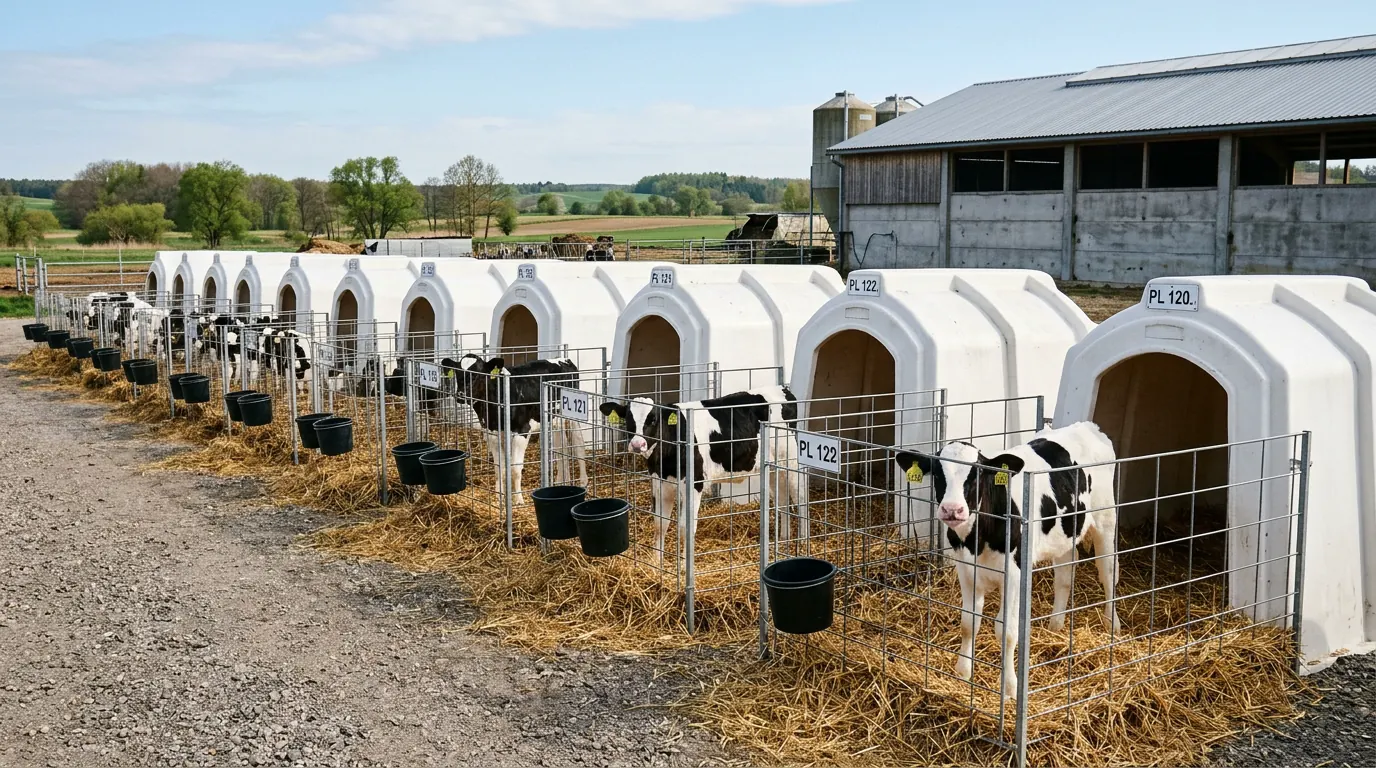
An igloo hutch, an individual pen and a group calf house are three ways to rear calves. Each needs the same things: a dry bed, fresh air without drafts and a place where you can easily watch the calf. Set up rearing in this order: first isolation and the pen, then groups and the building, last feeding, hygiene and records. Hygiene and ventilation rules are close to those for a poultry house described in How to set up a poultry house, but calf rearing has its own space requirements.
Why isolate a calf in the first weeks
Isolating young calves in the first few weeks of life can help prevent the spread of infectious disease. This is stated in the rearing manual of KPODR Minikowo (a Polish agricultural advisory center), written by authors from SGGW (Warsaw University of Life Sciences). According to the same source, under current rules calves may be kept in individual pens until 8 weeks of age. Isolation does not replace observation. A calf in a single pen will not show you a problem, so check appetite, breathing and droppings every day. Keep health records so you can easily show them to your vet.
Igloo hutch and individual pen
Placing an igloo hutch
An igloo hutch is usually a small house with a short outdoor run. EFSA describes this layout as typical for individual housing of calves after separation from the dam. The same document points out that in summer a calf in an outdoor hutch can suffer heat discomfort if the site gives no shade or protection from heat. Place the hutch so the entrance does not face the prevailing wind. Where there is no natural shade, provide cover. Keep the ground around the hutch dry. Where water collects, choose higher ground or improve drainage.
Size of an individual pen
The KPODR Minikowo manual recommends that an individual pen be no smaller than 1.2 m wide and 1.7 m long. This is a minimum, not a model. With a bigger calf or in a warmer building, extra space makes movement and rest easier. Council Directive 2008/119/EC, legal status 22.11.2026, requires that individual pens have no solid walls but openings that give the calf direct visual and physical contact with other calves. A full wall cutting the calf off from its neighbors does not meet this rule. Before building or buying, check the requirements with your county vet (powiatowy lekarz weterynarii) or the Chief Veterinary Inspectorate (Główny Inspektorat Weterynarii).
Calf house: groups, not crowding
When to put calves in groups
Keeping calves in pairs or groups after birth can increase weight gain and solid feed intake. Groups also support social development and learning. KPODR says calves in a group should be of similar age and weight, and recommends 4–6 animals. The same table lists what to avoid: do not mix older and younger calves, do not form groups above 30 animals and do not share space with older calves. Mixing calves from different pens also makes rearing harder, so keep group membership fixed.
Space and air in the calf house
IZ PIB (the Polish Institute of Animal Production) names four factors that decide calf welfare in a building: space per animal, amount of fresh air, air speed and temperature. Hygiene comes on top, because calves exposed to pathogens catch respiratory infections and gut disease more easily. Flooring and lighting also affect comfort and health. Air should be fresh but must not create a draft at the height of a lying calf. Check it with smoke or a strip of tissue paper at the inlet.
A village of igloos and protection from cold
The calf village
Kaczor et al. (2016), cited by IZ PIB, developed a layout called a "calf village". Individual and group igloo hutches were set in a planned arrangement, an open shelter was built over the feed alley, and runs were added by the hutches. Results from trials in summer and winter showed that in low temperatures arranging hutches in "villages" protects calves from bad weather. A small farm does not need to build a whole village, but keep the principle of a shared, sheltered hutch layout along one alley.
Calf coat and cold
A coat can help a calf on cold days, but it does not replace a dry bed and wind protection. Put it only on a dry, clean animal, because damp fabric in the cold does more harm than good. Every few days check that the coat does not rub, does not restrict movement and is not wet. Decide on a coat together with watching the calf's condition. A coat does not treat a cold and does not replace a call to the vet when the calf coughs, has a fever or refuses to drink. See also calf coats: when to use and how to choose.
Feeding bucket and hygiene
Bucket: one calf, one clean container
The feeding bucket is the easiest place to pass germs from one calf to another. Wash each container after every feeding and dry it before the next use. Keep milk and water containers separate. If several calves share a bucket, clean it thoroughly between animals. The isolation rule from the start of this guide only works if equipment does not carry disease between pens. More on feeding in calf rearing: colostrum, milk replacer, weaning.
Droppings as a warning sign
A change in the consistency of droppings is usually the first sign of gut trouble. Watch the calf every time you enter the pen and write down what you saw. When droppings are abnormal, take a sample as your vet advises and contact them. Reading droppings and sampling for the vet explains how to prepare notes for the consultation. The vet always chooses the medicine and dose. You record what was given and when.
Recording rearing
Planning intake
Calves born in one period are easier to keep at a similar age, which makes it easier to form groups that follow the recommendations. Record the birth date, the date moved to a pen and the date moved to a group. Planning intakes and the cycle helps you work out how many pens and calf house places you will need in a given season.
Treatment and withdrawal period
Record every medicine at once: product name, the dose prescribed by the vet, date given and the end of the withdrawal period. An exact entry protects you from mistakes when you send an animal to slaughter. The treatment and withdrawal module keeps these entries in one place, so you do not need to search a notebook at every sale.
Frequently asked questions
How big should an individual calf pen be?add
The KPODR Minikowo manual recommends a pen no smaller than 1.2 m wide and 1.7 m long. This is a minimum. With a bigger calf or poorer ventilation, extra space improves comfort and movement.
How long can a calf stay in an individual pen?add
According to the KPODR Minikowo manual, under current rules calves may be kept in individual pens until 8 weeks of age. After that they move to a group, and the pen rules require openings that allow contact with other calves.
Is a calf igloo enough in winter?add
Describing the calf village, IZ PIB states that in low temperatures a grouped hutch layout protects calves from bad weather. A hutch alone, without dry bedding and wind protection, is not enough. In winter check the bed and the calves' health every day.
How many calves should be in one group?add
KPODR recommends 4–6 calves of similar age and weight. According to the same source, do not form groups above 30 animals or mix older and younger calves.
Does every calf need a coat?add
No. A coat helps on cold days, provided the animal is dry and clean. If the calf shows signs of illness, the vet decides on treatment, and a coat does not replace it.
How often should I wash a calf feeding bucket?add
Wash the bucket after every feeding and let it dry before the next use. Keep milk and water containers separate. With many calves, clean containers thoroughly between animals so germs do not spread.
Sources & resources
- linkKPODR Minikowo — Rearing beef calves (manual, SGGW authors)
- linkIZ PIB — Farm animal husbandry and breeding over 70 years. Cattle Breeding Department, Sheep and Goat Breeding Department
- linkEFSA AHAW Panel — Welfare of calves (EFSA Journal 21(3):7896)
- linkEU / Publications Office of the EU — Council Directive 2008/119/EC laying down minimum standards for the protection of calves
- linkChief Veterinary Inspectorate — gov.pl/web/wetgiw
Prepared by: DlaFerm Team based on data from the sources listed · Publisher: INSTA-TECH sp. z o.o.
Rearing calves and want your records in one place?
The treatment and withdrawal module collects medicine entries, dates and notes for each calf. Create a free farm account on DlaFerm.pl and start with records for your own calf rearing.
Phone
+48 796 258 151