Calf Jackets: When to Use Them and How to Choose
You put a jacket on a calf when the young animal loses too much heat, most often in winter, in damp air and drafts. A jacket only works when the bedding is dry, ventilation is good and the calf has had colostrum. Below we explain when a jacket makes sense and how to choose one.
verifiedFrom the team that has organised work on poultry farms for years.
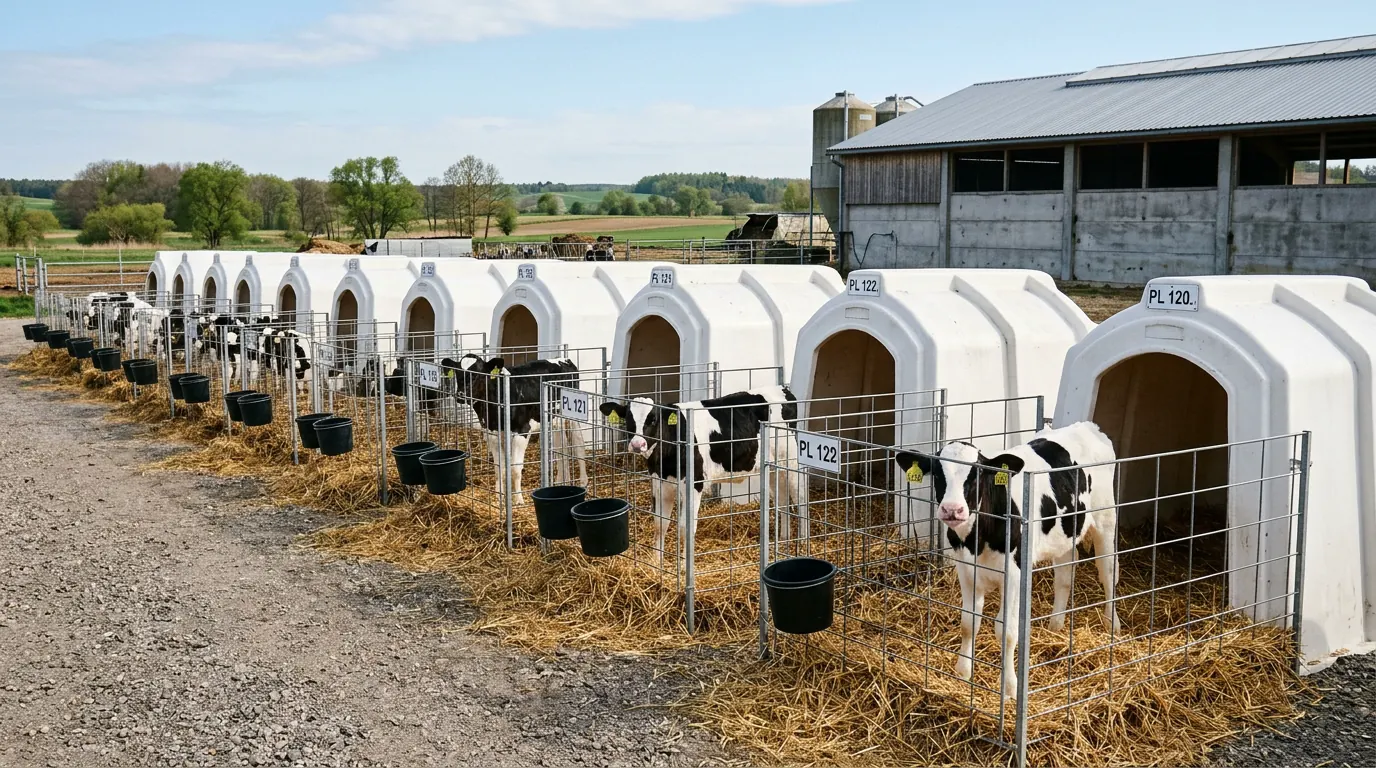
You put a jacket on a calf when it loses too much heat and cannot make it up from feed and dry bedding alone. This mostly concerns young calves in winter and early spring, in wet weather, wind and drafts in the pen. A jacket protects skin and coat from chilling and wetting, but it does not replace colostrum, milk or a warm, dry bed. A good jacket works only together with a well-arranged rearing area, such as igloo hutches and pens that dry out easily.
A jacket supplements, it does not replace
The most common mistake is treating a jacket as a fix for poor conditions. If water stands in the pen, the bedding is wet and wind blows in at the entrance, the jacket only delays the problem: the calf still loses heat through the floor and the air. Before you buy one, check that the bed is dry, the hutch is tight and ventilation works. According to KPODR Minikowo (a regional agricultural advisory center), in its guide to rearing beef calves, prevention works best: the calf's immunity, biosecurity and hygiene. A jacket is one way to protect the calf from the environment, not the first tool to reach for.
Situations where a jacket makes sense
The first weeks and cold
A young calf has little body fat and a large body surface relative to its weight, so it gives off heat faster. Put a jacket on mainly in the first weeks of rearing, when the calf is most sensitive to cold. This applies especially to winter and early spring births, when nights are cold and calves lie on cold ground. Watch behavior: a calf standing hunched with an arched back and eating slowly is losing heat.
Damp and drafts
A jacket helps where the air is very damp and the calf is in constant contact with a draft. A wet coat loses its insulating value, so a jacket is especially useful after rain or fog, as long as the animal has somewhere to dry off. If the jacket keeps getting soaked, it is not doing its job. Then the problem is ventilation and moisture removal, not a missing jacket.
Calves after moving
After moving to a new group or after transport, a calf may be weak and slow to warm up. A jacket can support adaptation in that case, but the decision about treatment always belongs to the vet. A jacket does not cure disease. If the calf coughs, has diarrhea or will not feed, call your vet.
How to choose a jacket for a calf
Size to fit the calf
The jacket must match the calf's size. Measure the back length from the withers to the base of the tail and the chest girth behind the shoulders, then compare with the manufacturer's size chart. A jacket that is too small presses on the shoulders and limits movement. One that is too large shifts and slides to the side, and damp folds form underneath. While calves grow fast, check the size regularly, because a too-tight jacket quickly becomes a problem.
Material and filling
For winter rearing choose a material that does not absorb water and dries fast, with insulating filling that does not clump when damp. The outer layer should resist dirt, and the inner layer should be gentle on the skin, with no rough seams. Check the fastenings: straps and buckles must be secure against being pulled off by the calf, and the belly strap must not press in a way that hinders breathing or movement.
What to check before buying
Ask the seller about the material, washing instructions and how the jacket is fastened. Ask whether the manufacturer gives sizes for specific weights or body measurements. Compare price with durability, because a cheaper jacket needs replacing more often. Before you buy a whole batch, test one jacket on one calf and watch for skin rubbing.
Cleaning the jacket and infection risk
A jacket can carry germs
A jacket touches coat, skin and bedding, so it can pass germs between animals. In its Beef Manual (section 7, animal health), Teagasc, the Irish agriculture and food development authority, states that the agents causing calf diarrhea pass from cows and calves into the surroundings in feces, and that without regular cleaning and disinfection of the places where calves stay, germs build up. Do not put a jacket from a sick calf on a healthy animal without washing it.
How to wash and check
Take the jacket off at every check and look at the skin underneath. Redness, rubbing and damp are signs that the jacket fits badly or is wet. Wash it as the manufacturer advises and dry it fully before putting it back on. Remember that washing the jacket does not replace disinfecting the calves' surroundings.
Isolated calf
Move a calf showing signs of illness, such as diarrhea or cough, to a separate pen used only for sick animals. Teagasc recommends cleaning and disinfecting that pen after each use and returning the animal to the group only after recovery. Do not swap a jacket from a sick calf to a healthy one without washing. Record every treatment in your treatment and withdrawal-period records, so you know which calf got what.
Jackets, ventilation and bedding
A jacket does not replace ventilation
A jacket holds heat, but it does not remove moisture or ammonia. In a barn with closed doors and no vents, water vapor settles on the coat, and under the jacket the calf sweats and gets wet faster. Before you put a jacket on, check that barn ventilation works at calf height, not only under the ridge. A draft at animal level does harm even with a jacket on.
Bedding underneath
Good, fresh and dry bedding limits heat loss through the floor. Straw that gets soaked needs replacing before you put a jacket on the calf. If calves live in a group, keep the bed apart from the feeding place so they do not lie in urine and manure. For calf feeding, including amounts, see our article on dry TMR for calves.
Jackets in calf health prevention
Colostrum first
A jacket does not replace colostrum. IZ PIB (Poland's Institute of Animal Production, National Research Institute), in its paper on feeding beef cattle in organic systems, states that in the first 5 days of life colostrum is taken from the dam's udder or given from a teat bucket 3 times a day, at 1.5–2.5 l per head, depending on the farm type. The calf's immunity depends on taking enough colostrum quickly. A jacket protects against chilling, while colostrum builds immunity, so one cannot stand in for the other.
Biosecurity and quarantine
KPODR Minikowo lists five main points for preventing disease: the calf's immunity, biosecurity with a baseline health assessment, proper colostrum management, quarantine on the farm, and hygiene, including disinfectant mats and regular cleaning. A jacket fits into hygiene only when it goes on a calf clean and in a clean place. When you buy new animals, check their health and do not mix calves from different batches without quarantine.
Daily check
Set up a simple routine: morning and evening, check how the calves move, whether they feed, whether they are dry and whether the jacket sits well. Write down any problems. If a calf limps, coughs, has diarrhea or loses activity, call the vet. The vet always chooses the medicine and dose, and you keep to the withdrawal period and the records.
What a jacket costs and whether it pays
What sets the price
The price depends on material, filling, size, type of fastening and whether the maker offers versions for different calf weights. Market prices change often, so we give no amounts. Check current offers with cattle equipment dealers and farm shops, and compare price with expected durability.
A simple calculation
Count how many calves a year need a jacket, how many washes the jackets will realistically survive and how many years one will last in your conditions. Add the cost of washing and any replacement. Compare that with the number of calves that fall ill or grow slower in bad weather. A jacket will not fix poor rearing, but in a herd where winter regularly chills the young, the numbers often favor a jacket. Data on beef income calculations can be found in ODR publications (Poland's regional agricultural advisory centers), and the result depends on how intensive the production is.
Frequently asked questions
When should you put a jacket on a calf?add
Most often in winter and early spring, in the first weeks of life, when the calf shivers, stands hunched or feeds slowly. Watching the animal and keeping the bed dry matter more than the calendar. If the calf is dry and warm in its hutch, a jacket may not be needed.
How do you choose the size of a calf jacket?add
Measure the back length from the withers to the base of the tail and the chest girth, then compare with the manufacturer's chart. The jacket must not press on the shoulders or slide off the back. Check the fit regularly, because the calf grows fast.
Does a calf jacket replace colostrum?add
No. Colostrum builds immunity and must be taken in the first days of life, in the amount recommended for your rearing system. A jacket protects against chilling and wetting, but it does not affect immunity.
How often should you wash a calf jacket?add
It depends on dirt and weather. Take it off at checks, and if it is wet or dirty, swap it for a dry one. Wash it as the manufacturer advises, always after use on a sick calf, and dry it fully before it goes on a healthy animal.
Do the rules require calf jackets?add
Minimum standards for the protection of calves are set by Council Directive 2008/119/EC. Check the current text of national rules in ISAP (Poland's legal acts database), and the Chief Veterinary Inspectorate (Główny Inspektorat Weterynarii) gives its interpretation for inspections. It is worth confirming the legal position, as of 22.11.2026, with your county veterinary officer.
Sources & resources
- linkKPODR Minikowo — Rearing beef calves (guide, SGGW authors)
- linkIZ PIB — WZ — Feeding beef cattle in organic farming (K. Bilik et al.)
- linkTeagasc — Teagasc Beef Manual — Section 7: Animal Health
- linkEU / Publications Office of the EU — Council Directive 2008/119/EC laying down minimum standards for the protection of calves
- linkChief Veterinary Inspectorate (Główny Inspektorat Weterynarii) — gov.pl/web/wetgiw
Prepared by: DlaFerm Team based on data from the sources listed · Publisher: INSTA-TECH sp. z o.o.
Rearing calves next to a herd of dams?
DlaFerm's integration with IRZplus, ARiMR's online animal register, helps you keep animal data and identification in one place. Create a free farm account or get in touch, and we will show you how it works for calf rearing.
Phone
+48 796 258 151