Manure and slurry in Poland: contracts, fertilization plan, spreading dates
Manure and slurry need a written contract when you hand them to another farm, a nitrogen plan or dose calculations, heap locations marked on a map, and spreading within set dates. We describe the rules as of 22.11.2026 for beef cattle farms. Key numbers: spreading until 31.10 or 30.11, slurry storage 6 months, manure on a pad 5 months, limit 170 kg N/ha.
verifiedFrom the team that has organised work on poultry farms for years.
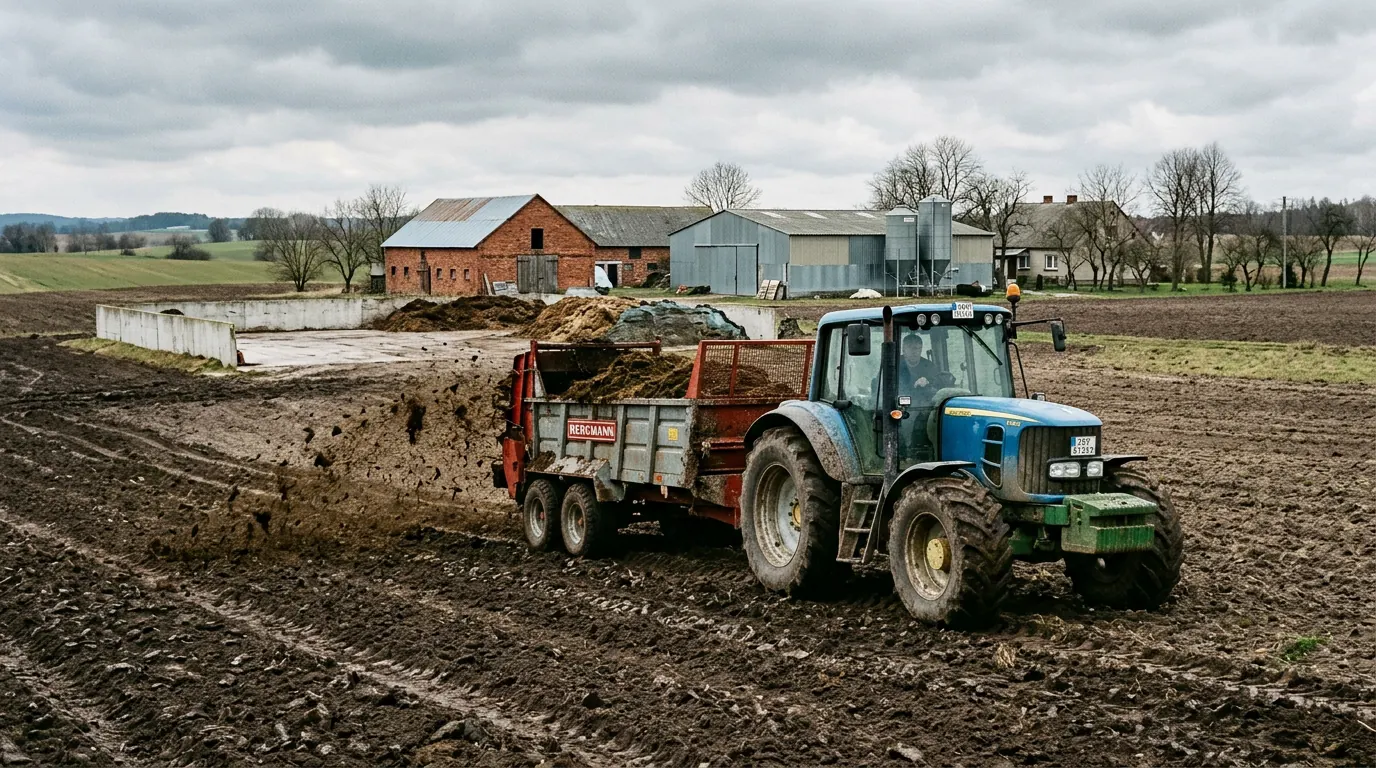
You can pass manure and slurry to another farm only under a written contract that states the amount of fertilizer and its nitrogen content. You may spread them on land only within set dates, and you must store them in designated capacity. Below we explain who needs a plan, who only needs dose calculations, what a transfer contract looks like, when to spread and how long to store. You will find more in the Nitrates Program (Poland's nitrate action rules).
Who needs a plan and who needs calculations
A nitrogen fertilization plan is mandatory before you start applying fertilizer on, among others, farms with more than 40,000 poultry places, 2,000 fattening pig places or 750 sows, and farms over 100 ha or above 60 DJP. DJP is Poland's livestock unit (large livestock unit). Beef cattle farms often fall under the lower threshold: from 10 ha or 10 DJP you calculate maximum nitrogen doses and keep a record of applications. Convert your herd using the conversion table in the regulations, and if in doubt ask the county adviser at the ODR (Agricultural Advisory Center). The plan must be ready before the first spreading, so work out your threshold before spring.
Contract for handing over manure and slurry
What the contract must contain
A contract transferring natural fertilizer (manure, poultry droppings and slurry) must be in writing. State the amount of fertilizer and its nitrogen content, calculated by the transferring party, which means you as the keeper. Without these two details the document does not meet the requirement of the Act on Fertilizers and Fertilization (Dz.U. 2024 poz. 105, art. 3; Dz.U. is Poland's Journal of Laws). Keep the contract for at least 3 years after it expires. It helps to keep a copy of the contract, the amount calculation and the nitrogen conversion in one binder.
Fertilizer handed to another farm
Large farms that must have a fertilization plan may transfer natural fertilizers only under a written contract. This follows from the Water Law (Dz.U. 2026 poz. 1335, art. 105a ust. 4). In practice, it is wise to follow the same rule on a smaller farm too. Before you sign, check that the recipient has land within reach and that their doses stay within the nitrogen limit per hectare.
Fertilization plan, calculations and nitrogen limit
The 170 kg N/ha limit
From natural fertilizers you may apply at most 170 kg of nitrogen per hectare per year. The limit comes from the Action Program (Dz.U. 2023 poz. 244) and the EU Nitrates Directive. The IZ PIB (National Research Institute of Animal Production) guide on organic farming gives the same maximum dose from animal manure and notes that slurry suits early spring application. Work out the nitrogen from your own manure from the amount of fertilizer and its nitrogen content in the contract or calculation. If you work on many plots, calculate each one separately.
Records of applications
Record every spreading: date, crop and area, type of fertilizer, dose and, on slopes, the date of incorporation. The record template is in table 15 of the Nitrates Program. You can keep records in a notebook, but it is easier to maintain them in farm management software, which keeps the farm's documents in one place. Keep documents for 3 years.
Meadows and pastures
Also enter fertilizer doses on meadows and pastures in your calculations and records if you spread manure or slurry there. According to IZ PIB, on good pastures fertilized naturally, in favorable weather, supplementary feeding may turn out to be unnecessary. These benefits do not change the nitrogen limit or the spreading dates.
When you can spread manure and slurry
Arable land
On arable land you can apply solid natural fertilizers, meaning manure, from 1.03 to 31.10. You spread slurry and mineral nitrogen fertilizers from 1.03 to 20.10. In some municipalities the deadline is 15.10 or 25.10, so check yours before you plan the last spreading. Note the dates in your calendar in line with the Nitrates Program. Outside the window the fertilizer must wait in storage.
Permanent grassland and permanent crops
On permanent grassland (TUZ) and permanent crops, liquid fertilizers can be applied until 31.10 and solid ones until 30.11. For manure this is the longest autumn window in the rules. The nitrogen limit and the record requirement apply here too. Check the dates in the current legal text before each season, because the rules get amended.
Capacity of stores and heaps
Slurry: 6 months
You keep slurry in sealed, covered tanks with capacity for at least 6 months. Size the tank to hold the whole period between the last autumn spreading and the first spring one. The tank must be watertight, because leaks threaten waters. Check the structure and cover before winter. When you build a new tank, plan its capacity from the amount of fertilizer, not from convenience.
Manure on a pad: 5 months
A manure pad must hold manure for at least 5 months. The pad should be hardened and protected against runoff to waters, and manure effluent must not reach the ground where there is no store. If you leave manure on the pad longer, remember that spreading must still fit within the date window. See also manure pads and liquid manure tanks.
Field heap and map
You may keep manure in a field heap for at most 6 months. Mark the heap's location on a map or sketch of the plot, because it is a documentation requirement and basic evidence at an inspection. The heap must be more than 25 m from waters, and you can build it in the same place again only after 3 years. Keep the map for 3 years.
Inspections and penalties
Who inspects
WIOŚ (Voivodeship Environmental Protection Inspectorate) inspects fertilizer use. A breach of the Nitrates Program is also a cross-compliance failure, which reduces subsidies. Penalties are provided for violations, including under the Water Law (art. 477). Exact amounts depend on the type of breach, so confirm details with a local adviser or check the legal act.
What to show at an inspection
Prepare the full set: transfer contracts with amounts and nitrogen, the fertilization plan or dose calculations, application records with dates and doses, the heap map and documents from the last 3 years. Compare animal data with the IRZplus register (ARiMR's online animal register). See integrations with IRZplus and sensors.
Frequently asked questions
Until when can you spread manure on fields?add
On arable land you apply solid manure from 1.03 to 31.10. On permanent grassland and permanent crops, solid fertilizers can be applied until 30.11. You spread slurry on arable land until 20.10, and in some municipalities until 15.10 or 25.10.
Can you spread manure in winter?add
From 1.12 to the end of February you do not spread manure on any land, because the window on arable land starts on 1.03. During this time manure must wait on the pad or in the tank. You may spread it on fields only from March, within the dates in the rules.
Do you need a contract when you give manure to a neighbor?add
Yes, the transfer contract must be in writing. State the amount of fertilizer and its nitrogen content, calculated by the transferring party. Keep the contract for at least 3 years after it expires.
How many months can you store slurry and manure?add
You keep slurry in sealed, covered tanks for at least 6 months. A manure pad must hold manure for at least 5 months. Manure in a field heap may lie at most 6 months, with its location marked on a map.
Does every cattle farm need a fertilization plan?add
Not every one. A nitrogen fertilization plan is mandatory at higher thresholds, for example above 100 ha or 60 DJP. From 10 ha or 10 DJP, calculations of maximum nitrogen doses and a record of applications are enough.
What is the nitrogen limit from manure per hectare?add
From natural fertilizers you may apply at most 170 kg of nitrogen per hectare per year. The limit comes from the Action Program (Dz.U. 2023 poz. 244). Calculate doses separately for each plot.
Sources & resources
- linkIZ PIB — Guide to organic pig farming (ed. E.R. Grela)
- linkIZ PIB — WZ — Feeding beef cattle in organic farming (K. Bilik et al.)
- linkInternet System of Legal Acts — isap.sejm.gov.pl
- linkMinistry of Agriculture and Rural Development — gov.pl/web/rolnictwo
Prepared by: DlaFerm Team based on data from the sources listed · Publisher: INSTA-TECH sp. z o.o.
Do you keep a cattle herd and want your fertilizer documents at hand?
Our farm management software helps you keep the farm's documents in one place. Create a free farm account at DlaFerm.pl or get in touch, and we will show you how it works in practice.
Phone
+48 796 258 151